 Click to enlarge
1 / 18
c.1910 – 1996
- Region
- Eastern Desert
- Community
- Utopia
- Language group
- Anmatyerr (Anmatyerre)
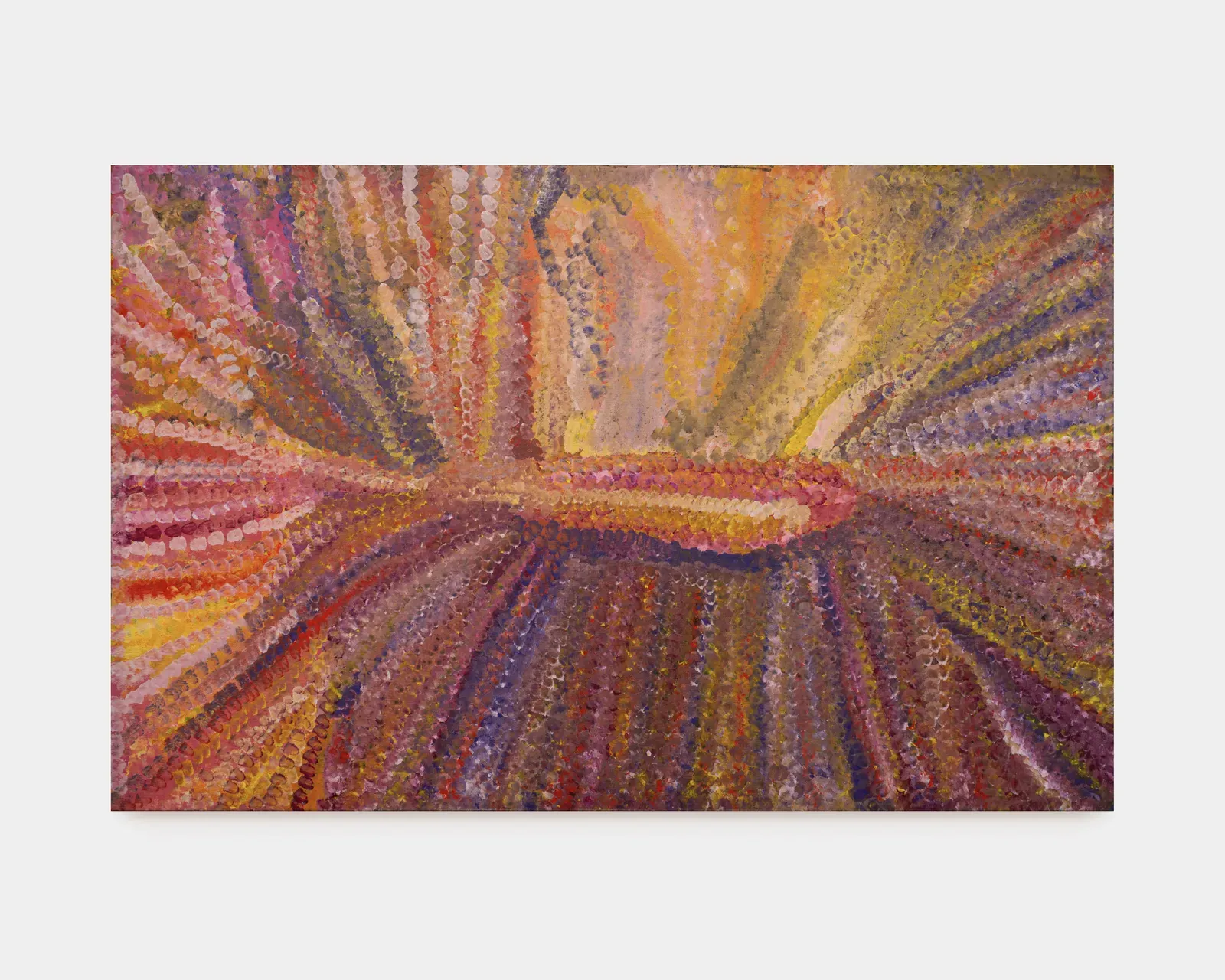
Alalgura, My Country, 1994
Synthetic polymer on linen
229.5 x 148 cm
Enquire for price
- Provenance
- Delmore Gallery Cat No. 94K61 Barry Stern Gallery Private Collection NSW
- Artwork story
- In barely eight years, from her first canvases at the end of the 1980s to her death in 1996, Emily Kame Kngwarreye produced one of the most remarkable bodies of work in Australian art. An Anmatyerre elder who had never seen European painting, she developed a language of colour and gesture often compared with de Kooning, Pollock and Monet, yet drawn entirely from her own country and ceremony. Kngwarreye was born around 1910 at Alhalkere (Alalgura), on the north-western edge of the Utopia region, north-east of Alice Springs. She was a senior custodian of women’s ceremonies (awelye) and of the Dreamings of the kame, the pencil yam, from which her name is drawn. She began making batik with the Utopia women in 1977, and in the summer of 1988–89 took up acrylic on canvas, the medium that suited her best. Working with astonishing speed, she produced several thousand paintings, her style evolving from yam tracks beneath fields of dots to dense colour fields, bold stripes and sweeping late gestures. She represented Australia at the 1997 Venice Biennale, and major retrospectives followed at the Queensland Art Gallery (1998), in Japan and Canberra (2008), and at the National Gallery of Australia (2023–24), which travelled to Tate Modern, London, in 2025. From 1989 Donald and Janet Holt of neighbouring Delmore Downs supplied her with materials, and Delmore Gallery documented each work with a catalogue number, such as 94K61 for the present painting. Alalgura – My Country Alalgura – My Country is a painting of energy radiating from a centre. An elongated horizontal form, glowing pink and gold, lies across the middle of the canvas. From it, long arcs and rays of dotted colour fan outward to every edge, in purples, crimsons, rose, lemon yellow, soft blue and white. In the upper half the strokes rise and spread like a sunburst or a gathering sky. Below, they fall in warmer golds and oranges, suggesting earth saturated with light. The central form may be read as a watercourse or soakage, the life-source of the surrounding country, or simply as the still point around which the whole composition turns. The painting’s dots are not the precise, discrete markers of Western Desert painting. They are loaded, overlapping touches of the brush, laid down at speed, merging into lines and swathes of colour. Each arc records the reach of the artist’s arm as she worked from the edges of the canvas laid flat on the ground. This gives the work its physical rhythm and its human scale. Here colour is no longer descriptive. It is the subject itself: the shifting hues of country after rain, when wildflowers, seeding grasses and new growth transform the land. A major comparable: Desert Storm, 1992 The closest comparison for Alalgura – My Country is Desert Storm, painted in December 1992 for Delmore Gallery (cat. 92L113, 137 x 304 cm). In the 1998 Holt monograph, art historian Terry Smith described Desert Storm as “the major work of its kind” by the artist.¹ It conveys the drama and fertility of the desert in the aftermath of an early summer storm. Desert Storm shares with the present work the same fundamental structure: lines of dots gathered into converging and diverging arcs, built from the artist’s repeated reach across the canvas. Smith read that structure as a direct equivalent of the event itself. Storm clouds converge over the desert, rain falls on rock and sand and runs towards a central watercourse, and the land bursts into bloom. In his reading, the painting’s process and its subject become one.² Painted at the moment Kngwarreye was abandoning the underlying tracery of yam roots and emu tracks for fields of pure colour, Desert Storm also marks her expansion of the palette into vivid reds, purples and yellows. Alalgura – My Country returns to that radiating structure fifteen months later, with the assurance of the artist’s mature style. The palette of Desert Storm, in reds, purples and yellows, is here enriched with rose, blue and white. The marks are more densely layered, and the composition is resolved around a single luminous centre. Where Desert Storm captures the storm’s arrival, Alalgura – My Country evokes the release and renewal that follow it. Desert Storm was offered at Deutscher and Hackett in Melbourne in November 2017, where it sold for $183,000. That result predates the National Gallery of Australia and Tate Modern retrospectives, which have transformed the international understanding of Kngwarreye’s achievement. Earth’s Creation and the year 1994 Alalgura – My Country is contemporaneous with Kngwarreye’s most celebrated single work. Earth’s Creation, painted in 1994 (it is sometimes dated 1995) has played a defining role in the market for her work. In May 2007, offered by Lawson-Menzies in Sydney under the direction of Adrian Newstead, it sold for $1,056,000, then a record for Aboriginal art and for an Australian woman artist. Ten years later, at Cooee Art, it sold for $2.1 million, which remains the highest price paid for a painting by an Australian woman artist. The two works share the same year and the same preoccupation: colour as a vehicle for the life-giving power of country. Both demonstrate the freedom and confidence that characterise Kngwarreye’s work of 1994, a year in which she was painting at the height of her powers. Market and standing Kngwarreye’s position at the apex of the market for Australian Aboriginal art is now firmly established. Annual auction turnover for her work has risen from about $2.1 million in 2004 and $3.5 million in 2017 to more than $5.1 million in 2025, more than double that of her closest rivals. Prices for her finest works have grown sharply in the wake of the recent retrospectives. In 2025 Untitled (Awelye), 1992, sold at Deutscher and Hackett for $1,196,591. The same painting had sold at auction for $168,000 in 2013. Within this market, the premium is reserved for major paintings of the 1990s with secure provenance. Works documented by Delmore Gallery, the source of both Desert Storm and the present painting, are among the most sought after. Alalgura – My Country brings together the qualities that define her most important work: a major scale, the celebrated year of 1994, a composition directly comparable to one Terry Smith singled out as a benchmark of its kind, and documented Delmore provenance. It is a painting of joy and abundance by an artist whose achievement the world has only recently begun to fully recognise. ¹ Terry Smith in J. Isaacs et al., Emily Kame Kngwarreye Paintings, Craftsman House, Sydney, 1998, p. 31. ² Ibid., p. 32; Desert Storm is illustrated pl. 34, p. 101. The artist’s family and the National Gallery of Australia now use the spelling Emily Kam Kngwarray.