 Click to enlarge
b. c.1938
- Region
- Arnhem Land
- Community
- Gochan Jiny-Jirra
- Language group
- Rembarrnga; Kune
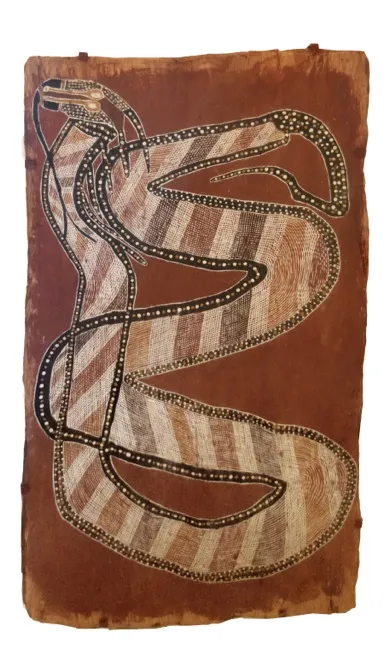
Borlung 1974, 1974
natural earth pigments on bark
93 x 50 cm
Enquire for price
- Provenance
- Maningrida Arts & Culture, Maningrida, NT Private Collection NSW Cooee Aboriginal Art Gallery, NSW
- Artwork story
- The Borlung Rainbow Serpent, is a powerful mythological figure for all Aboriginal people throughout Australia. Characteristics of the rainbow serpent vary greatly from group to group and also depending on the site. Often viewed as a female generative figure, the rainbow serpent can sometimes also be male. She has both powers of creation and destruction and is most strongly associated with rain, monsoon seasons and of course the colour seen in rainbows which arc across the sky like a giant serpent. For Aboriginal people in Northern Australia, the rainbow serpent is said to be active during the wet season. Often she is associated with billabongs and freshwater springs where she resides, and she is responsible for the production of most water plants such as water lilies, water vines, algae and palms which grow near water. The roar of the waterfalls in the escarpment country is said to be her voice. Large holes in stony banks of rivers and cliff faces are said to be her tracks. She is held in awe because of her apparent ability to renew her life by shredding her skin and emerging anew. Aboriginal myths about the rainbow serpent often describe her as a fearful creature who swallows humans only to regurgitate them, transformed by her blood. The white ochre used by artists to create the brilliant white paint for bark paintings, body decoration and in the past, rock art, is said to be the faeces of the rainbow serpent. Aboriginal people today respect and caretake sacred sites where the rainbow serpent is said to reside. Often certain activities are forbidden at these places for fear that the wrath of the great snake will cause sickness, accidents and even tempests. This is not always the case however, and there are many rainbow serpent sites today where people may enter to hunt, fish and swim.