 Click to enlarge
1 / 4
c.1920 – 2006
- Region
- Western Desert
- Community
- Amunturrngu (Mount Liebig, Amunturrungu, Watiyawanu, New Bore)
- Language group
- Pintupi
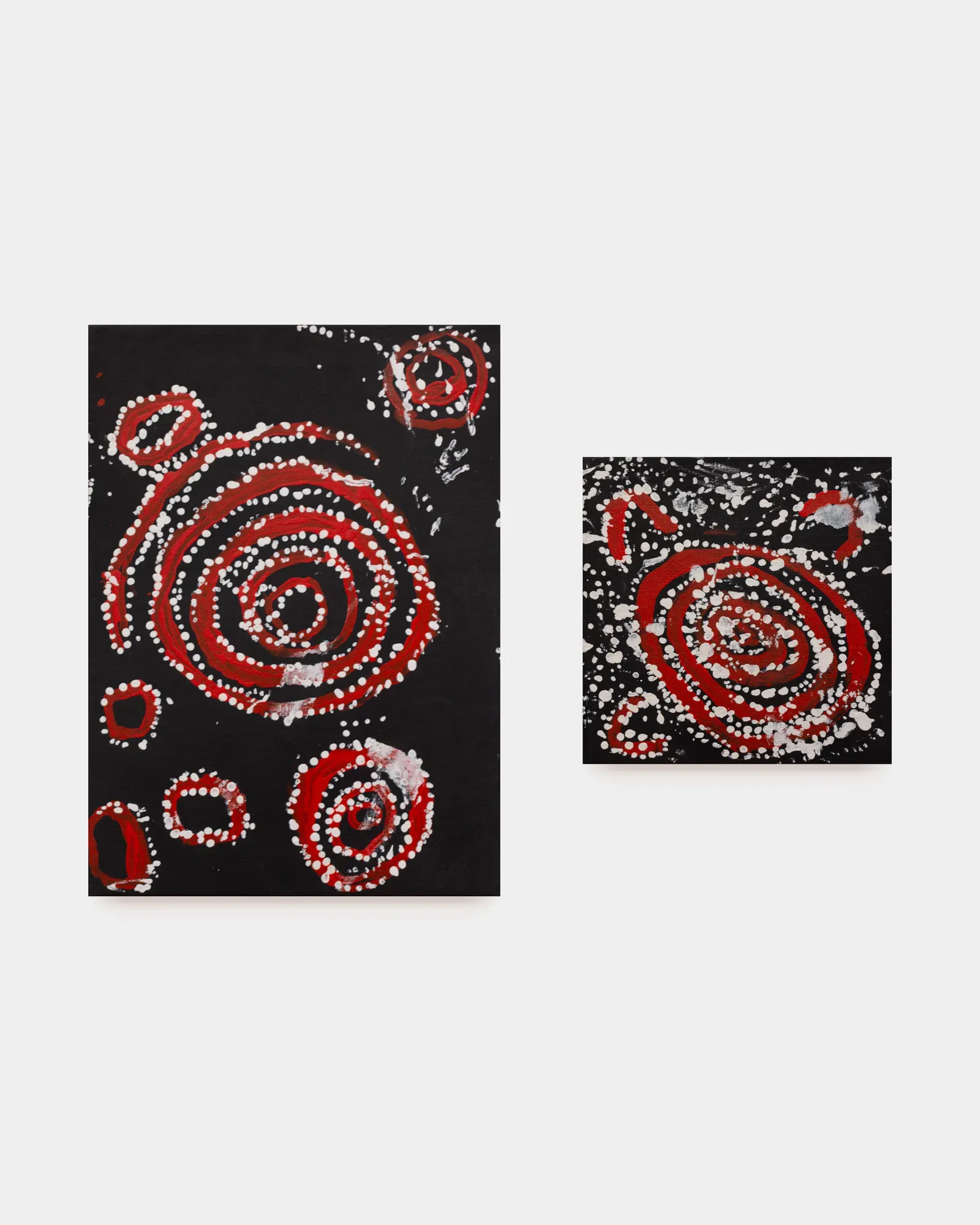
Tingari, 2005
synthetic polymer paint on linen
55 x 40 cm & 30 x 30 cm (pair) (framed)
$450
- Provenance
- Yanda Aboriginal Art, Cat No. 1701204 Private Collection Vic
- Artwork story
- Pegleg Tjampitjinpa came to painting in his late 70s while visiting his lifelong friend Pinta Pinta Tjapanangka at Kintore. A senior Pintupi lawman from the Kiwirrkurra region of the Western Desert, he had grown up before sustained European contact, and he brought that authority to his canvases. His work was included in the Art Gallery of New South Wales's landmark exhibition Papunya Tula: Genesis and Genius in 2000, confirming his place among the senior custodians of the movement. He returned again and again to the Tingari, the ancestral men whose travels and ceremonies shaped the desert, rendering them in the spare red, black and white palette of the earliest Papunya boards. These two small works belong to the very end of his life. On black grounds, loosely brushed concentric roundels in red ochre, studded with white dots, mark sites of the Tingari journey, while smaller rings and arcs gather around them. The hand is looser now, but the vision remains unmistakably his.