Catalogues335 of 349
 Click to enlarge
1 / 3
Sale 4 · Lot 70
c.1925 – 1998
- Region
- Western Desert
- Community
- Papunya
- Language group
- Pintupi
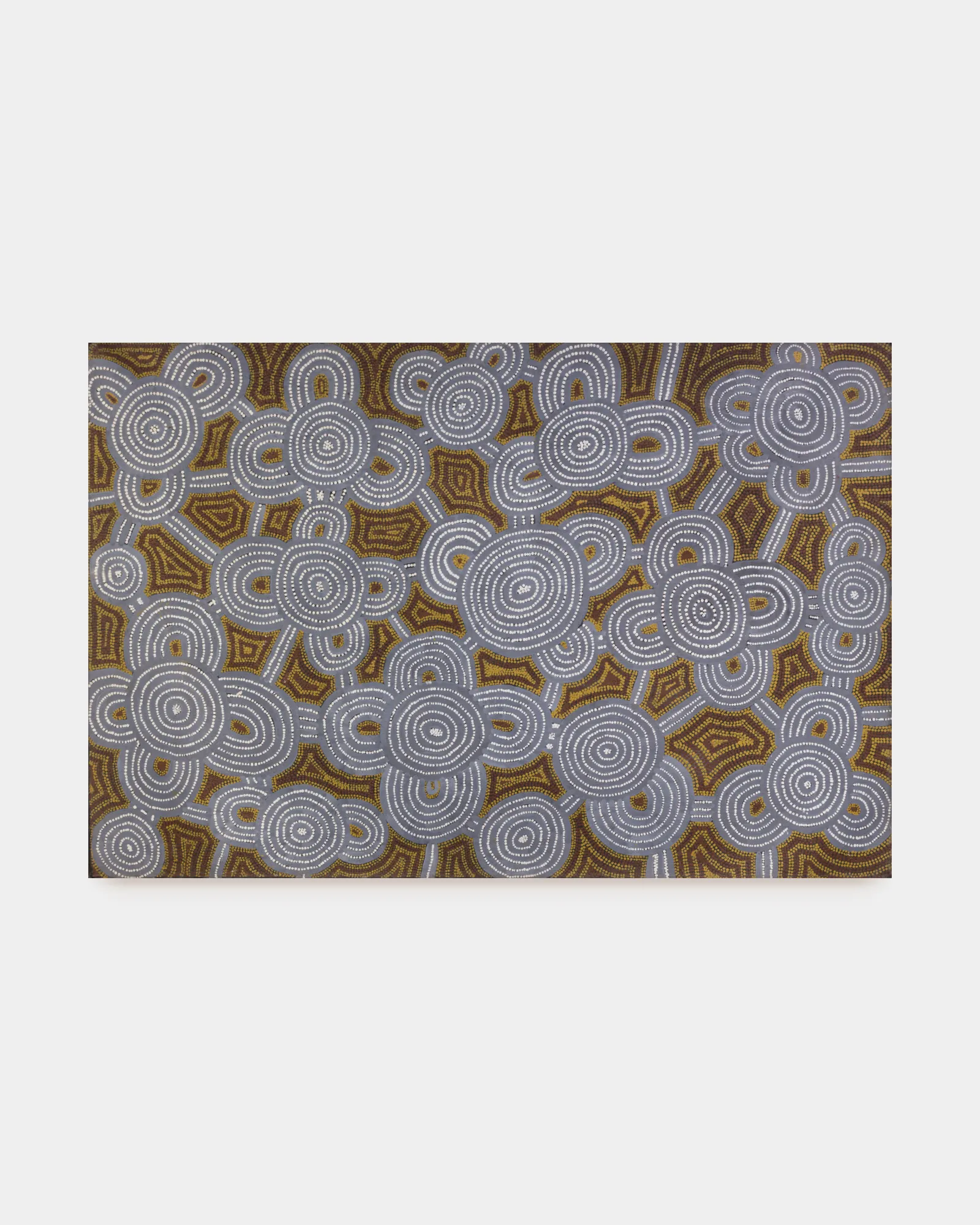
Tingari at Karrkurruntjintjana, 1994
synthetic polymer paint on Belgian linen
90.6 x 136 cm
in Australia
Est. $6,000 – $8,000
Bid Onlinevia Theodore Bruce* No added 3% platform feeBid Onlinevia InvaluableBid Onlinevia Drouot
- Provenance
- Papunya Tula Artists, Alice Springs, NT, Cat No. YY940120 Aboriginal Gallery of Dreamings, Melbourne, Vic, Cat No. 3290 Hank Ebes Collection, Vic Accompanied by a certificate booklet from Aboriginal Gallery of Dreamings
- Artwork story
- Yala Yala Gibbs Tjungurrayi painted the way he sang, chanting the songs of his country as he worked and building his compositions by touch, with his hands and fingers as much as the brush. A solemn, quiet man, he was among the six artists who received a government allowance to paint full time in the first years at Papunya, and his precise line drawings helped Geoffrey Bardon grasp the hieroglyphic-like language that underlies the Dreaming stories. He had walked into Papunya in 1962 from his homelands west of Lake Macdonald, with his wife Ningura Napurrula, who would herself become a celebrated painter, and their injured son Mawitji. By the late 1970s he stood at the forefront of the classic Tingari period, and his work was included in the landmark 1981 exhibition of large acrylic canvases at the Art Gallery of New South Wales. He later established his own outstation at Muntardi, near Kintore, close to his traditional lands, and painted until the end of his life. The Tingari were ancestral beings who travelled across the Western Desert, performing ceremonies that created and shaped the country at rockholes, sandhills, soakages and sacred hills. Their cycle belongs to men's law, and its details remain restricted. In Yala Yala's hands, roundels, loops and spirals joined by travelling lines, in a restrained ochre palette, become mind-maps of his country: song-lines made visible.