

DOROTHY ROBINSON NAPANGARDI
MARKET ANALYSIS
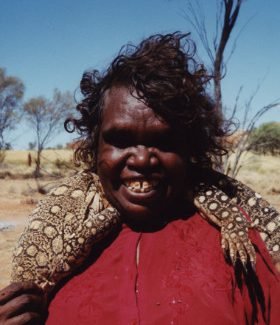
Dorothy Napangardi’s success flared brightly after she won the major prize at the 2001 National Aboriginal and Torres Strait Islander Art Awards (Telstra NATSIA’s). This, and her 2002 –2003 solo exhibition at the Museum of Contemporary Art, threw those interested in Aboriginal art into a spin. In a controversial and extremely unusual move, Roslyn Premont’s Gallery Gondwana, held a commercial exhibition of her work at the Danks Street Depot Gallery concurrent to the MCA show, and within 2 years Dorothy’s major large black canvases featuring tight grids of carefully dotted white lines sold for around $60,000-80,000 each; double the prices similar works had attracted just six months earlier in her Alice Springs exhibition. Similarly, 120 x 120 cm paintings previously exhibited for $10,000-12,000 and 150 x 90 cm works at $8,000 had jumped in price to $25,000 and $18,000 respectively. Dorothy’s MCA show and the success that followed heralded a dearth of quality paintings in relation to the hot demand generated by serious collectors. She was certainly the artist of the moment; her Sydney show was a sell-out. Now considered to be a top calibre artist, her highest auction results gave her one of the best records for any living artist at the time.
Despite having produced paintings from the late 1980s, Dorothy’s popularity and the high prices she achieved relate almost entirely to her post-1997 works. In fact, all of her ten highest sales to date have been for paintings produced after 2000. All are restricted to the limited pallet and grid-like patterns of vertical and horizontal dotted lines, which mimic the salt encrustations at Mina Mina. Despite the beauty of her highly accomplished and colorful Bush Plum and Bush Banana works, as demonstrated in the Museum of Contemporary Art exhibition and accompanying catalogue, Dancing Up Country, the very best of these have never been offered at auction and minor works in this style have attracted little interest, though two have sold in Paris.
Dorothy Napangardi’s most successful paintings at auction have featured the network of closely knit interconnected dotted squares which build to form duotone patterned grids on dark, most often black, backgrounds. By randomly in-filling white dotted squares with yellow or deep red ochre dots, a mottled effect is produced as demonstrated in her top-selling lot, Karntakurlangu. When this work sold at Sotheby’s in July 2004 (Lot 113), it more than doubled its high estimate of $60,000, taking $129,750. Dorothy’s second-highest result at auction was for Karntakurlangu Jukurrpa 2003 a much larger 183 x 350 cm work on linen. Carrying a presale estimate of $80,000-100,000 it sold for $120,000 at Lawson-Menzies in November 2007 (Lot 62).
Tragically, Dorothy died in a car accident while still a relatively young woman. At just 50 years of age, she could have had many productive years ahead of her. However, at the time of her death, her art practice was being severely compromised by the quantity of ‘copycat paintings’ that were being produced by members of her family and other paintings that were being sold under her name. The closure of Gallery Gondwana, her principal agent, did not help. Sales in 2008 were poor, in line with the market slump and the end of Lawson Menzies specialist sales. The intense interest in her career generated through the early 2000s to 2009 declined, even more so following her death when other’s became the ‘artiste de jour’.
Today, Dorothy’s clearance rate has dropped to 61%. However, this statistic is skewed by the fact that most failures at auction carry poor provenance or are for smaller paintings. These results should not diminish the results for her finest pieces. In 2019, two works included in a Sotheby’s New York sale of important indigenous artists, sold for $AUD50,000, Her average price jumped up to $27,996. followed by another good year in 2000. Though this has lowered since then, the occasional beautiful Mina Mina paintings of mid to large size that have appeared through recent years still show good value and these are the ones to watch out for. Her design also lends itself well to prints and etchings (selling near $1000), that have proved increasingly popular.
Buyers lucky enough to purchase works prior to her MCA show in 2002 will always be able to make a very tidy profit on their paintings at sale. However, those paying higher prices in her exhibitions during the following decade will need to rely on a buoyant market and excellent provenance if they are to reap financial rewards.
© Adrian Newstead & Sophie Pearce