Clifford Possum Tjapaltjarri
AAMI artistc.1932 – 2002
- Region
- Western Desert
- Community
- Papunya
- Language
- Anmatyerr (Anmatyerre)
Region: Western Desert · Community: Papunya · Language: Anmatyerr (Anmatyerre)
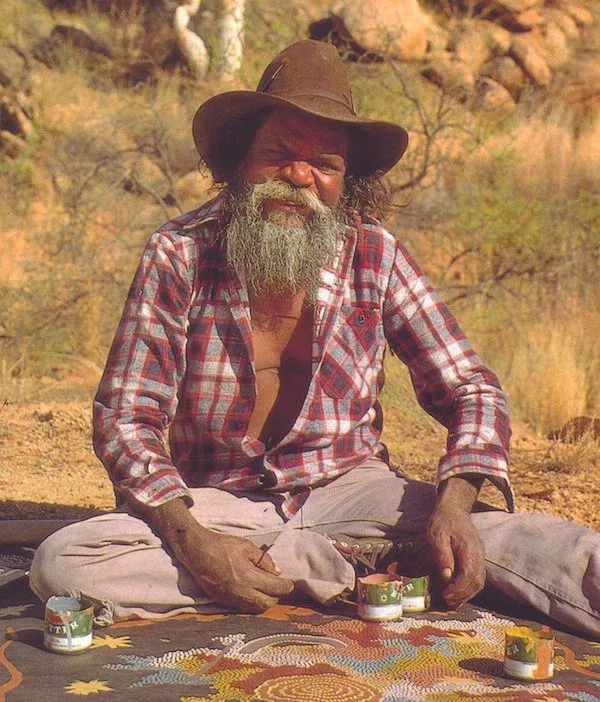
Clifford Possum was the first recognised star of the Western Desert art movement and one of Australia’s most distinguished painters of the late twentieth century. After his father, Tjatjiti Tjungurrayai, passed away during Clifford’s youth in the 1940s, his mother, Long Rose Nangala, settled at Jay Creek with her second husband, One Pound Jim Tjungurrayai. One Pound Jim, a legendary figure in Central Australia, acted as guide to early travellers and anthropologists and became the Aboriginal face of the centre after his portrait featured on the stamp used by the Australian postal service between 1950 and the introduction of decimal currency in 1966. It was under his tutelage, with that of other Tjungurrayai men that Clifford was initiated into manhood at Napperby Station. Yet it was from Tjatjiti’s country West of Mount Allan that Clifford inherited his famed Love Story and this, along with the Bush Fire Dreaming inherited from his mother’s country south of Yuendumu, became the major Dreamings he came to depict in his art.
During his early days Possum worked with cattle at Glen Helen, Mount Allan, Mount Wedge, Napperby Station and Hamilton Downs. He began his artistic career at Glen Helen when he found that he earned more pay and lived under better conditions while producing carvings for the developing tourist market than he had as a stockman.
His carvings of wooden snakes and goannas, like those of his classificatory ‘brother’ Tim Leura, were renowned in Central Australia for their brilliant craftsmanship. Together they worked on the construction of the Papunya settlement in the early 1950s, joining Clifford’s first cousin Kaapa Tjampitjinpa, the son of Long Rose’s sister Margie Long. It was during this period that Clifford married Emily Nakamarra who became the mother of his four children, Daniel, Lionel, Gabriella, and Michelle. Tim Leura became a founding member of the Papunya Tula artists, Clifford Possum did not join the growing band of active painters working with art teacher Geoffrey Bardon until February 1972.
His unique artistic style developed rapidly and was characterised by its innovative use of spatial configuration beyond the more conventional Papunya idiom of dots, circles and lines. This inventiveness with space, perhaps derived from his skills in woodcarving prior to the Papunya movement, resulted in early paintings that conveyed a remarkable sense of atmosphere. These stood out from those of other Western and Central Desert artists, who were less preoccupied with evoking a psychological mood in their paintings. His small early career works, however, were a mere foretaste of the grandeur of the paintings he was to create, on an unprecedentedly massive scale, in the late 1970s. They have been described as ‘beautiful palimpsests’ of his extensive multiple Dreaming sites, seen from shifting viewpoints in space. Clifford’s works at this time enabled the ‘unfamiliar viewer to see these sites as a fusion of the abstract diagrams of ancestral passage in the traditional expressive forms of the Western Desert, with the maps of Europeans’ (Johnson 2003: 79), a form very familiar to the Western onlooker.
As he developed his art practice, Clifford introduced Western iconography and figurative imagery to convey certain elements in his narratives. This played a dual role in both making them more intelligible to western audiences and allowing him to create imaginative compositions within the parameters of the ‘law’. Possum was acutely aware, as one of the founders of the desert painting movement, that to give away too much ancestral meaning could at that time have risked his life. He employed a set of his own invented, secular, non-traditional motifs in what would become a recurrent theme in his art, the ‘Man’s Love Story.’ This story is a story of the Tjungurrayai man who desired, against kinship rules, a Napangardi woman, and wooed her by spinning hair string while singing love songs. This and other works from the start of the 1980s onwards are characterised by a complex of designs rendered with modulated tone and broken colour. The fractured shaping of the in-filled fields of dots achieves an extraordinary visual effect, ‘flat but with a thin three-dimensional disguise’ (Bardon 2004: 82). It was only towards the end of Clifford’s life that there was a dramatic reduction in his palette. His most emblematic final works are bleak depictions in black and white; boys skeletal remains float starkly on unadorned backgrounds as if ethereally infused with the artist’s ‘own impending sense of death’ (Nicholls 2004: 24).
The retrospective of his work that toured extensively throughout Australia from 2002 included works spanning the artist’s 30-year career with the wonderful examples of his early smaller works of 1972-1973, and the dramatic skeletal sketches of the final years acting as the bookends to a great artistic adventure. While Clifford himself may have pointed to his private audience with Queen Elizabeth II as the highlight of his career, the low point was most likely his discovery of an exhibition full of fakes in Sydney in the late 1990s and the adverse publicity that this attracted. Despite the fact that he was the only Papunya Tula artist honoured with a solo retrospective by a major institution by the beginning of the current millenium, he forsook his association with the organization almost entirely by the mid 1980s. He returned to his Anmatjerre homeland at Mount Allan and began selling his works directly to the government marketing company, Aboriginal Arts Australia, in Alice Springs. He also signed and passed off as his own many other works that had been produced by Michael Tommy, Brogus Tjapangarti and other countrymen in order to maximise their income.
In the late 1980s he produced a large body of works for John O’Laughlan who acted as his agent and travelled with him to his exhibition at Rebecca Hossack Gallery in London. Clifford worked for a time with disgraced dealer Chris Peacock in Adelaide whose company TOAC printed the logo ‘Bush Myths’ on the back of all canvases. Peacock worked with many artists who painted outside of the art centre system including Emily Kngwarreye. He was reported to have used stand over tactics and violent threats in forcing Possum to sign paintings that were not entirely his own. However, the truth is elusive as sadly, by this time, Clifford was addicted to alcohol and gambling and was producing a large number of perfunctory minor works, signing paintings that he ‘owned’ but which he did not actually paint and others that were not entirely executed by his own hand.
Throughout the early 1990s he lived and travelled with his daughters Gabriella and Michelle and his son-in-law Heath Ramzan as well as others. He worked for a variety of dealers including, Michael Hollows at his Aboriginal Desert Dreaming Gallery, Peter Los in Alice Springs and Semon Deeb at Jinta Gallery in Sydney. He painted for Frank Mosmeri in Broadmeadow and Des Rogers in Sunbury on the outskirts of Melbourne, and Swiss collector Arnaud Serval, who seemed to share a good relationship with the artist and ensured the works he handled were entirely in Clifford’s own hand. No doubt there were a great many others, as Clifford was a born entrepreneur and was in constant need of money. For a time, his affairs were managed by Joy Aitken who sold amongst the genuine paintings, individually painted by Clifford and his daughters, many collaborative works where the daughters’ assistance was never acknowledged. Leaving Aitken with a number of canvases in various states of completion it appears that out of desperation, given the financial difficulties involved in keeping the ‘Possum Shop’ going, she crossed the Rubicon and completed the dotting on some of these works herself.
Clifford’s career and standing reached its nadir when a solo exhibition organised for an important Sydney gallery in the late 1990s was exposed as being almost entirely composed of fakes. The works had been commissioned by the late Patrick Corbally Stoughton from Alice Springs based dealer John O’Laughlan who was found guilty of fraudulent involvement. When Clifford came down to view the exhibition, he visited the Art Gallery of NSW and other institutions pointing out countless works purported to have been created by him but which he denied having painted.
In abandoning the communal identity of the Papunya movement in favour of personally negotiating with the dominant western mainstream, the motivation of his painting practice became blurred in favour of his fame as a personality. In this regard his life was not dissimilar to that of Albert Namatjira who died 40 years earlier, before the Papunya movement had even begun. Both began their lives in a creek bed, light years from the international art circles in which they would later move with such fearless assurance. Clifford was actually asked by Namatjira to continue in his footsteps (Johnson 2002: 243), although undoubtedly, he did not mean that he should do it quite so literally.
Although physically unwell and with failing eyesight Clifford Possum lived throughout his final years in a loving relationship with Milanka Sullivan at Warrandyte in the hills outside of Melbourne and created many of his finest late career works in her care. Sullivan has continued to work since Clifford’s death in 2002 authenticating his paintings and uncovering suspect and fake works and writing a book that she maintains will re-establish Clifford’s reputation as Aboriginal Australia’s finest painter.
No life was written larger across the page of the Aboriginal Art Movement than that of Clifford Possum Tjapaltjarri. During a career, which lasted more than 30 years, he produced a number of masterpieces that will come to be seen by Australians as amongst the most important works created in this country’s artistic history. His inclusion in major national and international exhibitions and his presence in the literature rivals that of any other Australian Aboriginal artist. He received an order of Australia for his contribution to the Western Desert art movement, was chairmen of Papunya Tula in the late 1970s and early 1980s, had a private audience with Queen Elizabeth II in 1990, and was the first real Ambassador for Aboriginal art around the world. He was honoured posthumously by a solo retrospective by the Art Gallery of South Australia which toured state galleries and, moreover, was the subject of two books on his life and work written by Vivien Johnson, his longtime friend and biographer.
© Adrian Newstead
Bardon, G. 2004. Papunya: A Place Made After the Story, The Beginnings of the Western Desert Painting Movement, Bardon, G & Bardon J (eds), The Miegunyah Press, Melbourne University, Victoria.
Hill, P. May 8-9, 2004. ‘Spiritual Maps.’ Sydney Morning Herald, Spectrum,: 8-9.
Johnson, V. 2003. Clifford Possum Tjapaltjarri, Art Gallery of South Australia, Adelaide.
Johnson, V. 2002.’Clifford Possum Tjapaltjarri c. 1932 - 21 June 2002 Obituary.’ Art and Australia, v.40, no.2: 243-244
Lock-Weir, T. June-July-Aug 2003. ‘Clifford Possum, the divine navigator,’ Art and Australia, v.40, no.4: (602)-609
McNamara, A. Summer 2004/05. ‘No Two Ways About It: On The Clifford Possum Tjapaltjarrii Retrospective.’ Eyeline no. 56: 13-17
Exhibitions
- Early Western Desert Paintings and ArtefactsDecember 2023
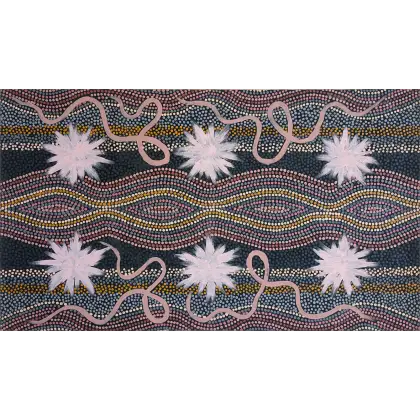
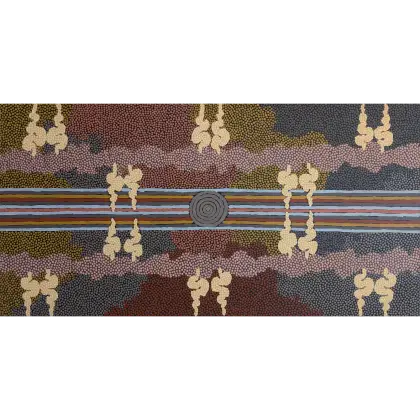
Clifford Possum’s career spanned more than three decades, with his most prolific period occurring between 1983 and 2000 after he began working independently of Papunya Tula Artists. While his 1971–72 boards remain the most highly prized by committed collectors, accounting for more than half of his top ten results, it is now widely acknowledged, both in the market and within curatorial circles, that major works from the 1990s contain some of the most complex, culturally rich, and visually ambitious paintings of his career.
His auction record stood at $411,750 by 2006, achieved for two very different works sold at Sotheby’s the previous year: the small early board Emu Corroboree Man 1972, and also the monumental Man’s Love Story 1993–94, which dramatically exceeded its modest estimate and helped reposition late-career Clifford Possum paintings in the eyes of collectors who had long dismissed them.
These results marked a turning point. Many long-term collectors, frustrated by the undervaluation of post-Papunya Tula works throughout the late 1990s, had been reluctant to release their holdings, particularly after the attribution scandals surrounding the artist during that period. Yet, Man’s Love Story demonstrated the unmistakable sophistication of his late canvases, prompting a renewed wave of sales. Although few could match the painting’s encyclopedic level of detail, the number of 1990’s works sold after its sale proved that large, confidently executed canvases from this era held real market power.
The dramatic revaluation of Clifford Possum’s oeuvre reached its peak in 2007 when Sotheby’s announced the sale of his 1977 masterpiece Warlugulong. The painting, long recognized by curators as one of the foundational achievements of the Western Desert movement, carried an estimate of $1.8–2.5 million and sold to the National Gallery of Australia for $2.4 million, a record for Aboriginal art that remains one of the most significant milestones in the field. The painting’s history, including its prior life hanging in a cafeteria and its rediscovery by dealer Hank Ebes, became the subject of considerable public interest. ABC Radio programs of the time emphasized Clifford Possum’s stature not just as a painter but as a senior lawman whose authority underpinned the iconographic density of works such as Warlugulong 1977. The broadcasts also highlighted the deep familial connections within the Western Desert movement, including his relationship to Tim Leura and the intergenerational transmission of story ownership. This broader cultural framing reinforced market confidence in his most ambitious canvases.
Following his death in 2002, the number of works appearing at auction nearly doubled. While the average price rose, the clearance rate remained stubbornly low (334 of 578 lots sold) indicating that vendors were unwilling to accept what they considered inadequate valuations for works of such cultural importance. On the other hand, some contemporary collectors remained uncertain about his dense iconography, preferring the minimalism that defined a number of more fashionable artists of the early 2000’s. Yet seasoned buyers recognized that the cultural weight, narrative complexity, and painterly intelligence evident in Clifford’s strongest works, stands apart from his contemporaries and will likely outlast shifts in taste. There are canvases from the early 1990s, in particular, that rival the best of his 1970s output, and which remain undervalued opportunities within the market.
Another complicating factor has been the high volume of forged or misattributed Clifford Possum works that entered the market during the 1990’s; expert vetting remains critical. Even prestigious collections have been found to hold inauthentic pieces, underscoring the necessity for rigorous authentication. When works are determined to be assisted or misattributed, proper reattribution is essential. Many of these pieces may still be desirable but will command correspondingly lower values. Therefore, provenance will always be a critical issue for Clifford Possum. Buyers must take every precaution to ensure authenticity, while sellers should be prepared for thorough scrutiny. Works confirmed as authentic, unassisted, and of high quality will continue to attract strong interest. Those that prove otherwise may still find a place in the market but appropriately adjusted.
Although results softened considerably from 2012 onward, with the artist falling to 54th place in 2015 and 76th in 2016, his market rallied in 2019, when 80% of lots sold, restoring him to the 4th most successful Aboriginal artist of the year. Some excellent auction results followed. In 2020, Rain Dreaming Dance 1972, (51 x 35 cm), sold for $245,000, nearly doubling its price from 2011 and moving from 7th top to 3rd top sale (with now more extensive provenance research attached). It was a standout year for the artist with only one painting remaining unsold of 12 on offer and reaching an overall average of $32,907. 2022 was another good year with Untitled (Possum Dreaming) c.1971(37.4 x 50 cm) selling for $204,000. This painting was offered again in 2025 (Menzies) with a larger estimate of $220 –280,000 but failed to sell. In fact, there are several Clifford Possums that make repeat appearances. The unusual pattern of these successive resales speaks to a volatile period in the market, though it is impossible to comment further without inviting legal difficulties. Clifford dropped slightly to 5th most successful artist by 2025, but this ranking still aligns with his historical importance within the movement.
Recent auction results continue the divide between early boards and later canvases. Early boards, when they do appear at auction, continue to command exceptional prices. More moderately priced later canvasses are usually the livelier area of auction activity. Yet most works offered in the past three years fall into mid- or lower-tier categories: smaller canvases, repeat narrative structures, or late works from 1998–2001, with inconsistent results. Many of these pieces sell between $5,000 and $15,000, with occasional stronger outcomes such as Untitled (Two Jungala Men at Warlukulong) 2000, achieving $20,250 with Lawsons in 2025 and in 2024, Tjungurray and Tjapaltjarri Dreaming 1998, fetched $27,000 at Art Leven (though this was a significant drop from its peak 2009 price of $84,000). Large carved shields and boomerangs, which are comparatively rare, have performed well recently (four sold in 2025), regularly doubling their estimates. At the same time, a number of fine, mid-period works have been passed in, showing the ongoing need for strong provenance, excellent condition, and compositional ambition for successful secondary-market performance.
Clifford Possum’s artistic legacy remains vast and uneven: for every sprawling masterwork, there exist straightforward compositions intended for the market. Yet his finest paintings, those with narrative depth, compositional dynamism, and cultural gravitas, represent exceptional value today. As fashion continues to evolve, collectors with long-term vision will likely gravitate toward the richness of his strongest works, ensuring Clifford Possum remains one of the most enduring and significant figures in Australian art.
Rank #5Cumulative AAMI 50.39
Annual AAMI rating by year — hover or tap a bar for the exact figure.
How the AAMI rating is calculated
The AAMI (Aboriginal Art Market Index) measures an artist’s auction performance each year. Each annual rating combines the value of works sold (total sales and clearance rate), the number of works offered, and the average price achieved — with adjustments that temper thin trading years and a rising annual price threshold, so results stay comparable over time. The yearly ratings are added together into an artist’s Cumulative AAMI score, which determines their rank in the index.