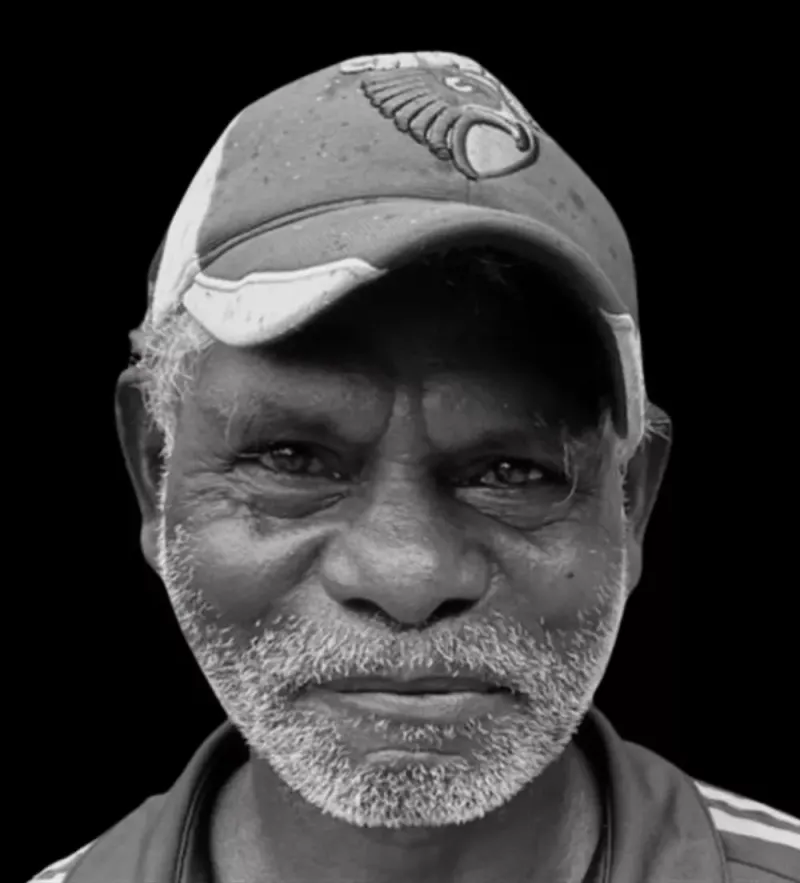
Declan Apuatimi
1930 – 1985
- Region
- Tiwi Islands
- Community
- Pirlangimpi (Garden Point, Pularumpi)
- Language
- Tiwi
Region: Tiwi Islands · Community: Pirlangimpi (Garden Point, Pularumpi) · Language: Tiwi
Declan Apuatimi was born at Iminulapi in the north west of Bathurst Island, 100 km north of Darwin, and spent most of his life in the island’s township, Nguiu. Though this was his home as a grown man, his actual country, inherited from his father, was Munupi on the north west coast of Melville Island, the second of the two Tiwi islands. The Tiwi people are culturally distinct from mainland Aborigines and were left largely outside the main sphere of European colonization until the arrival of Catholic missionaries in 1911. In the 1930's Japanese, Malay and Filipino pearling boats made frequent visits to the Islands and, as a young man, Declan worked on a number of them in return for rations. As Margie West recounts, Declan was ‘a salt-water person with a deep love of the sea and fishing. The pearling era was one of his fondest memories‘ (1987: 15).
With the onset of World War II the pearling era came to an abrupt end and Declan was relocated to a RAAF army base in Darwin. He did not return to Bathurst Island until the war ended. In 1956 he married Jeanne Baptiste and had ten children of whom only six survived. So profound was their loss that in each Pukumani ceremony thereafter Declan danced in memory of his lost children.
The Pukumani and Kurlama ceremonies lie at the heart of Tiwi culture, and involve elaborate preparations. The Kurlama is an increase and fertility ceremony during which poisonous yams are made edible. The Pukumani is a funereal ceremony during which elaborate poles are carved, decorated and erected to become the focus of dancing and singing. Intricate designs adorn the face and body of the performers, matching the designs of the poles, which though open to individual interpretation, became the basis of Declan Apuatimi’s artistic output.
As a boy he had learnt how to weave fine ceremonial armlets, carve delicate barbed ceremonial spears, fluted clubs, and the burial posts for Pukumani ceremony. He developed a particular affiliation to working in wood, which coincidently was his matrilineal clan totem. Declan did not produce carvings for sale, however, until the late 1950's, under the encouragement of Father John Cosgrove. The market for these objects, consisting of anthropologists, museums, art galleries, and occasional tourists, remained limited however. It wasn’t until the 1960's, under the influence of the new Father, John Fallon, that production increased for an outside market. Burial posts, once shaped by selective burning over coals and mussel shell scrapers, then decorated with striking arrangements of dots and cross-hatching, took on greater figurative form, with the replacement of the stone axe for metal tools.
During the 1970's Declan consolidated his artistic career and technique following the establishment of Tiwi Pima Art, a community-based body responsible for marketing traditional art and craft of the Tiwi, which opened in 1972. Declan became one of its most prolific artists and his carvings, mostly in ironwood, were characterised as solid figures with panels of geometric designs and staring almond eyes. He was also the first to begin painting three tiered faces on top of each other within one post. While some of his earlier carvings tended towards sombre ochre tones, the new work was of a much brighter spectrum, with great care taken to ensure that each pigment remained distinct and pure. Though carving was by far his most preferred medium, Declan continued to produce other artefacts, as well as painting his ceremonial designs onto bark.
Declan Apuatimi’s pioneering sculpture played a significant role in establishing Tiwi art in the market during the 1970’s and early 1980’s. In 1984 craft adviser Mick Reid collected his work for the first ever Tiwi one-man exhibition, which was purchased in its entirety by Lord Alistair McAlpine. Two years after his death he was honoured with a solo retrospective touring exhibition Declan- A Tiwi Artist, curated by the Araluen Art Centre in Alice Springs.
McDonald, John, Mar-Apr-May 2003, ‘Pumpuni Jilamara: Tiwi Art,’ Art and Australia, v.40, no.3,: 394-395.
West, M., 1987, Declan - A Tiwi Artist, Australian City Properties Limited, Perth.
Exhibitions
- Black Art White Walls2014 – 2016