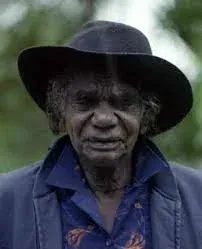
Ginger Riley Munduwalawala
AAMI artistc.1936 / c.1937 – 2002
- Region
- Arnhem Land
- Community
- Ngukurr (Roper River)
- Language
- Marra
Region: Arnhem Land · Community: Ngukurr (Roper River) · Language: Marra
Ginger Riley was born c.1937 near Maria Lagoon by the Limmen Bight River in Southern Arnhem Land. A ‘salt-water’ man Riley grew up in the bush, until the death of his mother when the family moved to the Roper River Mission, where Ginger attended school. Roper River was renamed Ngukurr in 1968 when control reverted to the Aboriginal community. As a young man Riley sought adventure and independence, traveling the Northern Territory working as a stockman and laborer on Nutwood Downs Station and elsewhere.
During these travels he met and watched Albert Namatjira painting his country and admired the nice paint and 'saw my colour country' (cited in Ryan 2001: 31). It was not until work became scarce in the 1970's and Riley returned to Ngukurr that he began to paint himself. At an Adult Education Centre printmaking course that he attended in 1988, he worked alongside Djambu Barra Barra with printing inks on cotton, which they unsuccessfully tried to sell as curtain material in the council office. The following year John Nelson brought canvas and paints to Ngukurr and Riley produced his first painting, a naturalistic landscape of sea creatures and animals.
By this time, he had moved to his outstation with his wife Dinah, in the country of his Mara ancestors, just eight kilometres from his birthplace, by Maria Lagoon. Riley’s paintings drew their inspiration from his mother’s country, the area surrounding four pyramidal hills, the Four Arches, some 45 kilometres inland from the Gulf of Carpentaria on the Limmen Bight River. Ginger’s iconography was informed by the sequence of events that took place there. According to legend, the Four Arches were created by a lethal taipan, the Garimala, who travelled from far away and returned to live in a waterhole he created nearby. From here, he journeyed to the Limmen Bight River, turning into the Rainbow and thus, it is believed he is present during the oncoming of the wet season. Apart from this central narrative, a reoccurring image in Riley’s work was the striking Ngak Ngak, a white-breasted sea eagle said to be the guardian of this country.
Though his iconography remained largely constant throughout his career, Ginger Riley tended increasingly toward panoramic landscapes that conveyed entire narratives rather than canvases depicting single elements of his stories. Early works are marked by their small-scale, with a horizon-less background on which images are silhouetted. The introduction of Arches paper in 1990 sparked Riley’s embarkment on a colourist adventure. 'I have to see it: it must be bright,' he was quoted as exclaiming (cited in Ryan 2001: 32). Around 1993 he experimented with altering perspective, composition and colour. As he matured as an artist his brushwork and the surface of his paintings were often more subdued and demonstrated a sophisticated knowledge of the properties of acrylic paint.
Ngukurr was one of the last Arnhem Land communities to develop an arts program similar to other aboriginal communities across Australia. It appeared that each new art centre that sprung up post Papunya produced work that was more radical than the last. Ginger, even more than other artists at Ngukurr, was daringly different and in an environment that associated authentic or traditional Arnhem Land art with ochre tones and sacred rarrk, his work was too confronting. However eventually the mainstream came to terms with Riley’s work and, importantly, developed a new openness to what defines Aboriginal art. This was helped enormously by Riley’s close relationship with Melbourne art dealer Beverley Knight and her Alcaston House Gallery. After organizing exhibitions with William Mora in Melbourne and the Hogarth Gallery in Sydney at the beginning of the 1990’s, Knight held solo exhibitions for the artist almost every year throughout the 1990’s and ensured that his work was well documented.
Acceptance brought Riley wide acclaim and a string of prestigious awards. In 1992 he won the Alice Prize award for a series produced for the new Australian Embassy in Beijing. The following year he won the National Aboriginal and Torres Straight Islander Heritage Commission Art Award, along with a further string of awards and exhibitions. In 1997 Ginger became the first Indigenous artist to be given a major retrospective at the National Gallery of Victoria.
Brody, Anne, Spring 1995 ‘Ginger Riley Munduwalawala: His Own Man,’ Art and Australia. Vol 33 no. 1: 70.
Judith Ryan, 2001, “Ginger Riley Munduwalawala: A seeing artist,” Artlink, vol. 21, no. 4:30
Ryan, Judith, June-July-August 2003, Ginger Riley Munduwalawala c. 1937-2002,’ Art and Australia, v.40, no.4: 575-576
Art Market capriciousness might seem to be exemplified well in the case of Ginger Riley. He reached unprecedented status as an artist just prior to his death in 2002, the year in which his now third record price was achieved at Sotheby's with the 161 x 172.5cm canvas, Untitled (Limmen Bight Country). His unique and colourful style established itself on the market as early as 1997, but this stellar sale of $100,375 set a high benchmark, which despite intervening years, was not exceeded until 2024 when two huge canvasses sold for twice this amount.
A record price that took over twenty years to shift could indicate an artist that has fallen out of favour but Riley's average price during the earlu=y years of the millennium was a very impressive $27,393 per work and interest in his work remained consistent despite the market malaise post GFC (2008-2014).
As would be expected, Riley’s large canvases fetch the highest prices, especially those of Limmen Country, in which the sea eagle Ngak Ngak is present along with the Rainbow Serpent. Smaller canvases and boards sell for $10,000-25,000. The one exception was an early career 38 x 43 cm work on plywood, exhibited in the artist’s first exhibition at William Mora Gallery, around which Ginger had screwed plastic moulding found in the local dump as a frame. Perhaps its quirky nature and the charm of the image ensured that this work (Limmen Bight Country, 1989), illustrated on the cover of the catalogue for Lawson-Menzies May 2005 auction, became his top-selling small work when sold for more than 2 1/2 times its top estimate at $31,200.
Late in his career in 1999, Ginger Riley participated in a workshop and produced a significant body of work outside of his relationship with his agent, Beverley Knight. During the well-documented workshop, many images similar to those in the National Gallery of Victoria retrospective catalogue were commissioned. Only one of these works has ever been offered for sale due to an ongoing dispute with the artist’s estate. Limmen Bight-River Country 1999, one of the largest of these 'unauthorised' canvases (285.5 x 197 cm), was offered at Deutscher~Menzies, 2000 ‘s auction with a presale estimate of $40,000-50,000 (Lot 84). It sold for a mere $32,825. These ‘unauthorised’ works, held in several private collections nationally, may be offered for sale from time to time, but they are unlikely to sell in Tier I auction houses or for prices commensurate with those authenticated by the artist’s estate. Moreover, it is unlikely that copyright permission allowing the reproduction of these images in auction catalogues will be granted by the estate.
However, Riley's clearance rates remain relatively low, hovering just below 60%, indicating some lack of interest in his early career and his smaller works. 2012 was a stellar year for the artist overall, in which he was the 8th best-performing artist despite his overall position as the 29th most successful of the entire movement at that time. This was followed by another pause and general market doldrums before another upsurge of interest began in 2020.
2021 saw his yearly total sales record at $349,039 though this included a new record price paid at Bonhams for My Mothers Country, 1996, measuring 195 x395 cms. Then, In March 2024, Christmas at Old Roper River Mission, 1995-96, measuring 129 x 257.5 cms sold at Deutscher and Hackett for $245,455, supplanting this record.
Ginger Riley was a good artist but not a great one. He consistently produced paintings of unique character. In a career marked by occasional brilliance, he created many eye-catching works. Just as he challenged the very nature of our perception of Aboriginal art during his lifetime, he continues to do so long after his death. Should his results continue on the trajectory set during the last 5 years, his overall standing in the history of the movement should eventually see him settle to a position around 30, and his name remain a familiar one in the annals of art history.
Rank #17Cumulative AAMI 18.79
Annual AAMI rating by year — hover or tap a bar for the exact figure.
How the AAMI rating is calculated
The AAMI (Aboriginal Art Market Index) measures an artist’s auction performance each year. Each annual rating combines the value of works sold (total sales and clearance rate), the number of works offered, and the average price achieved — with adjustments that temper thin trading years and a rising annual price threshold, so results stay comparable over time. The yearly ratings are added together into an artist’s Cumulative AAMI score, which determines their rank in the index.