Jack Dale
AAMI artistc.1922 – 2013
- Region
- Kimberley
- Community
- Derby
- Language
- Ngarinyin
Region: Kimberley · Community: Derby · Language: Ngarinyin
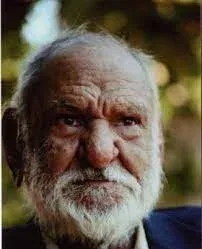
Jack Dale has lived in the remote and rugged Kimberley region of northwest Australia since childhood. His life spans from the turbulent and often bloody years of early white settlement through a life working cattle and traveling the north west as he accumulated knowledge and the ancient stories of the land and its creation spirits.
The son of a hard-living Scottish man and an indigenous woman of the Ngarinyin people, he spent his earliest years wandering the bush tracks further and further from his home. His cruel and often violent father shot him in the leg and tied him to a tree to stop him ‘running away’ while still a youth. (Dale, 2006) His father died however, when Jack was still young and to his good fortune Jack was taken under the wing of his Aboriginal grandfather who taught him Narrungunni law and protected him from the prevailing social attitude toward mixed blood children at the time. During this time Jack walked many hundreds of miles with his grandfather, learning about country and the ancestral spirits that created it. They often had to hide from police patrols that would forcibly take aboriginal children to be housed in institutions. Sometimes, from hiding places, they watched chain gangs of Aboriginal men being marched away by white men on horseback and later, saw the arrival of the Afghan camel drivers. When he began painting in his late 70’s at his home in Derby, these and other historical incidents that he witnessed first hand during his youth became some of the important subjects he explored in his art.
At the suggestion of David Mowaljarlai and anthropologist Kevin Shaw Melbourne natural history photographer, artist and entrepreneur Neil McLeod had visited Jack Dale during the late 1980’s. Ten years later, in 1997, re-introduced by Shaw, McLeod asked Dale if he would consider painting. The old man, by now in his 70’s was excited that someone had come to him at last to record his knowledge and traditions. McLeod supplied the materials and encouraged Dale to begin painting. As one of the last, dwindling, generation of old men who possess a complete knowledge of the rituals, law and culture of his people, Jack Dale had become a vital link to the past.
A custodian of ancient stories about the land and its creation, his most compelling and mysterious works focus on the Wandjina and other important spirit beings that created the land and instituted the laws that govern human behaviour. Wandjinas are powerful fertility spirits responsible for the life-giving monsoon rains Jack believes that the ‘big boss’ Wandjina can rally his attendants when conflict occurs between humans. These spirits are depicted in a distinctive style; ghost-like, with haloes, large dark pool-like eyes and with no mouth for, according to Dale, giving them a mouth would mean the heavens would open and the rain would never cease. “Whites have the bible. We have our Wandjinas. We have to go to these places else we are empty.” Says Dale. These Wandjina sites, located throughout the Kimberley, are over 60,000 years old and are painted on rock overhangs, often marked by striking geological features like the Djalala or ‘marking stones’ that indicate their presence.
Despite his age, Jack Dale works with an indefatigable energy, documenting important beliefs and events of his life. He is often assisted by family members including his wife, artist Biddy Dale. Now a very old man, he works by drafting out the major story elements onto his canvases, which can at times be up to 2 metres or more in size. As he does so he relates the story while instructing and overseeing his wife and daughter Edna Dale as they complete the dotted outlines and decorative infill.
The dramatic Kimberley country with its harsh stony areas, steeply rising ranges and deep gorges created by fast-flowing, wet season rivers are the focus of Jack’s more abstract works. In map-like paintings that trace the contours of the desert landscape, Jack uses broad areas of strong colour to create a feeling of tangible substance within his mythic vision of the land. His depictions of spirit beings and historical episodes are rendered in a figurative style while his striking depictions of the Kimberley landscape and features such as the rocky outcrops that guard the homes of the Wandjina are painted from an omnipotent perspective, thereby resonating with the spare minimal works of Rover Thomas and others who painted in the East Kimberley. However, in a stylistic departure that identifies his own work, Dale portrays these as spare geometric forms by employing red black and white pigments, with occasional surprising additions like gold powder, in preference to the earthy tones of his East Kimberley contemporaries. In doing so he inadvertently achieves remarkably modernist effects and imagery that resonate with those seen on Marimekko or Delaunay fabrics.
Jack Dale’s paintings, with their correlating landscape markers of hills, waterholes and traditional journey lines, were used in a land claim that returned the Imintji country to its traditional owners. Jack still spends time at the community there but these days, for health reasons, lives in the closest town, Derby. Sometimes called the ‘Grand Old Man of the Kimberley’, Jack is a highly respected tribal elder, both for his custodianship of Ceremonial Law and for his skill as a bushman. He came to painting late in life, after many hard-working years as a stockman. Even then he was revered for his extensive knowledge and admired for his physical strength and determined attitude. This, he re-lives and communicates in his painting, sharing with an international audience, a powerful experience of the inimitable Kimberley genius, so precariously balanced at the crossroads of change.
© Adrian Newstead
Shaw, Kevin, Jack Dale biography, 2000.
Jack Dale exhibition invitation, Japingka Gallery, Fremantle, 2006
Geissler, Marie, media release for Cooee exhibition, 2006
McLeod, Neil, Jack Dale Mengenen, (DVD)
Rank #96Cumulative AAMI 2.72
Annual AAMI rating by year — hover or tap a bar for the exact figure.
How the AAMI rating is calculated
The AAMI (Aboriginal Art Market Index) measures an artist’s auction performance each year. Each annual rating combines the value of works sold (total sales and clearance rate), the number of works offered, and the average price achieved — with adjustments that temper thin trading years and a rising annual price threshold, so results stay comparable over time. The yearly ratings are added together into an artist’s Cumulative AAMI score, which determines their rank in the index.