Jan Billycan
AAMI artistc. 1930 – 2016
- Region
- Kimberley
- Community
- Bidyadanga (La Grange)
- Language
- Yulparija (Yulparitja); Manyjilyjarra
Region: Kimberley · Community: Bidyadanga (La Grange) · Language: Yulparija (Yulparitja); Manyjilyjarra
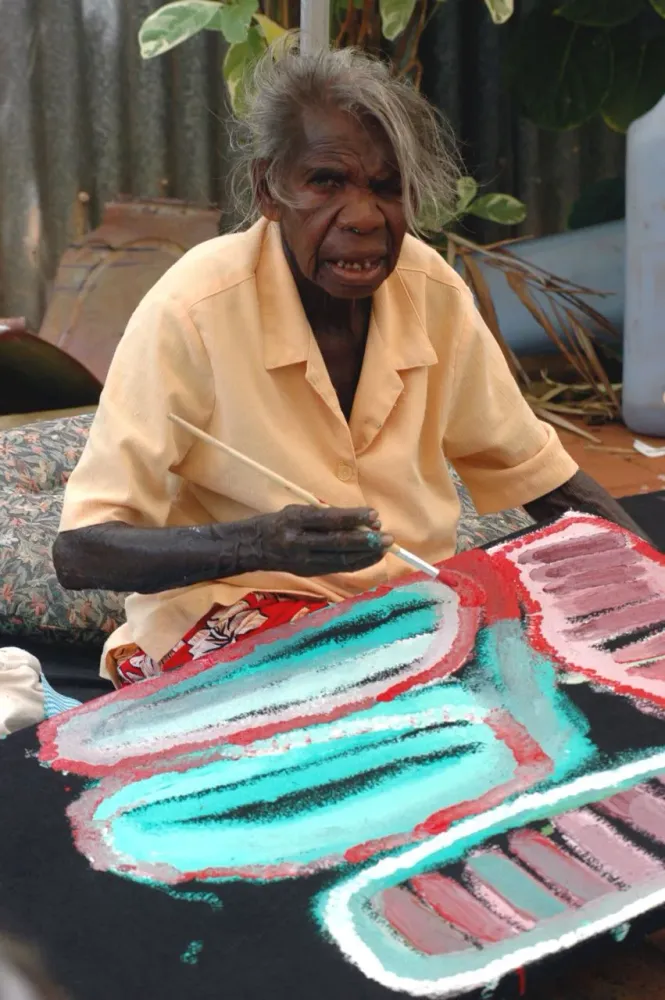
Jan Billycan (aka Djan Nanundie)'s work depicts the country of her birthplace, Kirriwirri and other sites in Ilyarra country. This is a land of spreading mud flats, gleaming salt lakes and a life-giving network of freshwater springs with their source deep underground. It was the home of the Yulparija people, deep in the Great Sandy Desert, before drought and mining caused the environmental catastrophe that drove them to the coastal refuge of Bidyadanga south of Broome. That was a time of grief and exile that lay dormant in the memories of the survivors. The stirrings of an art movement had reawakened these memories, breathing new life into an ancient land and its story. Emily Rohr of Broome’s Short Street Gallery brought art materials to the aged care home after being alerted to the elderly residents' desire (or ‘need’ as Daniel Walbidi suggested to her) to paint. The profusion of colour and untutored vitality that erupted took the eventual results to southern cities before the year was out. Sell-out group and solo shows followed, with Judith Ryan featuring them at the NGV in the exhibition 'Colour Power' (2004).
Among them, the distinctive works of Jan Billycan emerged as the expressions of a unique and startling talent. In 2011 she won the West Australian Indigenous Art Award at AGWA in Perth. Jan was a respected Marpan, or medicine woman, and as such, had the ability of x-ray vision. This capacity fed into her cell-like compositions that jangle and vibrate, similar to, as Emily Rohr says, a musical composition. It was a different manner of perception, and when applied to the geography of place and memory, carried with it the emotion of lived experience. Jan’s discordant greens, oranges, greys and purples had generated much discussion. The desert and the coast became the site of a disrupted continuity, but the desert iconography remained unmistakable.
There is Jila (living water) in this country, including Karrparti, Kawarr, Jurntiwa, and Wirrguj. Other places include Dodo, Kartal, Kiriwirri and Yukarri. When Jan was young, she walked all around these places with her parents. Jan explained, "In living water there is a quiet snake. Sometimes he rises up, but we sing him down sometimes, he can travel and bring rain. Ilyarra is my country Ilyarra, where I grew up. Lots of tali (sand dunes) and jila in this country. This big dog country." Her grainy textures instilled her works with the weight or gravitas of ‘an imaginary repossession’ (Nicholas Rothwell). Jan mixed her colours on the canvas, tracing over networks of sketched underpainting. She built her layers toward a colour and density that pushed all our boundaries, psychological as well as physical.
Jan’s close working proximity to the other painters of the Yulparija group meant that singing and discussion were ever-present as they brought back to their lives, lost relatives, precious ancestors and beloved sacred sites. These artists re-drew the perimeters of Western Desert art, though their links were still apparent. The scarcity of water that drove the flight from their homeland reverberates in their paintings with an insistent call. It remains one of the most remote and rugged regions of the world and the homeland of a diverse and dynamic Indigenous culture. Such precious memories are held in these works for future generations of Yulparija and for all of us to contemplate.
Profile author: Sophie Baka
Rohr, Emily, ‘Bidyadanga’ in Beyond Sacred, Recent painting from Australia’s remote Aboriginal communities, The collection of Collection of Colin and Elizabeth Laverty, Hardie Grant Books, Australia, 2008
Rothwell, Nicolas, ‘Remembrance of Things Past” in The Australian, April 1, 2006
Rank #90Cumulative AAMI 2.87
Annual AAMI rating by year — hover or tap a bar for the exact figure.
How the AAMI rating is calculated
The AAMI (Aboriginal Art Market Index) measures an artist’s auction performance each year. Each annual rating combines the value of works sold (total sales and clearance rate), the number of works offered, and the average price achieved — with adjustments that temper thin trading years and a rising annual price threshold, so results stay comparable over time. The yearly ratings are added together into an artist’s Cumulative AAMI score, which determines their rank in the index.