Mick Kubarkku
AAMI artistc.1922/ c.1925 – 2008
- Region
- Arnhem Land
- Community
- Mumeka
- Language
- Kunwinjku (Gunwinggu, Gunwinjgu)
Region: Arnhem Land · Community: Mumeka · Language: Kunwinjku (Gunwinggu, Gunwinjgu)
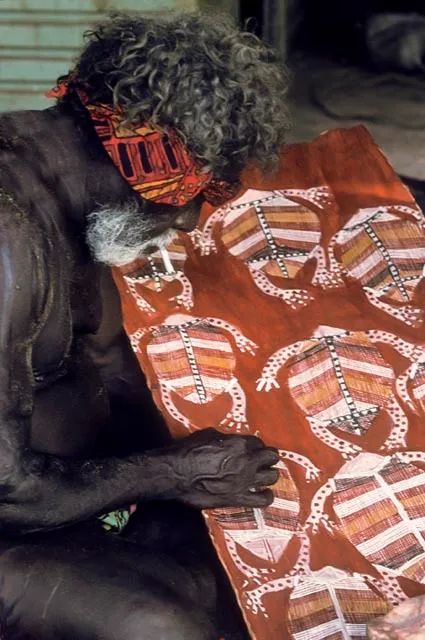
Mick Kubarkku is recognised as being one of the great Kunwinjku artists. He was born c1922 at Kukabarnka, the large Marrinj clan wetland area near the Liverpool River of Western Arnhem Land. Having spent his youth largely oblivious of a European presence, he was one of the few men who remembered the old men who painted the caves there, and could give detailed interpretations of their content. His father Ngindjalakku, instructed him in the creation of paintings for sacred ceremonies and he lived between his father’s Kulmarru land and his mother’s Kardbam country. As he matured through adolescence he attended and made art for the many Kunabibi,
Wubarr and Mardayin ceremonies that were held there. It was not until the outbreak of the war that Kubarkku was rounded up with his brothers and sent to Milingimbi Mission. Kubarkku returned to his country at the end of the war, however wanting tobacco, he decided to live at Oenpelli and work at the buffalo shooters camps.
Though he had sold a few barks at Oenpelli beforehand, Kubarkku moved to the new Government settlement of Maningrida in 1957 and along with David Milaybuma became the first of the regular painters there. A system of marketing art had operated since the 1950’s at Yirrkala and Millingimbi however it would be twelve years after Kubarkku began painting on bark before Maningrida Arts and Culture would be established in 1969. With Peter Crooke’s appointment as Art Advisor there, Kubarkku’s art gained increasing recognition.
In his early barks Kubarkku restricted himself to the dotted infill reminiscent of rock paintings. However later he incorporated his father’s ‘rarrk’ cross-hatching from the Mardayin ceremony in to a rugged and individual painting style. Gowan Armstrong, Maningrida’s chaplain recalled that ‘ the ever cheerful Mick Gubargu (sic) began to bring his crocodile paintings from about 1970s onwards ‘(cited in Altman 2004: 176) and these were accompanied by barks depicting other totemic animals including barramundi, turtle, kangaroo and echidna. The crosshatching that adorned these and other totemic figures at the time was not the meticulous geometric rarrk, common throughout Arnhem Land. It was less refined than that of many of his contemporaries having a similarity in style to that found in the rock markings found in the country near Kubumi, where he lived during the most artistically productive period of his life. His subject matter and stories were a direct continuation of that cave-art tradition executed with a raw, rough, and direct quality, in which the use of white dotted areas on black is a stylistic marker. Large, uneven dots were often applied to the heads, hands and feet of his figures as well as the internal divisions. Kubarkku's rarrk typically comprised horizontal, vertical or sloping bands of red ochre, relieved by patches of black dots on white.
He also began depicting Mimis and other spirit beings from the early 1970’s. Unlike many of the stone country artists, who’s Mimis are characteristically matchstick thin and fragile, Kubarkku’s were depicted as substantial spirits emerging from the rock escarpments. In later years the Mimi figure would appear in Kubarkku’s art as three-dimensional carvings. While figurative carvings were not traditionally made in central Arnhem Land Kubarkku credited England Bangala as the instigator (West 1995: 12). However Jon Altman has also suggested that the adoption of carving in the 1990 amongst Kununjku artists may have been at least partly due to influence form residing woodworking artist Andrew Hughes (2004: 184). In time, not only the Mimi were the subject of his carvings, but also the Yawk Yawk mermaid spirits, said to be a transformational manifestation of the Rainbow Serpent, that live in the freshwater streams of Kubarkku’s stone country. In a final late development in his artistic life he employed Kunwinjku iconic conventions to create astronomical paintings that revealed aspects of Yolngu cosmology.
However, apart from the introduction of carving, Kubarkku’s career was marked by an astonishing continuity in subject matter and style. At the time of writing Mick Kubarkku was still living on his outstation but frail and no longer producing works. During a rich and active life he produced a body of work that ranged across forty years of which the final twenty were a period of prodigious output, and while his work may not be characterized by aesthetic finesse, as that of other bark painters, its boldly figurative individually recognisable style is enduringly memorable.
Altman, Jon, ‘Brokering Kuninjku art: Artists, institutions and the market,” Crossing Country - the Alchemy of Western Arnhem Land Art, Hetti Perkins and Theresa Willsteed (Eds.), Art Gallery of New South Wales, Sydney, 2004.
West, M., (ed.), 1995, Rainbow Sugarbag and Moon, Two Artists of the Stone Country: Bardayal Nadjamerrek and Mick Kubarkku, exhib. cat., Museum and Art Gallery of the Northern Territory, Darwin.
Exhibitions
- Black Art White Walls2014 – 2016
Rank #78Cumulative AAMI 3.82
Annual AAMI rating by year — hover or tap a bar for the exact figure.
How the AAMI rating is calculated
The AAMI (Aboriginal Art Market Index) measures an artist’s auction performance each year. Each annual rating combines the value of works sold (total sales and clearance rate), the number of works offered, and the average price achieved — with adjustments that temper thin trading years and a rising annual price threshold, so results stay comparable over time. The yearly ratings are added together into an artist’s Cumulative AAMI score, which determines their rank in the index.