Paddy (Jampin) Jaminji
AAMI artistc.1912 – 1996
- Region
- Kimberley
- Community
- Warmun (Turkey Creek)
- Language
- Gija (Kija, Gidja, Kitja, Kidja)
Region: Kimberley · Community: Warmun (Turkey Creek) · Language: Gija (Kija, Gidja, Kitja, Kidja)
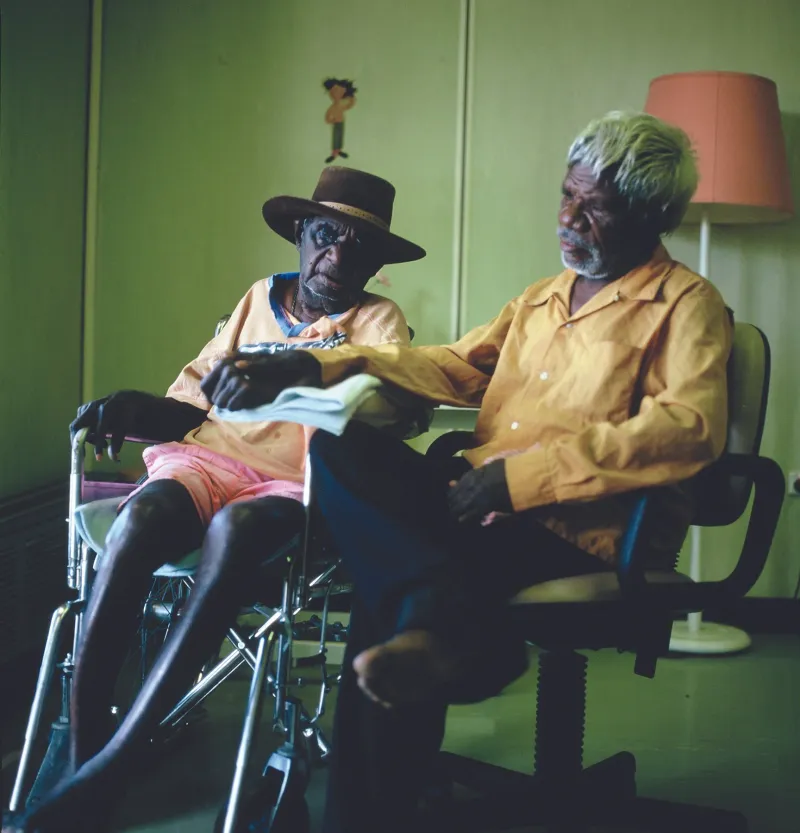
Paddy Jaminji, was the classificatory ‘uncle’ of Rover Thomas and a highly respected elder during the establishment of the Warmun Community at Turkey Creek in the early 1970’s. Due to a combination of economic hardship and political upheaval he, along with many of his countrymen, had been displaced from his working life as a stockman, and, by a strange twist of fate, became the founder of the contemporary painting style of the East Kimberley region.
In 1974, Jaminji, Thomas and their contemporaries, viewed the destruction of Darwin by Cyclone Tracy as a manifestation of the Rainbow Serpent, warning them to make a stand against sliding into the Gadiya (white man’s) ways. This cataclysmic event at the region’s centre of European influence became, for Gija people in particular, the catalyst for cultural revival.
While Rover Thomas, who would later become the leader of this new art movement, re-interpreted the dream of his travels visiting important sites throughout the Kimberley with the spirit of a deceased female relative in to a ceremony that included art and dance, it was Jaminji, who was initially the most prolific producer of the paintings that were associated with the story and ceremony, which would come to be known as the Krill Krill or Gurrir Gurrir. Rover Thomas described himself as apprentice and confidante to the older man as Jaminji’s great store of knowledge about the land, its features and spiritual significance, provided the grounding for the new ideas and images that would eventually infuse his unique and evocative ceremonial paintings with their strong traditional links. As these paintings generated interest, and a demand for similar works to those used in ceremonies grew, Thomas and others were emboldened to begin painting themselves.
From their genesis in the mid 1970’s, Jaminji’s paintings stood out as appreciably different to the better-known, multi-hued acrylic dotted works that were being created at Papunya during the same period. The remoteness of the Kimberley encouraged a separate development with Jaminji, and those who followed, choosing to work only in traditional ochres, which rendered a highly textured surface, conveying a warm, earthy quality. Jaminji’s diagrammatic depiction of the landscape, which followed the actual contours of the country, and used the earth itself as the medium, imparted the feeling that the actual traces of the events, which unfolded through time, were embedded in the works.
Jaminji worked as a gardener at the Argyle Diamond Mine during its early years and sold his first paintings to contractors and mine advisers from 1977 onwards. Later, Mary Macha, who ran the Government Marketing Company’s retail outlet in Perth, purchased his, and Thomas’s, paintings and, after leaving the company in 1983, made her garage in to a studio for Rover Thomas and occasionally Jaminji during their time down south. She continued to purchase Jaminji’s paintings throughout the early and mid 1980’s until by 1987 he was almost completely blind.
Jaminji’s most emblematic paintings were of mythic creatures depicted in a figurate style such as devil-devils, and Tawurr, the Half Kangaroo that was transformed into a rock at Elgee Cliffs, the site of an ancient cave painting and Dreaming place. During the Krill Krill ceremony, the spirit stops to acknowledge Tawurr, ensuring the continuity of the spiritual powers that he imparted which are inscribed within the cliffs just as Jaminji’s painting appears to capture the spirit of this ancient being.
Despite their formal composition, Paddy Jaminji’s works emanate a sense of power and freedom befitting the work of a man deeply versed in his tradition who spent most of his life working with cattle and moving them across the land. He was the inspiration behind Rover's decision to paint and went on to inspire many others including, late in his life, Lena Nyabi. The themes for his works were derived from his own beliefs, cultural iconography and working experiences and it is this intimate knowledge of tradition and country that imbues his paintings with their deep meaning.
© Adrian Newstead
Akerman, Kim, “Western Australia; A Focus on Recent Developments in the East Kimberley”, in Windows on the Dreaming; Aboriginal Paintings in the Australian National Gallery, Wally Caruana (ed.) Ellsyd Press, Sydney, 1989.
Ryan, Judith, Images of Power; Aboriginal Art of the Kimberley, National Gallery of Victoria, Melbourne, 1993.
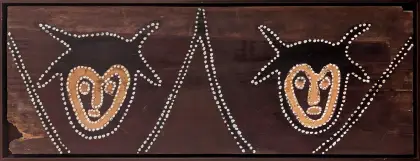
With only 1 or 2 Paddy Jaminji paintings appearing at auction each year, they are now rather a rare item. He painted for only a brief period between the late 1970’s and 1987, by which time he was almost completely blind. The first art centres in the region were not established until 1986 and by this time, Jaminji was barely able to paint. For the first half of his brief decade of creative activity, his paintings were made exclusively for ceremonies and not for sale. Thereafter, occasional visitors to the community would offer to purchase paintings, and eventually, Jaminji’s works found their way down to the Government marketing company outlet in Perth, run until 1983 by Mary Macha.
Three initial collections of ceremonial boards by Paddy, Rover and others, were sold to the Berndt Museum at the University of Western Australia, and to the Western Australian Museum. A number of boards were sold to individual collectors and contractors working on the Argyle Diamond Mine site or passing through Turkey Creek, however the majority of these had little if any fixative added to the pigments and were stored between ceremonies on earth floors and in poor conditions. Varying degrees of damage including smudging of the ochred surfaces and deterioration of the board on which they were painted, is reflected in the more disappointing auction results.
Only 101 works by Paddy Jaminji have been offered for sale through auction (compared to 450 works by Rover Thomas), with 64 sold. Those that failed to sell were considered lesser works either because of size, damage, or because of having somewhat simplistic images with little colour relief. Generally, the larger the work and the more engaging the image, the higher the price it has received. As expected for an artist who was already an old man when he began painting, large and complex works are limited in number, and attract the highest prices on the rare occasions when they appear for sale. His auction results do not reflect a great deal of difference between works painted early or late in his career, or those for sale or ceremony.
His top sale was for the large work (182.5 x 149.5 cm) on canvas, Hills of Turkey Creek c.1984 which sold for $170,800 in 2013. Number 2 and 3 top sales were back in 2005 but more recently, 2 works have entered his top ten sales. Dreaming Place 1982 sold for $52,800 with Art Leven in 2022 (#8 top sale) and, Nest for Owls and Birds at Drowney Gorge 1998 sold for A$45,851 (US$30,480) with Sotheby’s in New York, 2023 (#10 top sale). In 2026, Elgee Cliff, half kangaroo- Krilkril Country 1985 dropped below its estimate to sell for $24,545 while in 2025, the smaller but well-preserved board, Ngawallu Hills more than doubled its estimate to sell for $11,070 with Bonhams. A captivating Untitled 1987 achieved $19,520 in 2020, well over its top estimate of $15,000, with Deutscher and Hackett.
Paintings by Paddy Jaminji that remain in private hands are rare. Despite his lack of wide recognition and relatively small oeuvre, his seminal place in the emergence of the Kimberley art movement will increase their value considerably over time. The discovery of spectacular paintings by this artist are likely to be few indeed, but when these do come up for sale, they should be expected to better his existing sales records substantially.
Rank #40Cumulative AAMI 8.86
Annual AAMI rating by year — hover or tap a bar for the exact figure.
How the AAMI rating is calculated
The AAMI (Aboriginal Art Market Index) measures an artist’s auction performance each year. Each annual rating combines the value of works sold (total sales and clearance rate), the number of works offered, and the average price achieved — with adjustments that temper thin trading years and a rising annual price threshold, so results stay comparable over time. The yearly ratings are added together into an artist’s Cumulative AAMI score, which determines their rank in the index.