Sally Gabori
AAMI artistc.1924 – 2015
- Region
- Cape York, Gulf & Far North Queensland
- Community
- Bentinck Island
- Language
- Kayardild (Kaiadilt, Gayardilt)
Region: Cape York, Gulf & Far North Queensland · Community: Bentinck Island · Language: Kayardild (Kaiadilt, Gayardilt)
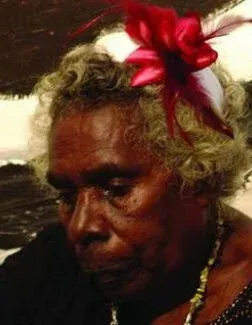
Sally Gabori began her relatively short but spectacular art career in 2005. She had never held a paintbrush or learnt anything of contemporary art when she was given art materials at the age of 81 at her aged care home on Mornington Island. By the time of her death in 2015, she had developed her own painterly language that had taken the Aiustralian art world by storm.
Gabori grew up living a traditional lifestyle on the low-lying Bentinck Island in the Gulf of Carpentaria. Due to environmental threats (such as drought and flooding) Presbyterian missionaries evacuated the population in 1948, somewhat pleased for an excuse to convert the local people to Christianity. Cultural practices (including polygamy) were outlawed and the Kaiadilt language fell into disuse. For years the birthrate fell as the island people mourned their loss, while the remained somewhat removed from the Lardil people of Mornington Island. Sally was one of the last remaining speakers of her Kaiadilt language and as such, a custodian of their traditional culture, its stories and ceremony. As she got older, she felt a great need and desire to share her memories and experiences.
Throughout her life, Sally maintained her traditional crafts of weaving mats and bags from grass or hand-rolled hibiscus bark. The Kaiadilt culture had no pictorial tradition and when it came to painting, it was the smearing and daubing of ceremonial body painting that seemed to be the primary influence. Her strong and energetic brushstrokes imparted a sensual quality as she recreated the beloved landscape of her early island life, feeling her way across the canvas with the sensitivity that only intimate familiarity with the natural environment bestows. Large areas of colour were painted over and into each other while still wet, mixing vibrant yellows, blues and reds, or in her more brooding works, blacks and misty greys. Her loaded brush attested to the outpouring of emotion and ideas as place and memory were woven into uninhibited fields of colour and shape.
Seven months after beginning to paint, Sally was attending her own sell-out show at a Brisbane gallery. This star-like prominence continued unabated throughout the remainder of her life. Her work was soon appearing in major exhibitions and she was chosen to represent Australia’s visual culture at the Queensland Art Gallery of Modern Art during the G20 world leaders summit in 2014. Kaiadilt culture had emerged from seclusion, its stories and country entering the mainstream. While theorists of abstraction tend to talk of emotional expression, Gabori was always picturing stories. Her enthusiasm to sing and relate her heritage gave an integrity to her work. The responce was rapturous. Audiences could feel the sun, sea and mists converging alongside island flora and fauna. The extensive stonewalls that encircle the island; fish traps, built to provide a steady food source. Shellfish and crabs; gathered there and the incoming tides bring fish. Egg-laying turtles and dugongs leaving their tracks as they fed in the shallows on abundant sea grass. All have associated stories, both historical and legendary.
Enjoying the rewards of her success meant that Sally was able to start visiting Bentinck Island again, accompanied by her late husband and relatives. Small communities had been re-established there during the 1980s as part of the return to country movement. Her tribal name Mirdidingkingathi Juwarnda indicates the part of the island where she was born (Mirdidingki, the southern side) and her totem, the dolphin (Juwarnda), refers to an event that occurred at the time of her birth. Her husband Pat Gabori was a warrior chief who won her in battle. She was one of four wives who mothered many children (11 of her own) and the support and sociability that this engendered continued up into her painting days. She soon inspired others to take up the brush, chattering and singing as they exchanged stories from the past. In her later works she used a thinner, milky solution, over-painting the brilliant colours beneath, as if the remembered landscape shimmered through a soft summer haze. Her amazing legacy throws stereotypical notions of contemporary Indigenous painting into question and infects the genre with exciting new perspectives in both theory and practice.
The Bentinck Project, Woolloongabba Art Gallery, Qld, 2006.
Webb, Penny, Making art out of alife time’s stories, The Age, Melbourne, p.27, 20/1/2007.
Xstrata Coal Emerging Indigenous Art Award, Queensland Art Gallery, Brisbane, 2006.
McLean, B., Contemporary Australia: Optimism, cat., Queensland Art Gallery, Brisbane, 2008.
For an artist who began painting at the age of 81 in 2005, Sally Gabori’s secondary market performance has been very strong indeed. Her first works at auction appeared in 2008 when 4 of the 5 works on offer sold for an average price of $4,336. By the end of 2010, her highest recorded price at auction was still only $7,800. Not surprising, as by then her works were available from primary market galleries for less, and only her best works at Alcaston Gallery in Melbourne and Woolloongabba Gallery in Brisbane fetched equivalent prices. Prices and interest in her work slowly increased, but the game changer in the market’s perception, and the willingness of collectors to pay much higher prices occurred in 2011. Three works, (hung as a triptych in the home of uber collector and art patron Anne Lewis AO), sold at Mossgreen’s prestigious single vendor auction held at the Art Gallery of New South Wales. Though they went to three different buyers, they set Gabori’s three highest sales records for the time at $29,280, $26,840 and a completely astounding $36,600, propelling her to national prominence. To date, 204 works have been offered at auction of which 177 (87%) have sold.
2026 got off to an excellent start for Gabori with two paintings sold in Paris at Bonhams. Both above estimate and achieving A$57,052 for (198 x 101cm) and A$32,915 for My Husbands Country with Saltpan, 2008 (151 x 101cm). Since 2020, Gabori has placed all of her top ten sales and in fact, her top 30 sales. 2023 was her best year ever, with total sales reaching $1,209,136 and of 25 works on offer, only 2 remained unsold. This is quite the pattern for Gabori, with very few works passed in at all. Her record sale was in 2023, for Big River at Thundi, 2008. It achieved US$190,500 (A$286,569) with Sotheby’s in New York and in the same auction, number 10 top sale, achieved US$40,640 (A$61,135) for Thundi – Barramundi Story, 2008, going beyond its estimate of 20 –US$30,000.
Sally Gabori’s work inspires brisk trade, with a number of paintings repeatedly changing hands at frequent intervals. Dibirdibi Country, 2011 (152 x101.5cm) became number 4 in the top ten at $71,182, in 2025. It has appeared in eighteen auctions since 2009 when it first sold for just $7,800, reflecting many ups and a few downs along the way. In recent years it has been much harder to find a Gabori work for under $10,000 though this was once her most active area of sales. However, they are still occasionally to be found, for example Bream and Mullet c.2005 (122 x91 cm) for $9,819 at Menzies in 2025, up from $8,400 in 2024 with Art Leven. Paintings in the 10- $25,000 are more likely to provide the entry point for new buyers. Gabori’s average price in 2025 was $53,330.
Gabori’s instinctive feel for colour and brushwork garners much attention. There are many major Gabori works in the finest private collections both in Australia and internationally. As these begin to appear at auction over the decades ahead, expect Sally Gabori to continue climbing inexorably.
Rank #21Cumulative AAMI 16.90
Annual AAMI rating by year — hover or tap a bar for the exact figure.
How the AAMI rating is calculated
The AAMI (Aboriginal Art Market Index) measures an artist’s auction performance each year. Each annual rating combines the value of works sold (total sales and clearance rate), the number of works offered, and the average price achieved — with adjustments that temper thin trading years and a rising annual price threshold, so results stay comparable over time. The yearly ratings are added together into an artist’s Cumulative AAMI score, which determines their rank in the index.