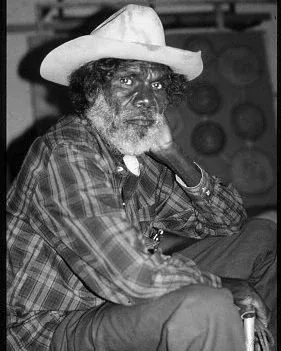
Turkey Tolson Tjupurrula
AAMI artistc.1938 – 2001
- Region
- Western Desert
- Community
- Kintore (Walungurru)
- Language
- Pintupi
Region: Western Desert · Community: Kintore (Walungurru) · Language: Pintupi
Turkey Tolson was born under a tree beside a creek bed about eight kilometres east of Haasts Bluff. After years of working in the Haasts Bluff stock camp droving cattle to Mount Leibig, he underwent initiation into manhood, and the family moved to the Papunya settlement where Turkey worked as a construction labourer and in the communal kitchen. In 1961 he married and moved with his young family to an outstation west of Papunya. After his first wife’s untimely death, he remarried at Papunya, where he lived during the early years of the painting movement. He joined Papunya Tula artists as one of its youngest members, painting his earliest artworks for Geoff Bardon in 1972.
Throughout the 1980s, Tolson’s unassuming leadership style and commitment to the community led him to remain focused on the more anonymous, collective meaning in his work – to the detriment of any personal ambition. He was, in fact, the artist Chris Anderson of the South Australian Museum had in mind when he stated, ‘Andy Warhol didn’t have a CV either. I mean- they’re not artists on the make. They’re not part of the whole career structure’ (cited in Johnson 1996: 98). Yet Tolson’s individual approach and quiet creative momentum were the hallmarks of what became an enduring career.
During his early period, Turkey Tolson was one of the most innovative and figurative artists of the Papunya Tula movement. In the 1980s, he travelled to Paris with Joseph Jurra Tjapaltjarri to create a sand painting as part of the Peintres Aborigines d’Australie exhibition. He collaborated with renowned artist Tim Johnson, supervising Johnson’s use of sacred designs in Emu, Porcupine and Bandicoot Dreaming 1983. Throughout his distinguished career, Tolson’s experimentality and versatility were abundantly manifest as he embraced new, less traditional mediums, including the prints he created for the Utopia Suite and multicolour woodblocks, which were, according to Stephen Rainbird, ‘a bold expression of his individual sensibility and creativity, his artistic maturity and outstanding carving skill' (1994: 182). His prints were included in the comprehensive survey of Aboriginal printmaking New Tracks, Old Land, which was shown to international acclaim in America, touring 25 venues throughout Australia in the early 1990s.
Turkey Tolson was elected Chairman of Papunya Tula in 1985 and held this role until 1995, despite painting for a variety of outside dealers from the early 1990s onward. He became one of the company’s best-known artists and seemingly had no problem in marrying this status with his desire to act independently when the circumstances seemed propitious.
His paintings were invariably included in landmark exhibitions from the early 1980s. These included the exhibition of works from the Richard Kelton collection, Contemporary Australian Art 1981 at the Pacific Asia Museum in Los Angeles, The Face of the Centre at the National Gallery of Victoria in 1985, Aratjara: Art of the First Australians which toured Germany and the UK in 1993-1994 and Papunya Tula: Genesis and Genius at the Art Gallery of NSW in 2000.
Tolson’s versatility in medium and practice was firmly grounded in his superb command of the more traditional painting techniques. His most emblematic and famous images are of Straightening of Spears at Ilyingaungau. Mick Namarari, in fact, was at Kirdungurlu for many of Turkey Tolson’s Dreamings, and this, in part, accounts for the striking resonance between their paintings of the period. Turkey’s Spear Straightening images depict spears lying in the desert. The subtle modulations of line and tone evoke the quintessential desert landscape. This, according to Johnson (1994), was one of the most influential artworks of the Papunya Tula movement. Mindful of the profusion of major abstracted canvases produced by artists like Mick Namarari, George Tjungurayai, Willy Tjungurayai, Ronnie Tjampitjinpa, and a number of other senior Pintupi men, Turkey Tolson becomes the pre-eminent figure in the last decade of the Central Desert art movement and the importance of his work can not be overstated.
© Adrian Newstead
Bardon, G, 2004, Papunya: A Place Made After the Story: The Beginnings of Western Desert Painting Movement, Melbourne University Publishing, Victoria.
Johnson, V,. ‘Turkey Tolson Tjupurrula c. 1938-2001,’ Art and Australia, v.39, no.3, Mar-Apr-May 2002: 386-387.
Johnson, V., 1994, The Dictionary of Western Desert Artists, Craftsman House, East Roseville, New South Wales.
Johnson, V., 1996. ‘Into the Nineties,’ Dreamings of The Desert, Aboriginal Dot Paintings of the Western Desert, Art Gallery of South Australia, Adelaide.
McCulloch-Uehlin, “Dealers Trade on Grey Areas in Red Centre Art,” The Australian: April 17-18, 1999: 4.
Perkins H. 'Beyond the Year of Indigenous Peoples' Art and Australia 1993 Vol 31 No 1 p 98-101.
Rainbird, S. ’Contemporary Aboriginal Prints in the Queensland University of Technology Collection,’ Australian Folklore, v. 9, 1994: 181-184
Sweeney, P. (2000) ‘An interview with Turkey Tolson Tjupurrula,’ Papunya Tula: Genesis and Genius, Perkins, H & Fink, H (eds), Art Gallery of New South Wales, Australia.
Zurbrugg, N., 1991, ‘Tim Johnson Interviewed,’ Art and Australia quarterly, Vol 29, No. 1, Spring 1991.
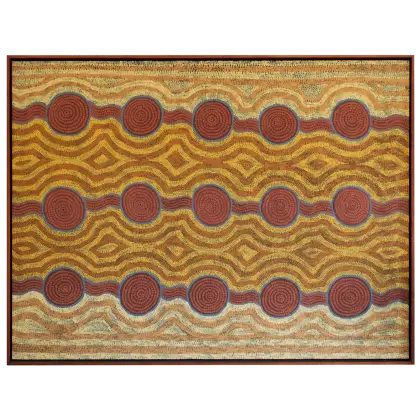
Turkey Tolson was present during the early painting years at Papunya. He painted continuously throughout the 1970s and into the late 1990s, exploring many themes and creating extremely pleasing and well-rendered images. Over time however, the market has consolidated around one particular body of imagery rather than rewarding his full stylistic range. This narrow group of paintings, those depicting the Spear Straightening (associated with the site Illingaungau), dominate his top results and largely continue to define his market. These minimal, rhythmic compositions, structured around parallel lines and subtle tonal shifts, have become both his signature and his commercial anchor. They occupy almost all of his highest results. Moreover, five of his top ten paintings were produced for Papunya Tula between 1996 and 2000, two years before his death, thereby further limiting demand.
Auction data from recent years confirms this pattern. Large and well documented Spear Straightening paintings such as Spear Straightening 2000 (151.5 x 183cms) achieve strong results: $41,272 (Deutscher and Hackett, 2025). These works remain the most sought after and achieve the highest prices, while smaller or less provenanced examples are increasingingly selective in their reception. Sales suggest a market that is moderately active but discerning. Top level sales have largely remained unchanged since 2017 when Spear Straightening 1997 (211 x364cms) once more changed hands (as it did in 2008 and 2010) but this time with a hefty loss of nearly $60,000: selling for $122,727, (Menzies, Lot no.57, Kat 004/97). Nevertheless, this monumental work still occupies 2nd, 3rd and now 5th position in Tolson’s top ten sales. Hammer prices in the $30,000 to $40,000 range, with clear Papunya Tula provenance or exhibition history, continue to sell periodically though a significant proportion remain unsold. Of the 406 works offered for sale at auction (since (1987), 235 or 58% have sold though the greater proportion of them have been under $20,000.
Turkey Tolson was a highly gifted, innovative artist whose range of imagery sets him amongst the finest exponents of desert painting. Institutional recognition remains an enduring foundation of his reputation. In comparison to the Spear Straightening works of his later years, his 1980s paintings have been mysteriously overlooked and would seem to represent great value in the current market for an artist of this stature. While less prominent in price terms, these early works are increasingly recognized for their compositional strength and cultural depth. Many of them explore a range of stories with imagery that is more varied and complex in structure than those created late in his life. Auction results show that large and well provenanced 1980’s pieces of this wider artistic range can still be acquired for modest amounts, presenting fantastic value for informed collectors. Two beautiful examples that sold in 2025 are, Wati Kutjara at Lampitjinpa, Pintupi, 1979 (50x 40cm) selling for $5,100 (Davidson Auctions) and, Mungurimbiri – soakage far to the wsw of Alice Springs 1979, (61 x 45cm) selling for $3,744 Elders Fine Art. Both works going above estimate.
While Tolson’s market is not immune to the fluctuations that affect Aboriginal art more broadly, Tolson’s artistic and cultural legacy remains significant. His disciplined minimalism and his role in the translation of ceremonial form into contemporary painting continue to influence generations of desert artists. The enduring appeal of the Spear Straightening series reflects both its aesthetic clarity and its cultural resonance. Nonetheless, the ongoing selectivity of buyers and the divergence between high and low results underscore that this is a mature and discriminating market rather than a speculative one. Works with strong provenance and in good condition continue to perform, while less documented or minor examples frequently fail to meet reserve. Tolson is a much better artist than he is given credit for, and canny collectors would be well advised to seek him out. Gathered together, his 1980s works would make a fascinating exhibition, and herald a major reappraisal of his career.
Rank #13Cumulative AAMI 22.76
Annual AAMI rating by year — hover or tap a bar for the exact figure.
How the AAMI rating is calculated
The AAMI (Aboriginal Art Market Index) measures an artist’s auction performance each year. Each annual rating combines the value of works sold (total sales and clearance rate), the number of works offered, and the average price achieved — with adjustments that temper thin trading years and a rising annual price threshold, so results stay comparable over time. The yearly ratings are added together into an artist’s Cumulative AAMI score, which determines their rank in the index.