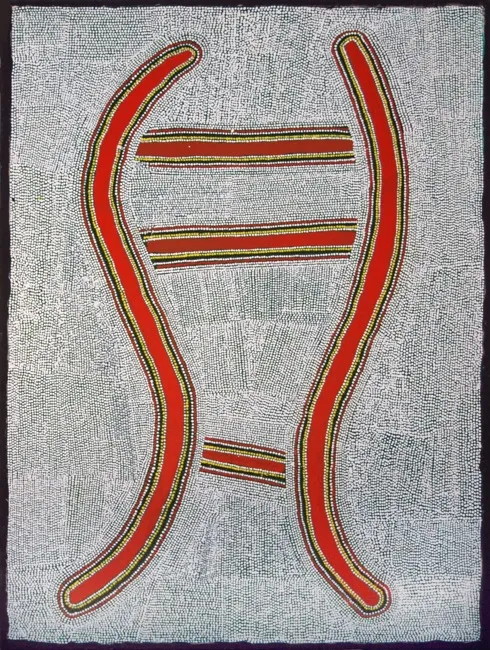
 Click to enlarge
c.1919 – 2002
- Region
- Central Desert & Tanami
- Community
- Lajamanu
- Language group
- Warlpiri (Walpari, Walpiri, Walpirie)
Water Dreaming V (Ngapa), 1997
synthetic polymer paint on Belgian linen
109 x 80 cm
$8,000
- Provenance
- Warnayaka Art Centre, Lajamanu, NT Cooee Aboriginal Art Gallery, NSW
- Exhibited
- Black Art White Walls – The Anne and Adrian Newstead Collection (Australian regional gallery tour): Grace Cossington Smith Gallery, Wahroonga NSW, 23 January – 30 March 2014 Wagga Wagga Regional Gallery, Wagga Wagga NSW, 7 April – 12 June 2014 Walker Street Gallery, Dandenong Vic, 4 September – 8 October 2014 Moree Plains Gallery, Moree NSW, 1 December 2014 – 29 January 2015 Manning Regional Gallery, Taree NSW, 30 January – 15 March 2015 Burrinja Regional Gallery, Upwey Vic, 4 July – 28 September 2015 Brunswick Regional Gallery, Brunswick Vic, 16 October – 8 November 2015 Caloundra Regional Gallery, Caloundra Qld, 20 January – 28 February 2016 O Tempo dos Sonhos – The Time of Dreaming (Arte Aborígene Contemporânea da Austrália), Caixa Cultural Foundation & Casa Fiat de Cultura, touring 2018 – 2024: Brazil: São Paulo, Rio de Janeiro, Belo Horizonte, Fortaleza, Curitiba, Brasília, Salvador, Recife, Uberlândia Argentina: Buenos Aires, Córdoba Uruguay: Montevideo
- Artwork story
- In his mature years, Abie Jangala was the most senior rainmaker amongst the Warlpiri people of the northern Tanami Desert. His Dreamings are associated with the Rainbow Men, who are venerated amongst Warlpiri people. Abie’s early works were created on a deep pthalo green or black ground with the stark symbols specifically representing rainbows, lightning, clouds, waterholes and frogs, composed in much the same way as they are etched in relief on the body of rain-makers when covered in kapok or feather down for ceremony. Abie typically painted these powerful symbols, which are also recreated in ceremonial ground constructions, in solid black or red, outlined in single alternate bands of bright yellow, green and red dots thereby emboldening the icons to evoke the shimmering and alluring effect of the Rainbow Men and their dramatic manifestation as natural climatic phenomena. This allure is imitated by the glint from pieces of broken mirror or shiny belt buckles worn and carried by men in ceremony; and the glistening skin of women covered in animal fat and red ochre. Typically these paintings are in-filled with compact white dots representing rain or fields of hailstones. At the height of his artistic powers Abie could apply these uniform white dots in such a way as to evoke the same meditative quality as that of the raked grounds of Zen meditation gardens.