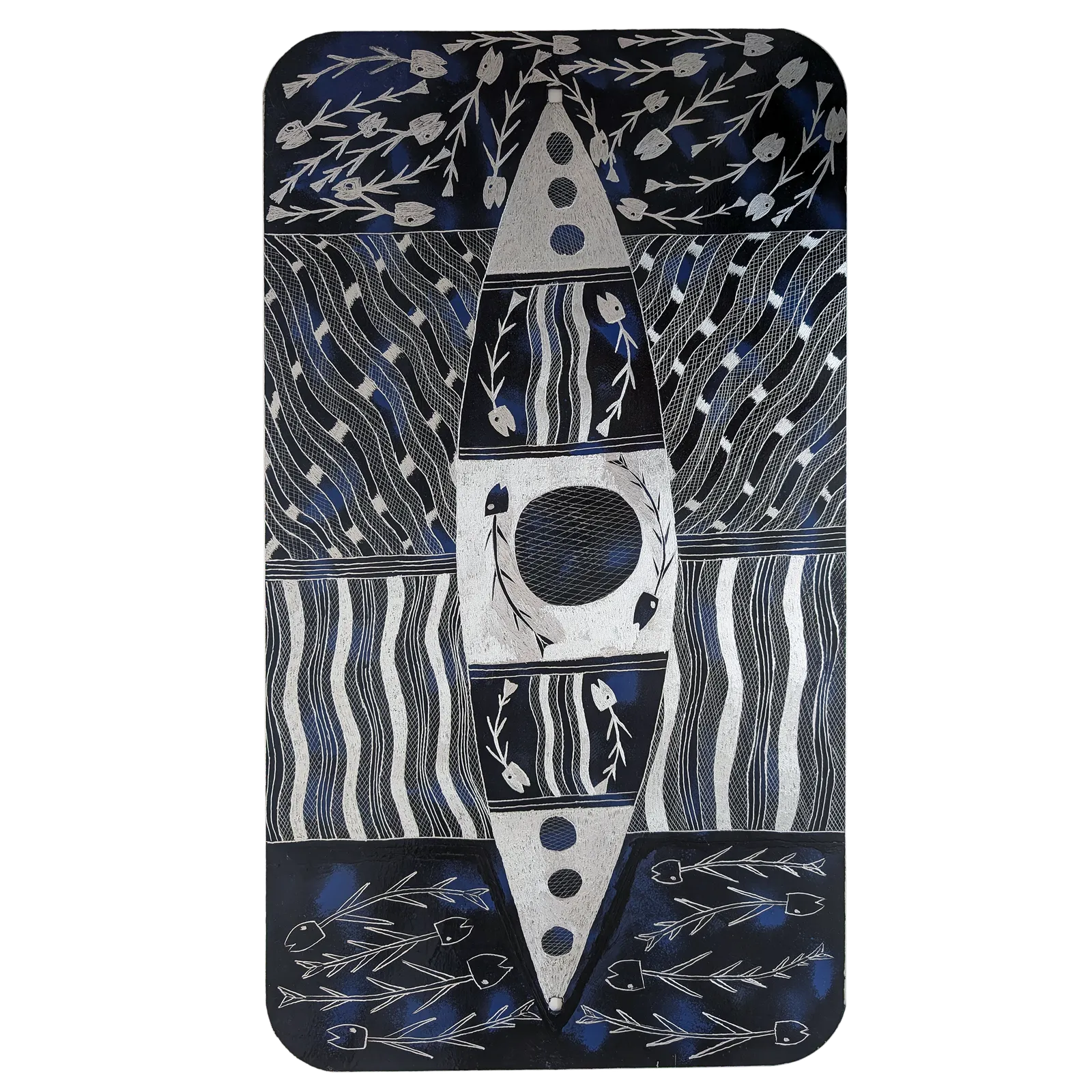
 Click to enlarge
b. 1980
- Region
- Arnhem Land
- Community
- Dhuruputjpi
- Language group
- Yolŋu – Dhuḏi-Djapu; Maŋgalili
Yiŋapuŋapu, 2022
etched aluminium
80 x 45 cm
$3,000
- Provenance
- Buku-Larrnggay Mulka Centre, Yirrkala, NT, Cat No. 1958-22 Accompanied by a certificate of authenticity from Buku Larrnggay Mulka Centre
- Artwork story
- This designs in this piece are tied to the saltwater estate and ritual focal point at Djarrakpi. This beautiful place is located on the Northern entrance of Blue Mud Bay on the Western coast of the Gulf of Carpentaria. It has its founding origins in the times of the first sunrises by the Guwak (a people, 2 men, a koel cuckoo) and a messenger in the form of ringtail possum called Marrŋu. The koel at Djarrakpi made roost atop the Marawili (native cashew tree) and Marrŋu made his mark for the Maŋgalili clan by scratching into its trunk. Behind the massive coastal dunes, there is also a lake of freshwater and at the back of these dunes is said to reside the powerful maternal figure of Nyapaliŋu. She wore a possum fur string girdle crossing her chest; the levy bank of the lake was also of the same masculine and sacred fur, a great long shank. The Guwak as two ancestral hunters left the shores of Djarrakpi in their canoe, testing themselves against the elements, unfathomable sea creatures, the distant horizon and the destructive wake of a giant turtle which eventually capsized their canoe. The Guwak drowned and with their canoe washed back to the Djarrakpi shore. This epiphany; original deaths of the original Maŋgalili gave birth to the original tradition of mortuary rites that nurtured the deceased, clearing the way for temporary release into the ether before reincarnation. Above this shore – made sacred with this profound wash up -is the Djarrakpi yiŋapuŋapu ground. The yiŋapuŋapu is a low relief sand sculpture of feminine elliptical shape, and used in the context of mortuary for the Yirritja clans of Maŋgalili, Madarrpa and Dhalwaŋu. This painting includes the yiŋapuŋapu of these three sites. Its primary traditional function is to keep the contamination of death within the confines ofthe sculpture. Placement of the deceased with in the yiŋapuŋapu on the associated clan land in days before contact had been reserved originally for the creator ancestors. In these areas and by way of permanence for perpetuity, yiŋapuŋapu sites denoted indisputable land ownership. Baluka has painted yiŋapuŋapu at Djarrakpi as the dominant ellipse central to this work and with icons that have reference to the events of the original Maŋgalili deaths. It is a saltwater painting with designs of waving ribbons of cross-hatching which indicate the muŋurru or deeper saltwater that connects the three-relative clan through current, tide and swell. The painting has reference to Nyapaliŋu the creator woman and her involvement as a mother earth figure when it comes to mortuary. She wears possum fur string belts that cross her chest, referred to by the ‘X’ throughout this painting. It is also a manifestation of her at these ends as the Waŋupini or large clouds on the horizon that have heralded the death. The fields of waving lines are part of the sacred design, having reference to saltwater and turtle tracks in the sand dunes. The tracks also of gunyan the ghost sand crab are on the same sand. Out of his hole (marking stations within the yiŋapuŋapu), the crab seeks carrion that has a cleansing effect on the beach, thus a metaphor in that the body is cleansed readying it for final rites outside the yiŋapuŋapu. The round 'stations' can be seen as holes within the yiŋapuŋapu used to bury food remains and/or places where specific relatives of the deceased administer mortuary rites. To come into the yiŋapuŋapu at Djarrakpi you have to pass the bathi and makul the sacred killing and fishing spears used by the ancestors Munuminya and Yakawaŋa buried there. Fresh waters imbued with the life forces of the Maŋgalili clan flow from their land estates to meet with tides and currents of the sea off Djarrakpi. This design can also be read as this water cycle out to the horizon where the ‘mother' cloud takes up within it the freshwater again to rain back over the sea and the shores and the Maŋgalili estates. The cycle of Maŋgalili life between mortality here on earth and ‘life' elsewhere uses the mechanics of the ancient yiŋapuŋapu as catalyst for this to happen. During the establishment of the mining town of Nhulunbuy, Narritjin performed an open yiŋapuŋapu ceremony for the residents as a sincere gesture of reconciliation. Baluka now presides over these ancient rituals and ceremony. Today, the belongings of the deceased are usually found within the Yiŋgapuŋgapu, the dead being sung and danced by families in readiness for burial on site but in a contemporary coffin. Baluka would argue not much else has changed. We argue that these explanations are indeed helpful in explaining the provenance ofhis work but certainly not essential as we see his art standing strong as fine and contemporary rather thana a curiosity from an ancient time. This time has its own place for the artist as the present also and into the future.