Stockroom168 of 616
 Click to enlarge
b. c.1948
- Region
- Arnhem Land
- Community
- Biranybirany
- Language group
- Gumatj
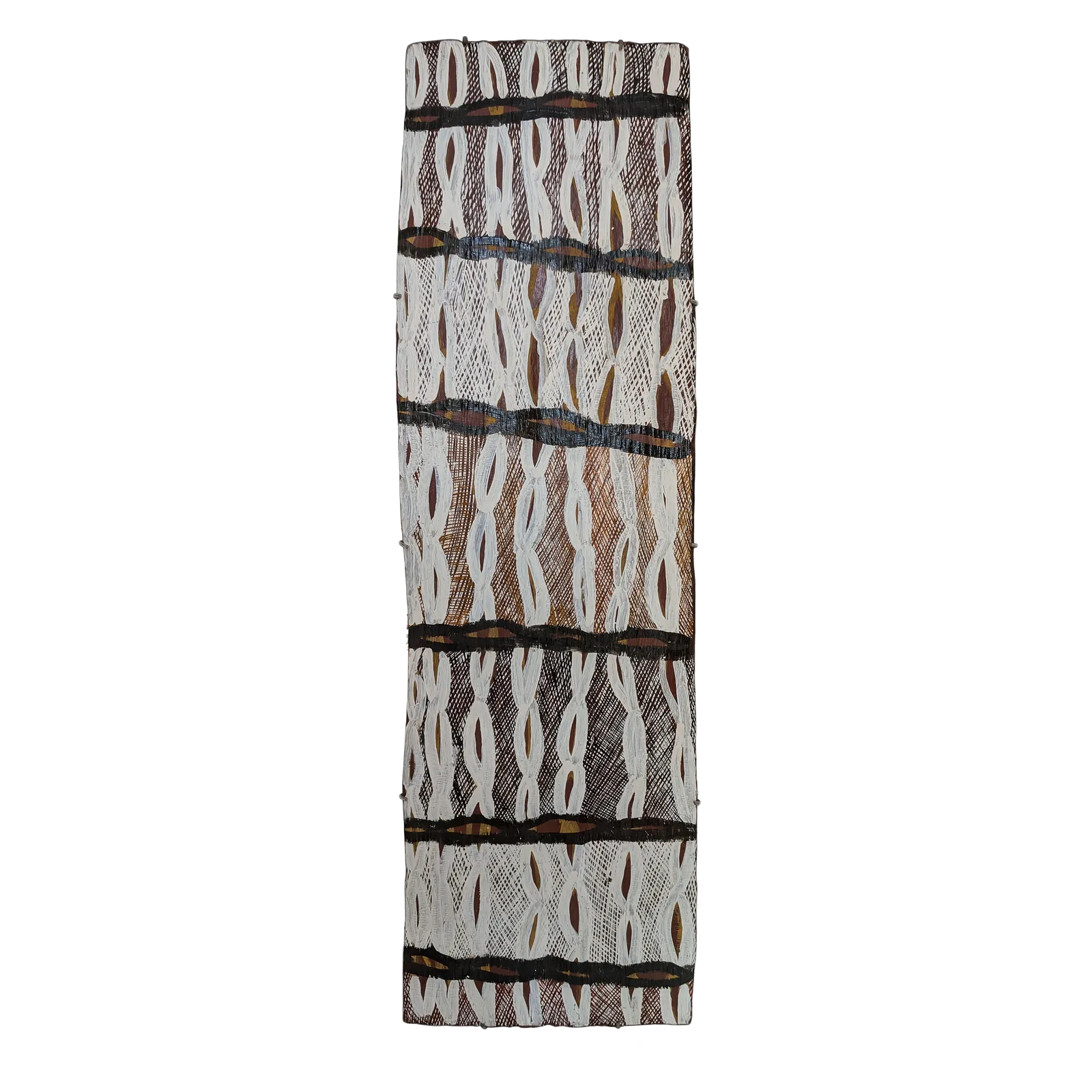
Gurtha
natural earth pigments on stringybark
42 x 137 cm
$5,500
Secure payment via Stripe. Prices in AUD.
- Provenance
- Buku-Larrnggay Mulka Centre, Yirrkala, NT, Cat No. 4287N Accompanied by a certificate of authenticity from Buku-Larrnggay Mulka Centre.
- Artwork story
- Barrupu first came to prominence through limited-edition works on paper, but her move into painting marked a significant shift. Her bark paintings are among the closest contemporary expressions of the sacred designs created by her father, Mungurrawuy, and his brothers in the early 1940s. These designs centre on Ancestral Fire, which is fundamental to the Yunupingu family of the Gumatj clan. Fire’s significance is reflected even in the clan language, Dhuwalandja, described as the “tongue of flame”—a metaphor for a language that exposes truth by cutting away artifice and burning off deception. To understand the importance of Barrupu’s work, it is necessary to consider how Yolŋu art has historically been presented to the outside world. When Yolŋu artists first began engaging with Western audiences, a conscious decision was made to conceal miny’tji—the sacred clan design that embodies identity, law, and country—beneath figurative motifs. Crocodile, shark, and other totemic species were often painted over the design to prevent uninitiated viewers from encountering the full spiritual potency of unmediated miny’tji. This distinction between artworks made for ceremony and those created for public display remained carefully observed for decades. Only in the 2000s did some artists begin showing miny’tji more directly, particularly on larrakitj (memorial poles). One theory is that a pole, which cannot be taken in from a single viewpoint, may be considered less spiritually risky to display than a flat surface—although such commentary comes from outside Yolŋu cultural authority and remains speculative. Barrupu’s painting departs from the long-standing convention of covering sacred design: it presents the Gumatj miny’tji on its own, expressing gurtha, or fire. The diamond patterning in the work is the ancestral design for Gumatj country and recalls a foundational narrative. In ancestral times, fire was carried by Baru, the Crocodile, into Madarrpa clan lands before spreading north to a ceremonial ground at Ngalarrwuy in Gumatj country. Yirritja-moiety leaders used fire there for the first time. As the flames moved outward, various ancestral animals responded to the event, and their reactions became the basis of Gumatj totems. The places associated with these episodes remain important clan sites. The diamond motif refers both to this ancestral fire—its red flames, white ash and smoke, black charcoal, and yellow dust—and to related symbolic layers shared by clans connected to this story. These include: the inner components of guku (bush honey) found in hollow stringybark trees; the skin, blood, fat, and bone of a Gumatj person; and the mud and aquatic plants of a billabong linked to Baru, who himself is a Gumatj power totem transformed through fire.