Stockroom308 of 581
 Click to enlarge
c.1925 – 1995
- Region
- Western Desert
- Community
- Fitzroy Crossing
- Language group
- Wangkajunga; Walmajarri
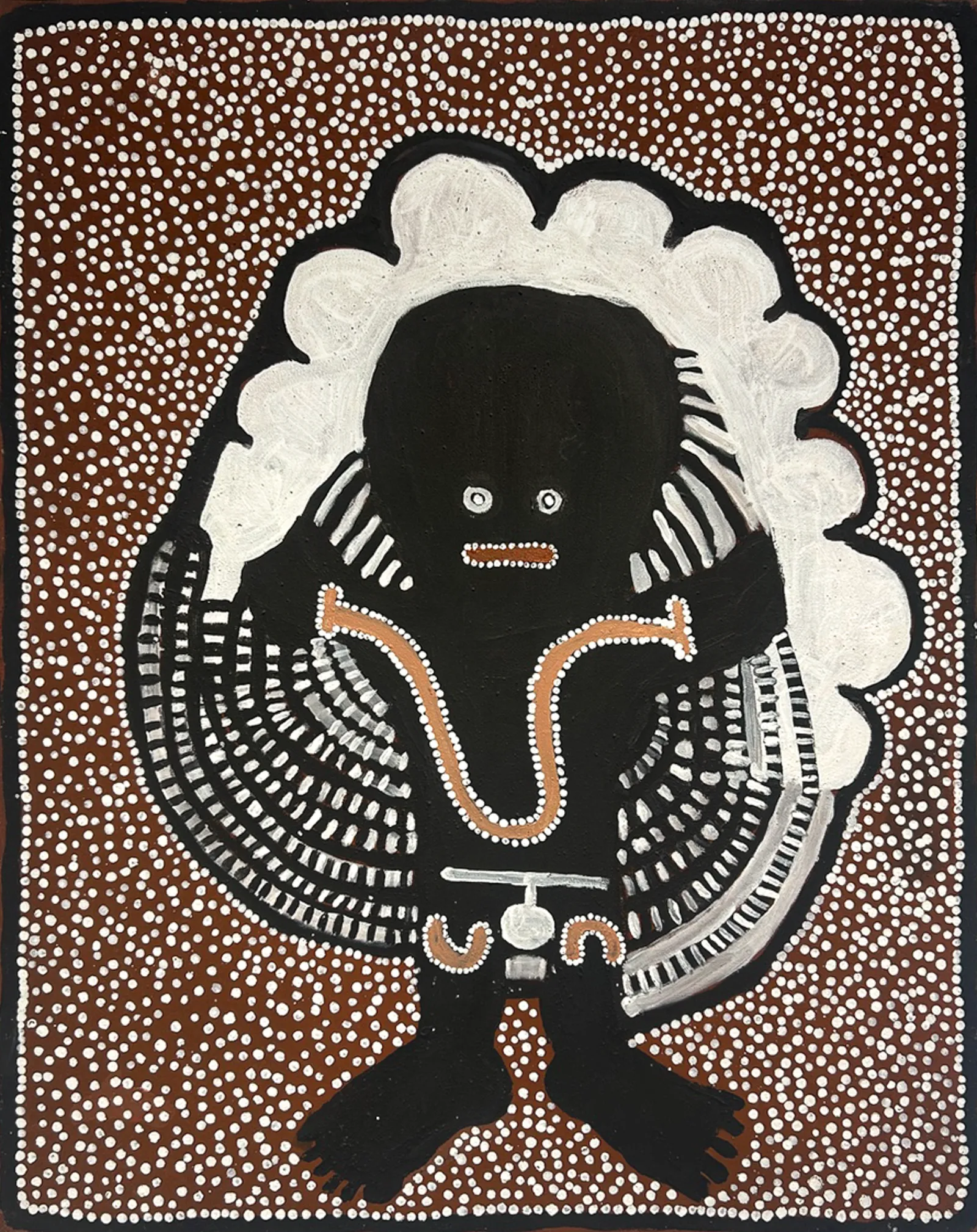
Kurtal, c.1990
natural earth pigments on canvas
76 x 60 cm
$2,500
Secure payment via Stripe. Prices in AUD.
- Provenance
- Duncan Kentish Fine Art, SA - signed verso ArtPlace, Perth, WA - Sold 23/09/1995 Fireworks Gallery, Brisbane, Qld Collection of Prof E.J. Jory (Prof Classics and Ancient History, University of WA) Adrian and Anne Newstead Collection, NSW
- Artwork story
- Jarinyanu David Downs (1925-1995) was born in Walmajarri country in the Great Sandy Desert but lived the greater part of his life in the Fitzroy Valley region north of his homelands. He began his artistic career in the 1980s drawing on the strong desert culture that had moved with the emigrating people into the Fitzroy area. In this sense his artistic career was analogous to that of Rover Thomas who also came from desert country to the south, but was to have a strong influence on Aboriginal art developments in the Kimberley. Jarinyanu David Downs moved north from his traditional Walmajarri lands to the cattle station country of the Fitzroy Valley in the 1940s. Like many of his countrymen, he worked as a stockman on the cattle stations, and during the 1960s made his first artworks featuring designs on traditional artefacts such as ch as boomerangs, shields and coolamons. Then around 1980 made his first paintings. In Fitzroy Crossing the United Aboriginal Mission had worked with Aboriginal people since the early 1950s and many of the desert lawmen and later artists had close ties with the Church. Jarinyanu David Downs painted many religious paintings and came to incorporate symbols from both Christian and traditional law practice from the desert, finding ways to represent what the locals came to call ‘two way’….a mixture of traditional and Christian themes in their artworks. The image of the Ancestral spirit Kurtal became closely identified with the artist and in this work he is seen with one of the many headdresses he wore, showing the different stages of the storm. Here, Kurtal wears full ceremonial dress with painted body markings and pearl shell ornament. Kurtal, the ancestral rain man. Became his primary vehicle for expressing this two-way religious philosophy. Born on a distant island, he traveled to the Kimberley as a cyclone and as he moved on inland he created places of ‘living water’ (permanent water sources) and visited other rain men, occasionally gaining valuable items from them through trickery and magic. Jarinyanu, along with Peter Skipper Jangkarti, was represented by Duncan Kentish, whilst Jimmy Pike whose career began in Fremantle prison in 1980 was represented by Steve Culley and David Wroth of Desert Designs. Individual representation brought many rewards, particularly solo exhibitions in galleries such as Bonython-Meadmore Gallery in 1988, Roar 2 Studios in 1991, Chapman Gallery in 1993, and Ray Hughes in Sydney in 1995, where always resplendent in his white shirt and pants, he was presented as a contemporary artist, alongside non-Indigenous artists. David Downs was one of the earliest Aboriginal artists to be individually represented and, at the time of his death, was considered one of the leading lights of the contemporary Aboriginal art movement.