 Click to enlarge
George (Hairbrush) Tjungurrayi
b. c.1943
- Region
- Western Desert
- Community
- Kintore (Walungurru)
- Language group
- Pintupi
Tingari, 2007
synthetic polymer paint on Belgian linen
118 x 89 cm
Enquire for price
- Provenance
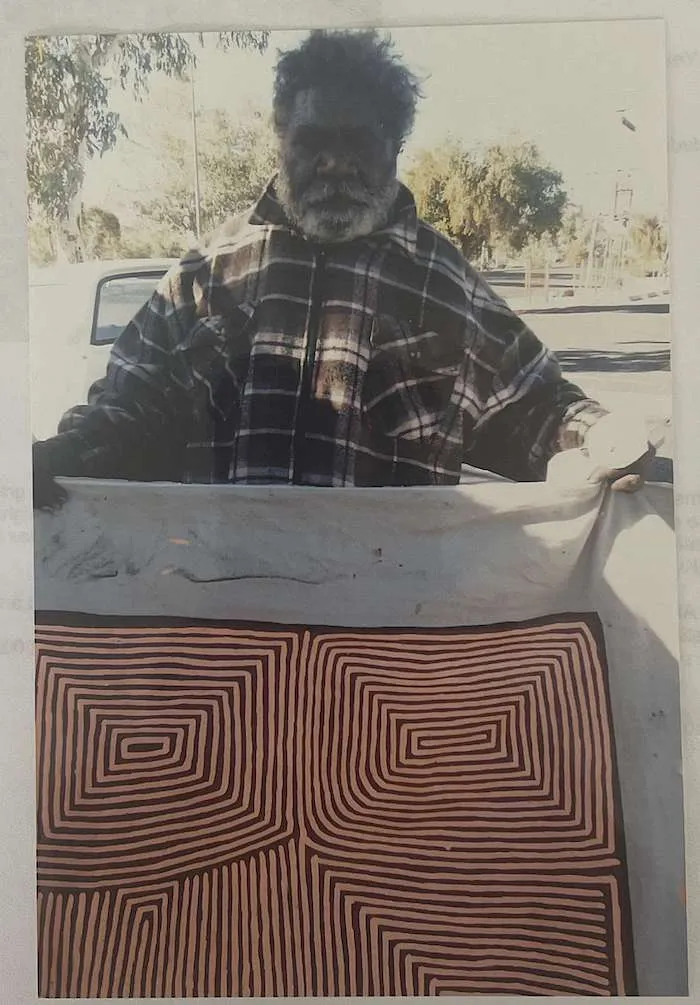
- Grasstree Gallery, Albany, WA, Cat No. GHT045GTG Accompanied by a certificate of authenticity from Grasstree Gallery and a photograph of the artist holding the artwork.
- Artwork story
- George Tjungurrayi's initial contact with the world outside his remote clan country occurred as a seventeen-year-old boy. He left the Gibson Desert on foot to walk the long road east until intercepted by a truck just south of Mount Doreen. He settled in West Camp, Papunya, where he began painting around 1976, after encouragement from Nosepeg Tjupurrula. Over the following decade, his works were characterised by the ubiquitous dotted grids of lines and circles, common to works by Yala Yala Gibbs, Anatjari Tjamptjinpa, and others who played a formative influence in Pintupi Tingari imagery. It was not until well in to the mid 1980s that he expanded his palette beyond the autumnal tones created by the basic palette of red, yellow, black, and white. He mixed a wider array of colours and experimented stylistically. His preoccupation from the outset had been the ceremonial activities and men’s stories associated with the travels of the Tingari ancestors. These stories related to his most significant sites, including his birthplace, Wala Wala. By 1994, George had forsaken figurative imagery altogether in favour of works entirely composed of duo-tone linear roundels and shapes, arranged in tight formal geometric patterns that pulsed with a subtle rhythm. His works had always suggested a sacred geometry related to the Tingari, yet, from this period onward, his paintings increasingly distanced themselves stylistically from their ceremonial origins and the application of distinct dotted brush strokes. Tjungurrayi’s minimalist approach, characterised by vibrating linear effects, shares much in common with paintings by Ronnie Tjampitjinpa and Turkey Tolson, who carried Pintupi men’s painting toward optical abstraction from the 1990’s and beyond. This painting depicts the designs relating to the claypan and soakwater site of Mamulttjulkulnga on the western side of Lake McKay. After heavy rains, the claypan becomes a freshwater lake. In mythological times, two Tingari Men of the Tjangala and Tjapaltjarri kinship groups camped at this site. They gathered seeds known as mungilypa, or samphire, from the small fleshy shrub known as Tecticornia verrucosa. These seeds are ground into a paste and cooked in the coals to make a form of unleavened bread.