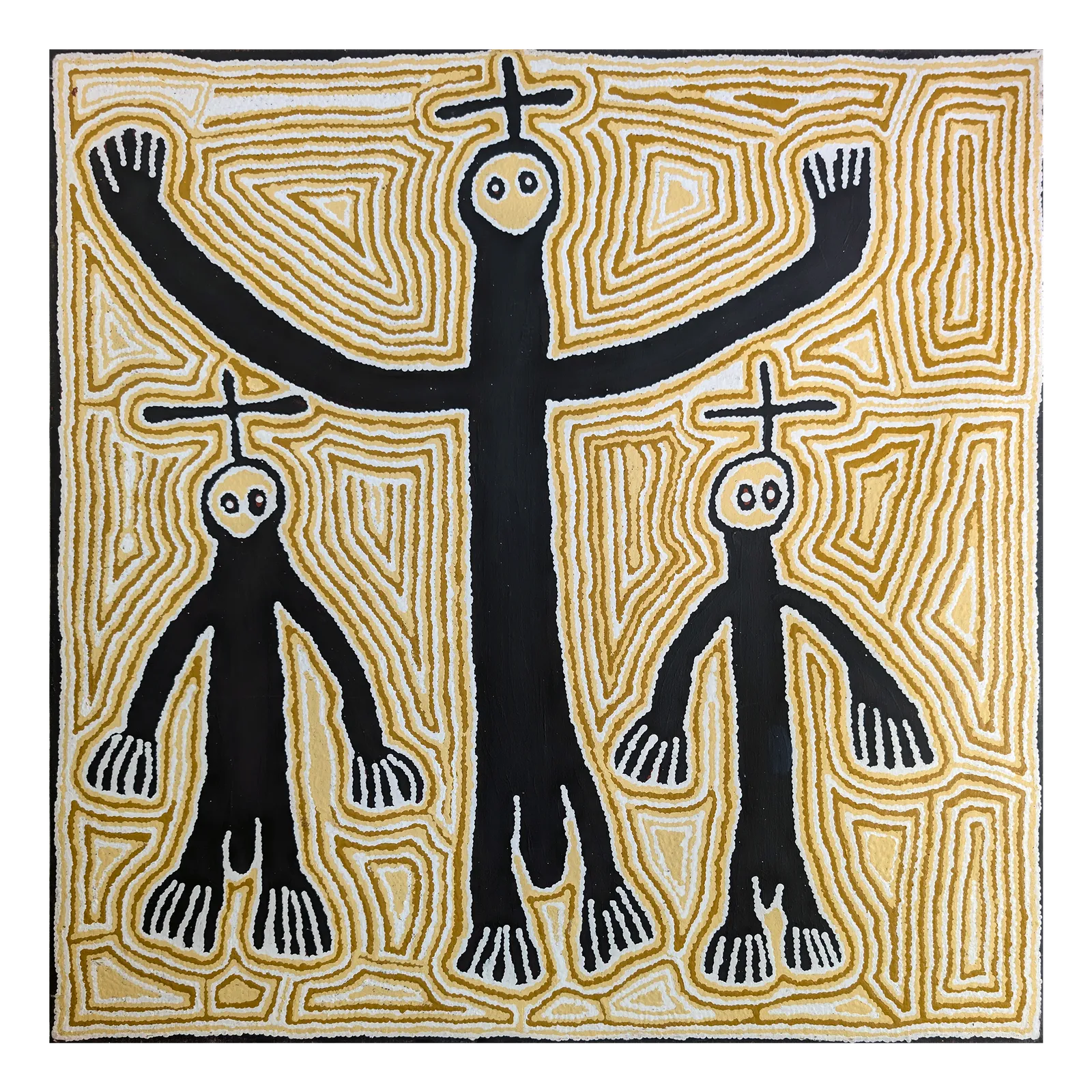
 Click to enlarge
c.1937 – 2021
- Region
- Western Desert
- Community
- Ikuntji (Haasts Bluff)
- Language group
- Pintupi; Pitjantjatjara
Spirits and Sandhills, 2006
synthetic polymer paint on Belgian linen
91 x 91 cm
$8,800
- Provenance
- Gundooee Aboriginal Art, Alice Springs, NT Cooee Aboriginal Art Gallery, NSW Accompanied by a certificate of authenticity from Gundooee Aboriginal Art, photographs of the artist creating the work and a hand written story.
- Exhibited
- Re-Collected, Cooee Aboriginal Art Gallery, NSW, May 2013 Linda Syddick Napaltjarri – The Windmill and the Witchdoctor, Cooee Aboriginal Art Gallery, Bondi Beach NSW, 2006 Black Art White Walls – The Anne and Adrian Newstead Collection (Australian regional gallery tour): Grace Cossington Smith Gallery, Wahroonga NSW, 23 January – 30 March 2014 Wagga Wagga Regional Gallery, Wagga Wagga NSW, 7 April – 12 June 2014 Walker Street Gallery, Dandenong Vic, 4 September – 8 October 2014 Moree Plains Gallery, Moree NSW, 1 December 2014 – 29 January 2015 Manning Regional Gallery, Taree NSW, 30 January – 15 March 2015 Burrinja Regional Gallery, Upwey Vic, 4 July – 28 September 2015 Brunswick Regional Gallery, Brunswick Vic, 16 October – 8 November 2015 Caloundra Regional Gallery, Caloundra Qld, 20 January – 28 February 2016 O Tempo dos Sonhos – The Time of Dreaming (Arte Aborígene Contemporânea da Austrália), Caixa Cultural Foundation & Casa Fiat de Cultura, touring 2018 – 2024: Brazil: São Paulo, Rio de Janeiro, Belo Horizonte, Fortaleza, Curitiba, Brasília, Salvador, Recife, Uberlândia Argentina: Buenos Aires, Córdoba Uruguay: Montevideo
- Artwork story
- The three spirits depicted here are those of three brothers who passed away in the Gibson Desert, long before the Pintupi people left it to reside in missions and out stations. In the ancient tradition, upon their death, their bodies were firstly put in a shallow depression in the sand and covered with tree branches. Later, after ceremonies each body was placed in a tree and once again covered with tree branches. According to ancient belief, the spirit left the body and came to reside in a tree. And even today, among the trees is where spirits can be seen by Aboriginal people, always at night time. They look like cotton wool. They can only be seen through the neuro-visual pathway of Aboriginal people - white people see nothing. The background lines indicate the rows and rows of high vegetated sand hills in the Pintupi Homeland. The Pintupi country covered a very large area, centred on Lake Mackay, which straddles the WA - NT border.