Stockroom316 of 616
 Click to enlarge
c.1930 – 2006
- Region
- Western Desert
- Community
- Ikuntji (Haasts Bluff)
- Language group
- Pintupi; Ngaatjatjarra
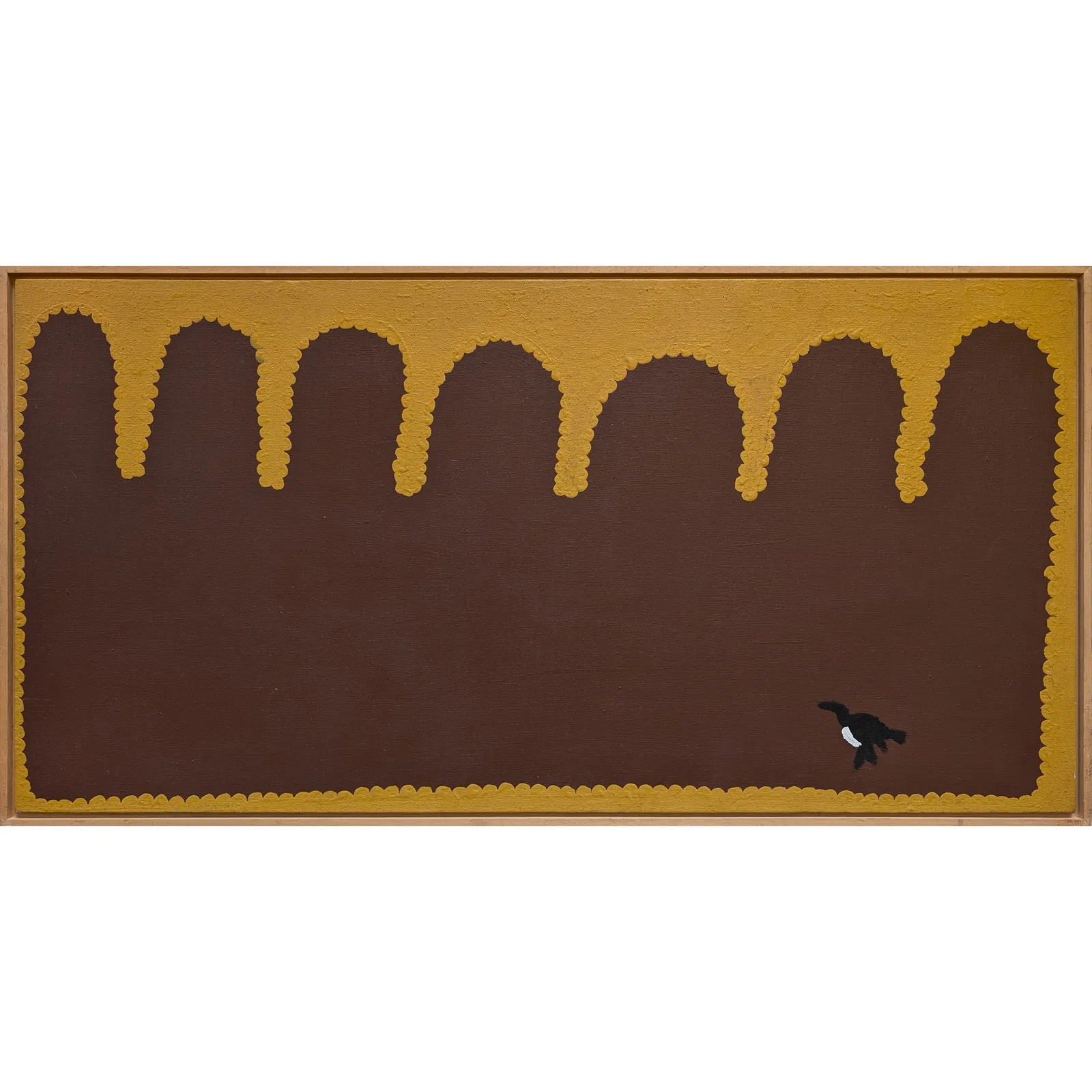
Untitled, c.2000
synthetic polymer paint on linen
50 x 101 cm
$2,500
Secure payment via Stripe. Prices in AUD.
- Provenance
- Watiyawarnu Arts, Mount Leibig, NT The David Bromley Chapel Street Studio Collection, Vic Leonard Joel, Prahran, Vic, 18 November 2012, Lot 494 Private Collection, NSW
- Artwork story
- The country Long Tom Tjapanangka painted was the country he walked as a young man, the ancient ranges around Ikuntji, or Haasts Bluff, some 230 kilometres west of Alice Springs, where tali, the sandhills, and puli, the rocky outcrops, define a landscape of immense ceremonial significance. Hetti Perkins, writing in Tradition Today for the Art Gallery of NSW in 2014, noted that his dense, clotted application of paint evokes a palpable sense of country, and that his tendency toward the figurative was anomalous within classic Western Desert painting — an idiosyncratic fusion that reflected the cultural hybridity of the Ikuntji community. That quality is present here. Against a deep red-brown ground, bold golden arched forms descend from the upper edge and border, their scalloped edges built up with layered impasto that gives the surface a physical weight. The palette is reduced to two tones, the whole composition held in a tension between landscape and abstraction. In the lower right, a single small bird, black and white, sits in the open field below the arching forms, a figurative detail of the kind Tjapanangka's contemporaries rarely allowed themselves. Tjapanangka was born around 1929 at Lupul in the Frederick Ranges and worked as a stockman and police tracker before coming to painting at Ikuntji Arts Centre in the early 1990s alongside his first wife Marlee Napurrula. He stated his intent was to paint for everyone rather than making works of implicit sacred significance.