 Click to enlarge
c.1932 – 2021
- Region
- Western Desert
- Community
- Kintore (Walungurru)
- Language group
- Pintupi
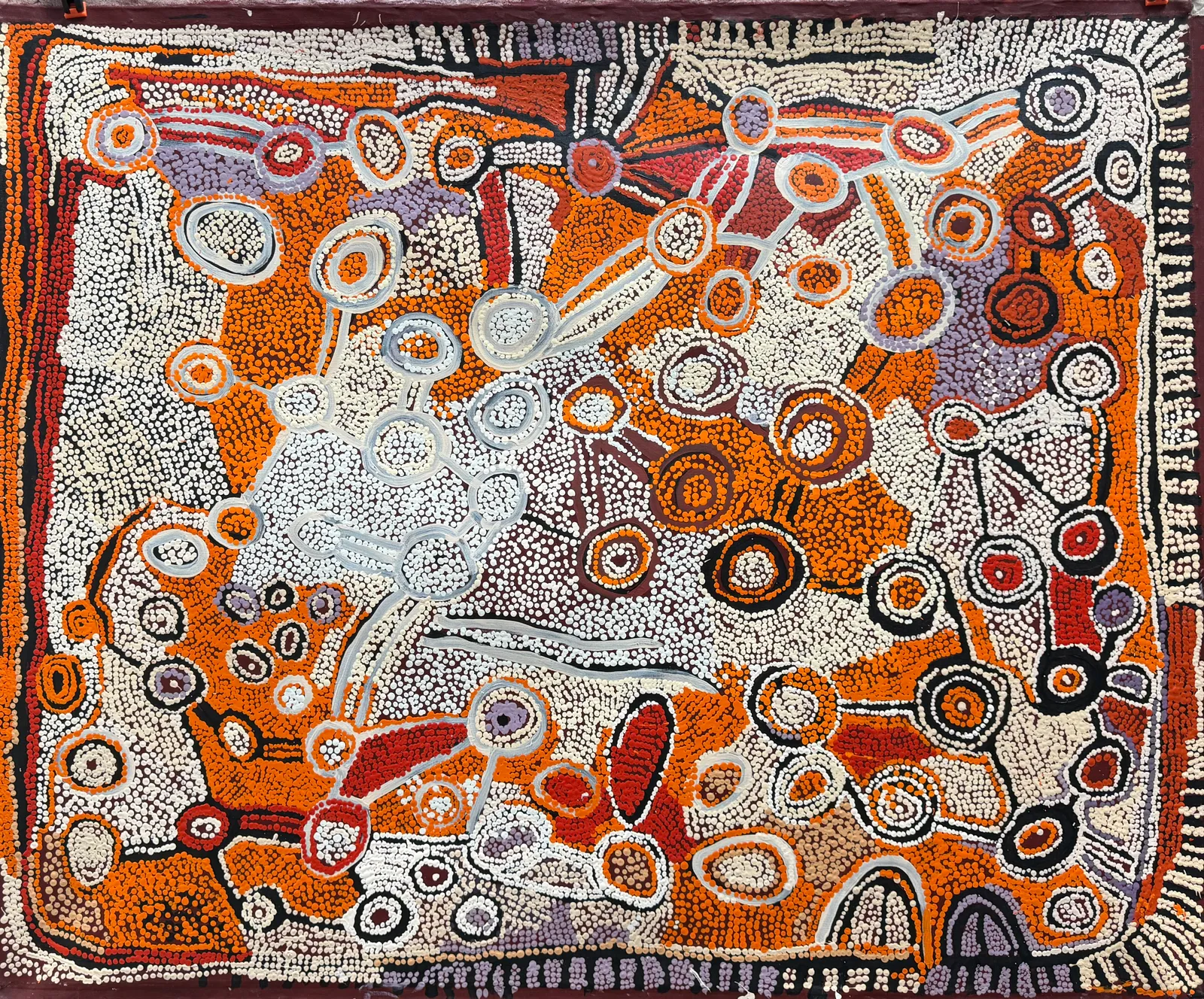
Marrapinti, 2010
synthetic polymer paint on linen
152 x 122 cm
Enquire for price
- Provenance
- Yanda Aboriginal Art, Alice Springs, NT, Cat No. NA201013 Red Desert Dreamings, Melbourne, Vic, Cat No. RDDNAA1103 Accompanied by a folio of 9 photographs of the artist creating the work.
- Artwork story
- Naata Nungurrayi was born at Kumilnga, west of the Pollock Hills in Western Australia, and was about thirty years old when she and her family were brought to Papunya by the welfare patrol in 1963. Though displaced from her desert homelands, the memory of these places — their topography, light, and ceremonial power — continued to inspire her life’s work. After time at Docker River, she settled at Kintore in the early 1980s and began painting for Papunya Tula Artists in 1996. Encouraged by arts coordinator Marina Strochi, Naata quickly developed a distinctive visual language that blended the geometric precision associated with the early Pintupi men’s style with the freer, more organic movement introduced by women’s painting camps of the 1990s. Initiated into Women’s Law, she held the authority to depict sacred sites and journeys connected to the Tingari women, whose ancestral travels shaped the landscape and taught the ways of survival across the desert. This painting depicts ancestral events connected to the important rockhole site of Marapinti, located west of Kiwirrkura. Presented from an aerial perspective, it represents Naata Nungurrayi’s homeland, translating the physical landscape into a vision that moves between observation and Dreaming. The natural forms of the terrain — rock escarpments, sand dunes, and vegetation — are reimagined as an ordered grid of colour and rhythm. Through this visual language, Naata conveys both the structure and the spirit of Country. For the Pintupi people, every feature of the land holds ancestral significance: each ridge, hollow and water source stands as a trace of the creation beings whose actions shaped the environment. These sites remain vital ceremonial places, connecting the present to the time of creation.