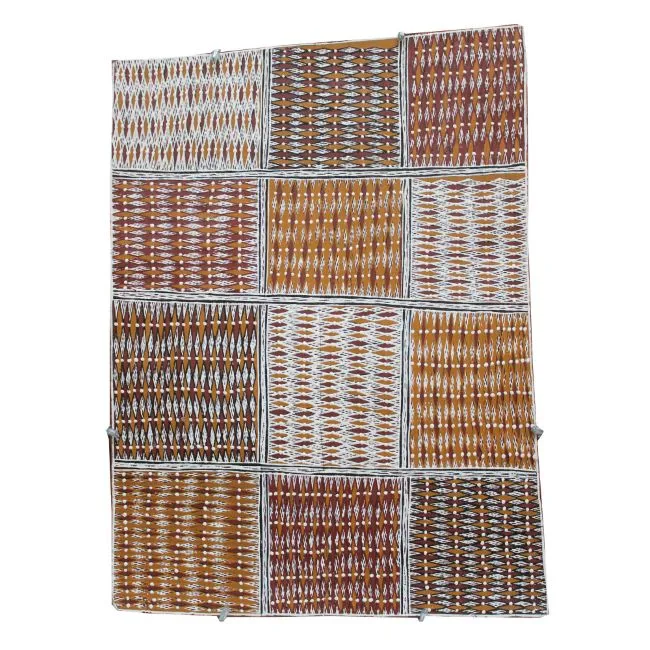
 Click to enlarge
b. 1971
- Region
- Arnhem Land
- Community
- Yirrkala
- Language group
- Yolŋu – Djapu
Gurtha
natural earth pigments on bark
32 x 42 cm
Enquire for price
- Provenance
- Buku-Larrnggay Mulka Centre, Yirrkala, NT, Cat No. 4486r
- Artwork story
- Not far along the shores of northern Blue Mud Bay, travelling south from Båniyala is an important ‘Fire’ site for the Madarrpa clan called Yathikpa. Madarrpa clan hunters Yikuwaŋa and Nurruguyamirri left the shores of Yathikpa in Yalwarr, the canoe constructed of paperbark, native bees wax, bush timbers and string. Djambawa has depicted the tree under which they sheltered preparing to go to sea. Their destination was Woodah Island, to see a brother in law. They were to collect from him hunting paraphernalia for fishing, principally fishing hooks of carved hard wood atiached to bush string lines. large shells for bailing unwanted water coming into the canoe and turtle shell for impending barter. Successful in this they paddled off from Woodah Island in search of good fishing grounds. However the hunters were met by a large storm that capsized the canoe. This is sometimes described as a huge wave caused by the giant ancestral turtle coming ashore to lay eggs. It seems possible that this is an ancient oral record of a tsunami. One of the men drowned and is depicted today up in the night sky as a rock cod (shape) in the Milky Way. The other was able to swim, both to and to become the rock Garramadji or another name Galkama. On climbing on top of the rock he saw the terns - gitgit - operating the surface of the water for fish. In seeing on the horizon the massive anvil shaped clouds Waŋupini building, he felt stronger and lucky to be alive. Today when Yolŋu hunt in these waters they venture out to Garramadji and sit on the rock to smoke and tell stories of the past, sing and pay respect to things past. In return for their homage the fisherman hope for slight seas and a good catch. Once off shore on seeing Dugong they pursued it to harpoon. In this area of saltwater was another sacred site of fire - a submerged rock surrounded by turbulent and dangerous water. It was here at Dhakalmayi that the Dugong took shelter to escape the hunters. The action of the flung harpoon towards the Dugong, hence the rock, enraged the powers that be, causing these dangerous waters to boil from sacred fires from underneath. The canoe capsized, both drowning and burning the Ancestral Hunters with their canoe and hunting paraphernalia. The harpoon, rope, paddles and canoe are sung at ceremony and manifestations of these objects are used as restricted secret sacred objects in ceremony today. Djunuŋguyaŋu the dugong are associated with this site, attracted by sandy sea beds that grow the sea grass called Gamaḏa that they graze. The crosshatched design in this painting is the sacred clan design for the Maḏarrpa representing saltwater and fire here and is a manifestation of the sacred waters and Gamaṯa waving like flames below the surface.