 Click to enlarge
c.1926 – 1998
- Region
- Western Desert
- Community
- Warmun (Turkey Creek)
- Language group
- Wangkajunga; Kukatja
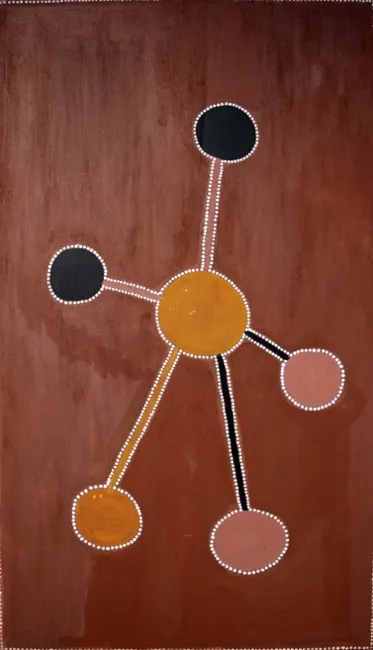
Untitled, 1994
natural earth pigments on canvas
91 x 164 cm
Sold
- Provenance
- This painting was commissioned directly with Warmun Community Corporation through the administrator David Rock. The originial certificate was lost in Chicago, where the painting was on show in the exhibition, ENCOMPASS. Photos of the painting in situ and a copy of the ENCOMPASS brochure are included.
- Exhibited
- Chicago Exhibition centre
- Artwork story
- This painting depicts Warmun at the center and surrounding communities and tracks leading to Warmun. Acclaimed as a cultural leader and the seminal figure in establishing the East Kimberley School, Rover Thomas is, according to almost every empirical measure, the most influential Aboriginal artist in the history of this movement. Yet, had he become an artist in his Walmatjarri-Kukaja traditional country, near Well 33 on the Canning Stock Route, his art would have doubtlessly developed along completely different lines, assuming he’d had the opportunity to paint at all. So remote was his birthplace that, had he not spent a lifetime of travel and finally settled in Gija tribal country at Turkey Creek, hundreds of kilometers to the north, he would most likely have been drawn to the Warlayiriti artist’s cooperative at Balgo Hills when it was established in mid 1987. The Kukaja artists of Balgo Hills have much closer aesthetic ties to the Pintupi painters of Kintore and Kiwirrkurra in their use of representational symbols, such as circles, u-shapes and dotting drawn from low relief ceremonial ground sculpture than the Gija, whose primary influence is rock art and ceremonial body painting designs. had he become an artist in his country, on the Canning Stock Route, it would have developed along completely different lines