 Click to enlarge
1934 – 2003
- Region
- Tiwi Islands
- Community
- Milikapiti
- Language group
- Tiwi
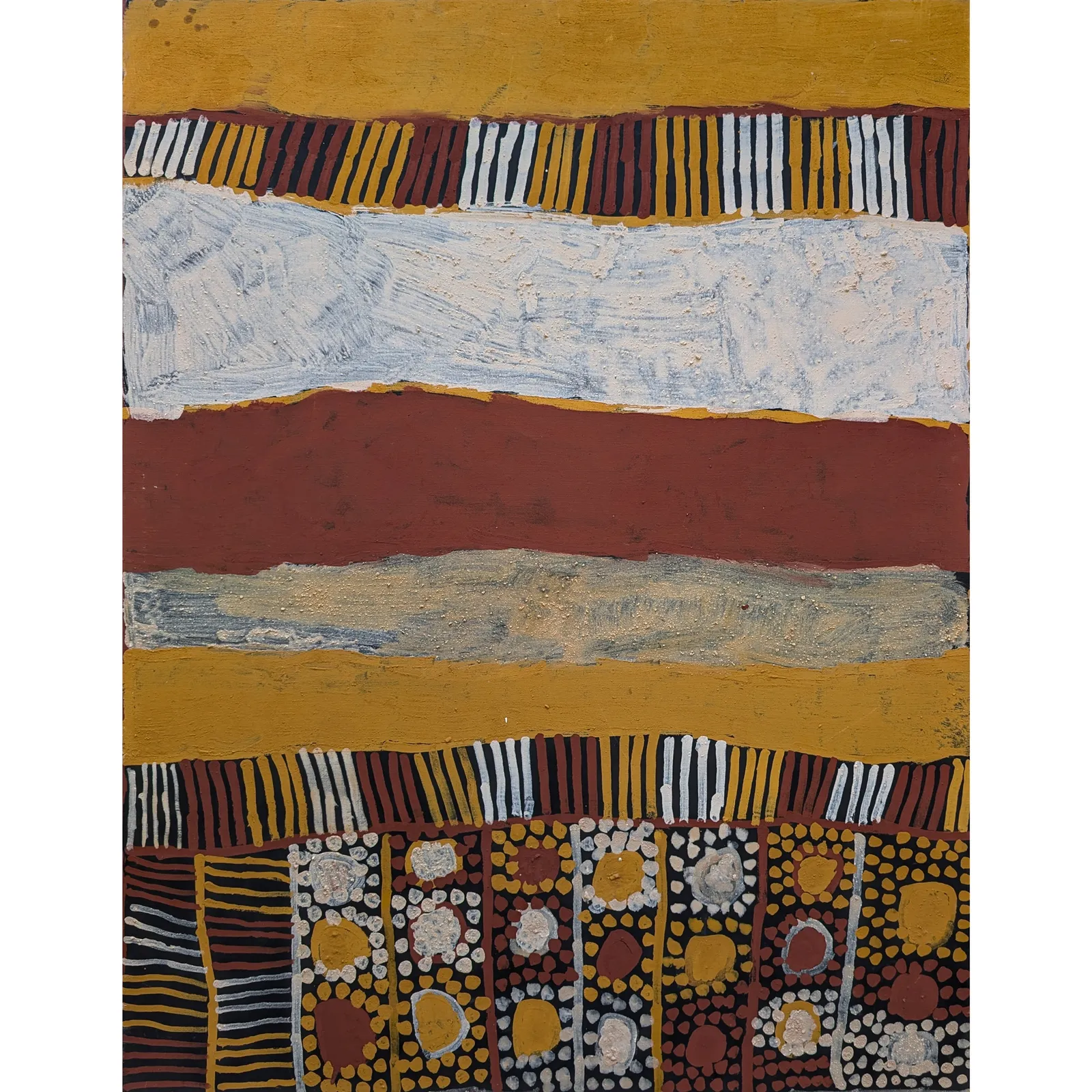
Untitled, 1999
natural earth pigments on canvas
119.5 x 84.5 cm
Sold
- Provenance
- Sotheby's, Aboriginal Art, Melbourne, Vic, 25 July 2005, Lot 201 The Jacquie McPhee Collection, WA
- Artwork story
- Tiwi ceremony begins on the body. The designs applied during Pukumani, the mourning rites that are the central ceremonial practice in Tiwi life, are painted directly onto skin: mulypinyini, the line, and pwanga, the dot, laid down in ochre by artists whose knowledge comes from a lifetime of participation. For Taracarijimo Freda Warlapinni, that knowledge was also inherited. Her father painted ceremonial Pukumani poles, and it was through watching him work those forms across carved ironwood that her visual language was first shaped. Warlapinni was born around 1928 on Mirrikawuyanga Country on Melville Island and was among the children taken from their families and raised by Catholic missionaries on Bathurst Island. She returned to Milikapiti around 1970, following her husband Alvin John Burunjamidi, and it was there that she raised her four children and, in 1996, began painting on canvas and paper through Jilamara Arts and Crafts. This canvas, made three years into that practice, shows a painter already in command of her register. The upper field is organised on a dark ground: rows of pwanga in white and ochre surround ovoid forms in deep red and gold, divided by vertical lines into rhythmic compartments that carry the patterning of Pukumani poles directly into two dimensions. Below, the composition opens into broad horizontal bands of raw ochre, grey-blue and deep red, punctuated by dense registers of vertical striping. What appears spontaneous was, in Warlapinni's own practice, built through slow and deliberate strokes. The velocity is in the eye, not the hand.