Stockroom465 of 581
 Click to enlarge
- Region
- Central Desert & Tanami
- Community
- Yuendumu
- Language group
- Warlpiri
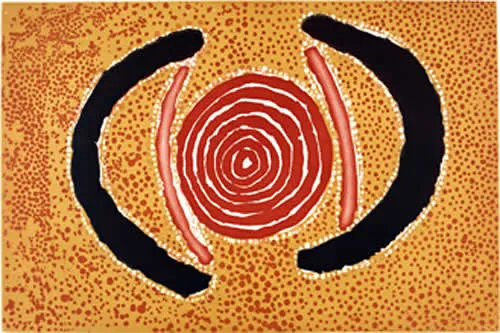
Ngarlu Jukurrpa - Love Story Dreaming, 2003
etching: sugar lift painting aquatint on two plates
$550
Secure payment via Stripe. Prices in AUD.
- Edition size
- 99
- Printer
- Basil Hall and Natasha Rowell
- Studio
- Basil Hall Editions, Darwin NT
- Paper
- Hahnemuhle 350gsm
- Paper size
- 76 x 56 cm
- Image size
- 32.5 x 49 cm
- AAPN
- SM042
- Production notes
- Plates created at Warlukurangu Artists, Yuendumu NT, May 2002.
- Exhibited
- Yilpinji: Love Art and Ceremony, Australian Museum, Sydney; toured nationally and internationally (Australia, United States and Europe), 2002–2003. Curated by Dr Christine Nicholls; coordinated by Adrian Newstead for the Australian Art Print Network.
- Artwork story
- Ngarlu is country belonging to the Anmatjerre language group south-east of Yuendumu. The Jukurrpa of this place tells of a Jungarrayi man, named Lilipinti, who is travelling west to another country for Kuridji, men’s ceremonial business. As the Jungarrayi men travelled he saw a Napngardi woman, his mother-in-law according to the Warlpiri kin system and therefore forbidden to him as a wife or sexual partner. Linjipirlingirnti watched the woman from where he sat whilst she was urinating. He was so impressed with what he saw that he decided to woo her. His imprint has been left in the rocks, which reminds the people of his thinking. He had weapons and a parraja (coolamon or wooden water carrier). Lilipinti fell in love with this woman. When he arrived back home to Ngarlu he couldn¹t stop thinking about her. A Jurlpu (bird) carried his loves songs over to the Napangardi. The Jurlpu (bird) flew back with the Napangardi on his wings, to join with the Jungarrayi at Ngarlu. The people of Ngarlu gossiped about this wrong-skin love union. These people turned into Miinypa, native fuschia flowers, which are prevalent at Ngarlu today. When Lilipinti and his Napangardi made love, his penis broke off in side of her and they both turned to stone. They are seen in the rocks at Ngarlu, a long water hole with a broken boulder reminds the people of this union. Wapunungku, a big tree was crying. That tree is still there today. The kirda (owners) for this Jukurrpa are Japaljarri and Jungarrayi men and Napaljarri and Nungarrayi women.