Catalogues250 of 257
 Click to enlarge
Sale 3 · Lot 102
- Region
- Western Desert
- Community
- Kintore (Walungurru)
- Language group
- Pintupi
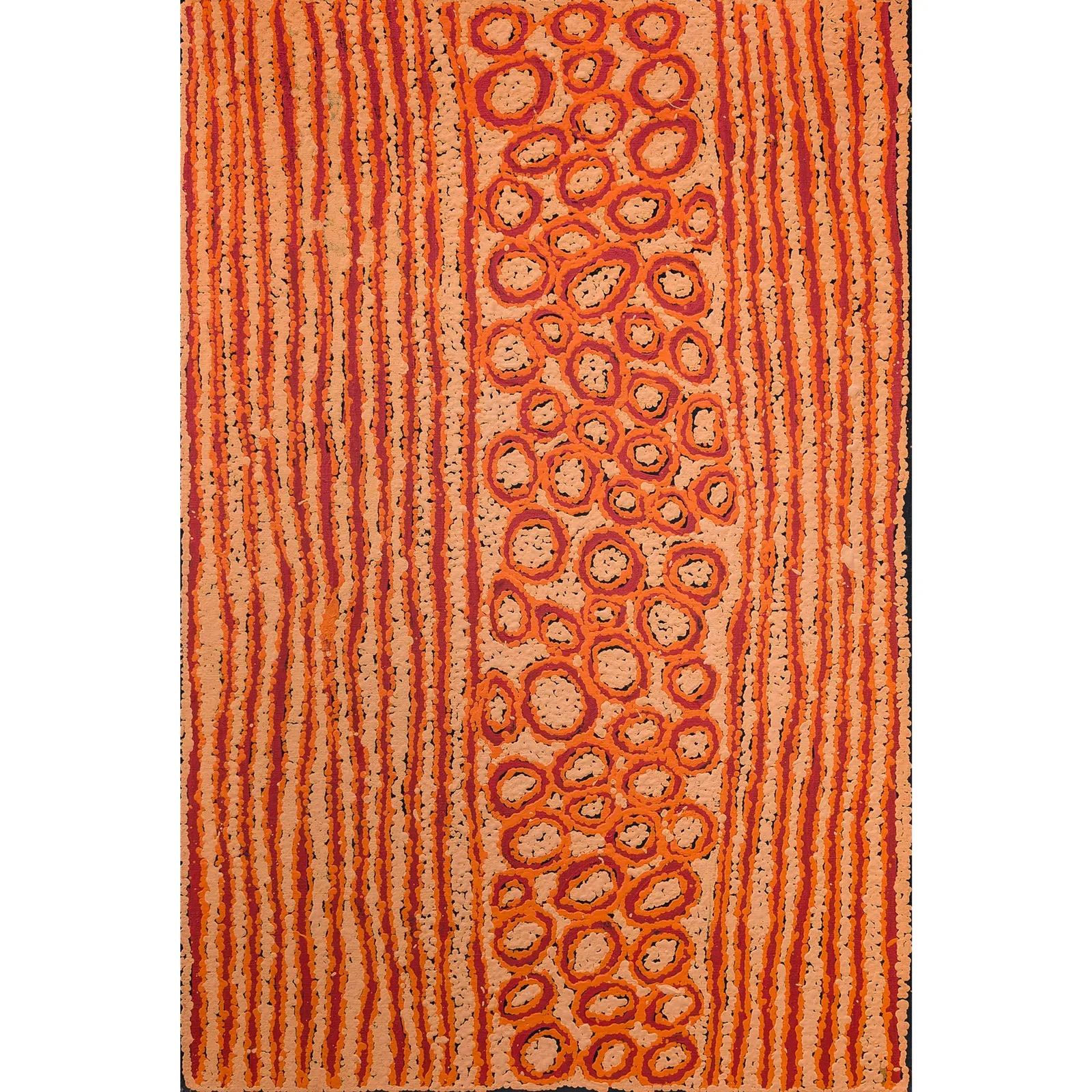
Travels of Katungka Napanangka, 2002
synthetic polymer paint on linen
91 x 61 cm
Est. $2,000 – $3,000
Hammer $2,000
- Provenance
- Papunya Tula Artists Pty Ltd, Alice Springs, NT, Cat No. WN0203017 Private Collection, NSW
- Artwork story
- Walangkura Napanangka was born in 1946 at Tjitururrnga, west of Kintore, the daughter of Rartji Tjapangati, a senior custodian of the country west of Karrkurutinjya (Lake MacDonald), and Inyuwa Nampitjinpa. As a teenager she joined Uta Uta Tjangala's group on the long walk east, arriving at Haasts Bluff in December 1956. When the outstation movement brought her community back to Kintore in 1981, she began painting in 1994 through the Haasts Bluff/Kintore Women's Painting Camp, established by the senior women to acknowledge their own ancestral and spiritual heritage. By 1996 she was working full-time with Papunya Tula Artists at Kintore, working alongside her husband, the painter Johnny Yungut Tjupurrula. Kutungka Napanangka travelled eastwards through the Gibson Desert during the creation time, across sandhill country, through rockholes and underground caves to the west of Kintore, gathering, camping, and marking the landscape with the evidence of her presence. It was a subject Walangkura returned to across her practice, mapping the ancestral path in paint so that the knowledge it embodies endures. Vertical parallel lines in warm red-brown and terracotta sweep the full height of the canvas on either side, describing the sandhills through which Kutungka travelled. At the centre, a vertical band of dense oval and circular forms in deep burgundy on a warm ochre ground records the seeds, berries, or campsites associated with the journey, the material evidence of women's ceremony held in the landscape and now held in paint. The surface carries a fine sandy texture throughout, the ochre ground pressing through the paint layer to give the work the quality of pigment on Country itself. Her work is held in the collections of the National Gallery of Australia, the Art Gallery of New South Wales, the Museum, and Art Gallery of the Northern Territory.