Catalogues255 of 257
 Click to enlarge
Sale 3 · Lot 107
Terry Dhurritjini Yumbulul
b. 1950
- Region
- Arnhem Land
- Community
- Galiwin'ku (Elcho Island)
- Language group
- Djangu – Warramirri clan
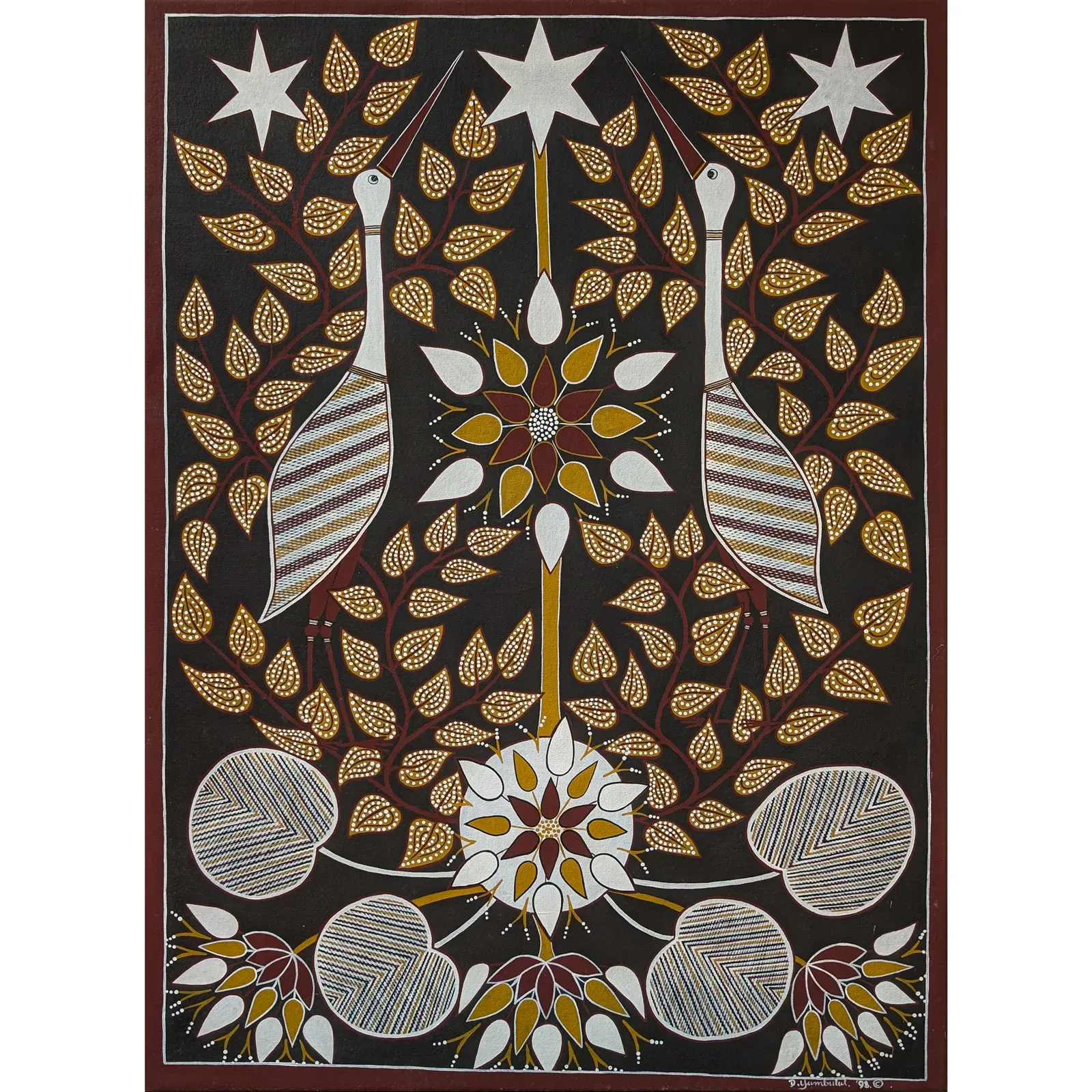
Star in the Billabong, 1998
synthetic polymer paint on canvas
110 x 81 cm
Est. $1,500 – $2,500
Hammer $1,200
- Provenance
- Elcho Island Arts, Galiwinku, Elcho Island, NT, Cat No. C/0160 Private Collection, NSW, acquired from the above
- Artwork story
- The story behind Star in the Billabong is recorded in Yumbulul's own hand. Long before people inhabited the land, a small star gazed down and saw its own reflection shimmering in a newly formed billabong. It drew closer and asked the creator for permission to descend. The creator warned there could be no return. The star accepted, came down into the cool water, and was transformed forever into a waterlily. From that billabong, Yumbulul wrote, “all life began, the water flowed, the plants grew and so life began and continued on forever.” The painting gives that story its full ceremonial weight. Against a deep black ground, two brolgas face each other across a central vertical axis, their wings patterned in Warramiri crosshatching, their long necks arching inward toward a flowering waterlily that rises through two great mandala-like blooms in white, ochre, and deep red. Three six-pointed stars blaze across the upper register. The surrounding canopy of gold leaf-forms fills every quadrant with tapestry-like density, the bilateral symmetry giving the composition the quality of sacred architecture. Yumbulul received that inheritance directly from his father, David Burrumarra, Warramiri clan chief and MBE recipient, who had been the first Aboriginal teaching assistant at Yirrkala Mission and at seventy-five committed Warramiri history to writing. He held his first solo exhibition in Sydney in 1983 and by 1993 was showing at Mall Gallery in London — a measure of the international recognition his Warramiri designs had earned, and of the seriousness with which the art world received a tradition he was uniquely placed to carry.