Catalogues174 of 257
 Click to enlarge
Sale 3 · Lot 26
b. c.1937
- Region
- Kimberley
- Community
- Kalumburu
- Language group
- Tjarintji; Wunambal (Woonambal)
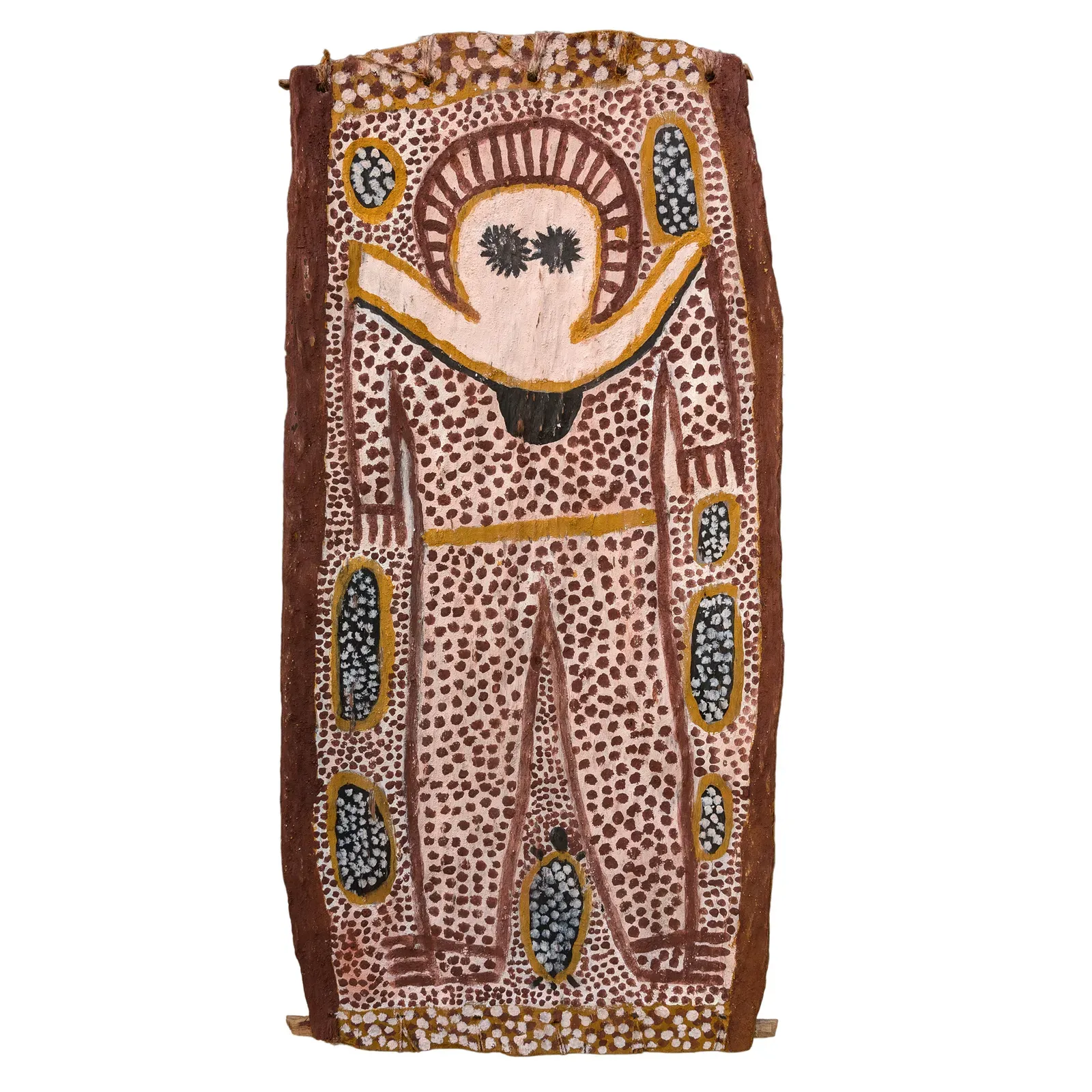
Wandjina (Rain Spirit), 2002
natural earth pigments on bark
80 x 39 cm
Est. $3,000 – $5,000
Hammer $3,000
- Provenance
- Narrangunny Art Traders, WA, Cat No. N-2135-LK Private Collection, WA
- Artwork story
- The Wandjina carry no mouths. This is not an accident of style but a matter of consequence: were the mouth left open, rain would fall without end, washing everything away. The face holds instead large dark eyes, a halo of radiating lines that are the lightning preceding the storm, a concentrated power held deliberately in check. This single figure, rendered in earth pigments on bark, stands frontally as Wandjina figures always do: shoulders slightly raised, the body covered in fine dotting that represents rain, ovoid forms of associated totemic species ranged at either side. Lily Karadada was born around 1921 near the Prince Regent River, in her father's country Woombangowangoorr. Her father named her Mindindil, meaning "bubbles," after the freshwater spring beside which she was born. She is Wunambal, and it is Wunambal country — the caves and rock galleries of the north-west Kimberley — where the Wandjina completed their creative acts in the Dreaming, lay down, and left their life-giving essence in the paintings. The responsibility for maintaining and renewing those images passed to the clans whose country they inhabit. For the Karadada family, that responsibility has been carried across generations, and Lily and her husband Jack were among those who brought it into the contemporary art world when, under the guidance of Mary Macha, Kimberley art first reached the Perth market in the 1970s. The Benedictine mission at Kalumburu had displaced Lily's people from their traditional lands and forbidden the ceremonial re-touching of rock images that sustained the tradition. That it survived at all is a measure of the Karadada family's determination. Lily was awarded the Australian Centenary Medal for her contribution to art in 2003. Her daughter Angelina continues the tradition at Kira Kiro Artists in Kalumburu today.