Catalogues181 of 257
 Click to enlarge
Sale 3 · Lot 33
Walangkura Napanangka I (Uta Uta’s Wife)
b. c.1946
- Region
- Western Desert
- Community
- Kintore (Walungurru)
- Language group
- Pintupi
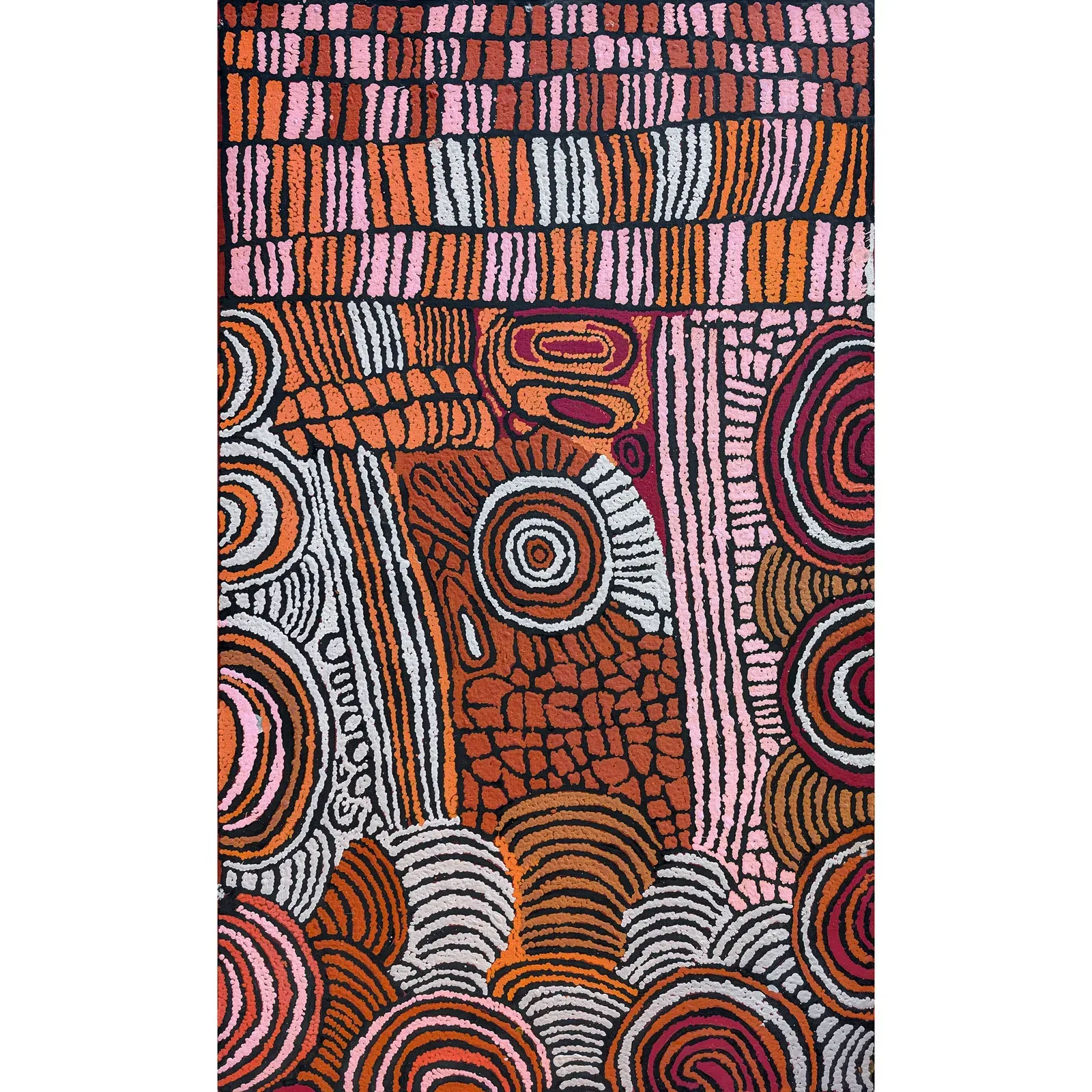
Untitled, 2004
synthetic polymer paint on Belgian linen
153 x 91 cm
Est. $5,000 – $7,000
Hammer $4,600
- Provenance
- Papunya Tula Artists Pty Ltd, Alice Springs, NT, Cat No. WN0409158 Alcaston Gallery, Fitzroy, Vic, Cat No. AK11703 Private Collection, NSW, acquired from the above Accompanied by certificates of authenticity from Papunya Tula Artists and Alcaston Gallery, and two photographs of the artist with the work
- Exhibited
- Papunya Tula Artists Group Show, Alcaston Gallery, Melbourne, Vic, 8 – 30 April 2005
- Artwork story
- Napanangka was born beside a rockhole near the site where the Tjukurla community was later established. As a young person she travelled with her family between Pumkilpirri near Docker River and Walukirritji rockhole on the south-western side of Lake MacDonald, until her family was met by a welfare patrol that included Nosepeg Tjupurrula and invited to travel in to the Haasts Bluff settlement. She later moved to Papunya to live with her husband Uta Uta Tjangala, one of the original shareholders of Papunya Tula Artists, first painting for the company in 1997 and beginning to paint regularly from 2002. The Papunya Tula documentation records that this painting depicts designs associated with a lake site near the Tjukurla community: concentric roundels describing the waterholes, arced lines rendering the surrounding hills, and dense straight linework evoking the tali, the sandhills of that Country. A group of women travelled to this site, made hair-string skirts for ceremony, and gathered mungilypa (samphire seeds, Tecticornia verrucosa), kampurarrpa (desert raisin, Solanum centrale), and maku (witchetty grubs) from the roots of Acacia kempeana. The seeds and berries were used to make damper. The surface rewards close attention: Napanangka moves fluently between the tightly hatched registers of the left panel and the more expansive field of the right, anchoring the composition with boldly rendered roundels in deep burgundy and ochre.