Catalogues188 of 257
 Click to enlarge
Sale 3 · Lot 40
c.1916 – 1981
- Region
- Arnhem Land
- Community
- Djarrakpi
- Language group
- Yolŋu (Yolngu) – Maŋgalili (Manggalili)
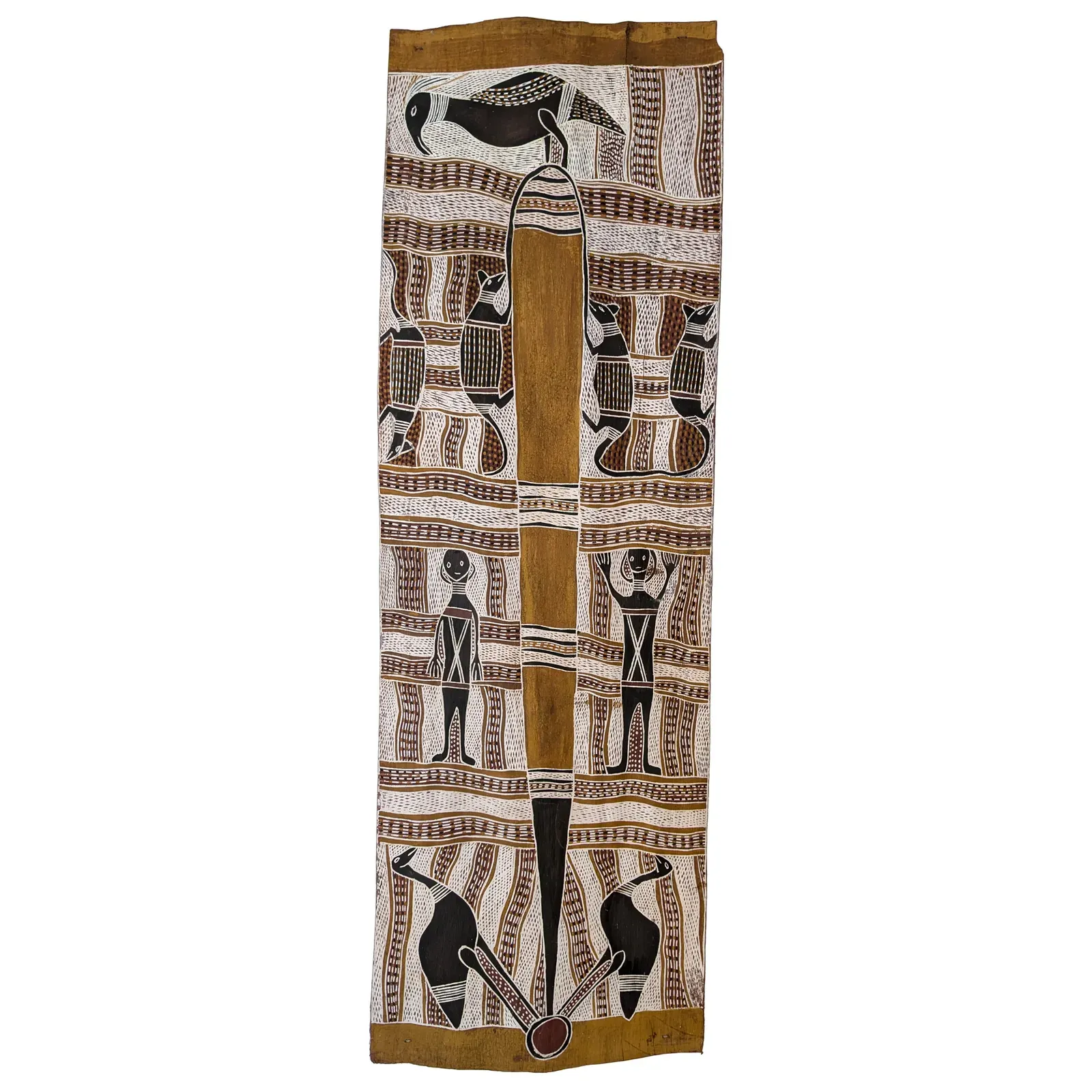
The Journey of the Possum and Guwak to Djarrakpi, 1979
natural earth pigments on bark
136 x 44 cm
Est. $5,000 – $8,000
Hammer $4,400
- Provenance
- Acquired from Yirrkala Art: An Exhibition of Aboriginal Bark Paintings and Carvings, presented and arranged by the Department of Prehistory and Anthropology, Australian National University, Canberra, ACT, curated by Howard Morphy, 1979, Cat No. 5 Private Collection, ACT
- Exhibited
- Yirrkala Art: An Exhibition of Aboriginal Bark Paintings and Carvings, Department of Prehistory and Anthropology, Australian National University, Canberra, ACT, curated by Howard Morphy, 1979, Cat No. 5
- Artwork story
- Djarrakpi, on the northeast Arnhem Land coast, is the sacred homeland of the Manggalili clan and the site of the Marawili tree, around which their ancestral law is centred. It was Narritjin Maymuru's country. Howard Morphy writes in Tradition Today (Art Gallery of NSW, 2014) that he was an artist with a passion for making things, a great intellectual and ceremonial leader, and within his community a mediator who brought disputants together, working late into the night while his family slept, bent double over a sheet of bark, painting by the light of an unshaded bulb. The Guwak, the koel cuckoo, travelled with Marrngu the possum to create the lagoon and sandhills of that country. The Marawili tree at Djarrakpi is the subject Narritjin returned to throughout his practice, and this bark, painted at the Australian National University in 1979 during a Creative Arts Fellowship he held jointly with his son Banapana, is a direct rendering of that narrative. Possums climb the tree spinning fur string. Nyirrk, the white cockatoo, sits at its crown. The emus scratch for water among the sandhills while the female Mokuy spirits, the Nyapilingu, look on. Narritjin used a brush of human hair, a marwat, to cover the entire surface of his barks in the geometric clan designs of the Manggalili. Down the length of this tall narrow bark, the Marawili tree occupies the central axis as a warm amber-gold form, the surrounding field resolved into horizontal bands of white and deep red-brown in which figures of bird, possum, human, and emu are distributed with ceremonial precision. The subdivisions, as Judith Ryan observed in Spirit in Land (National Gallery of Vic, 1990), meander in harmony with the clan designs rather than introducing harsh vertical and horizontal accents. The whole composition is anchored at the base by a small roundel pressed into Country.