Catalogues209 of 257
 Click to enlarge
Sale 3 · Lot 61
c.1938 – 1992
- Region
- Western Desert
- Community
- Papunya
- Language group
- Ngaatjatjarra; Pintupi
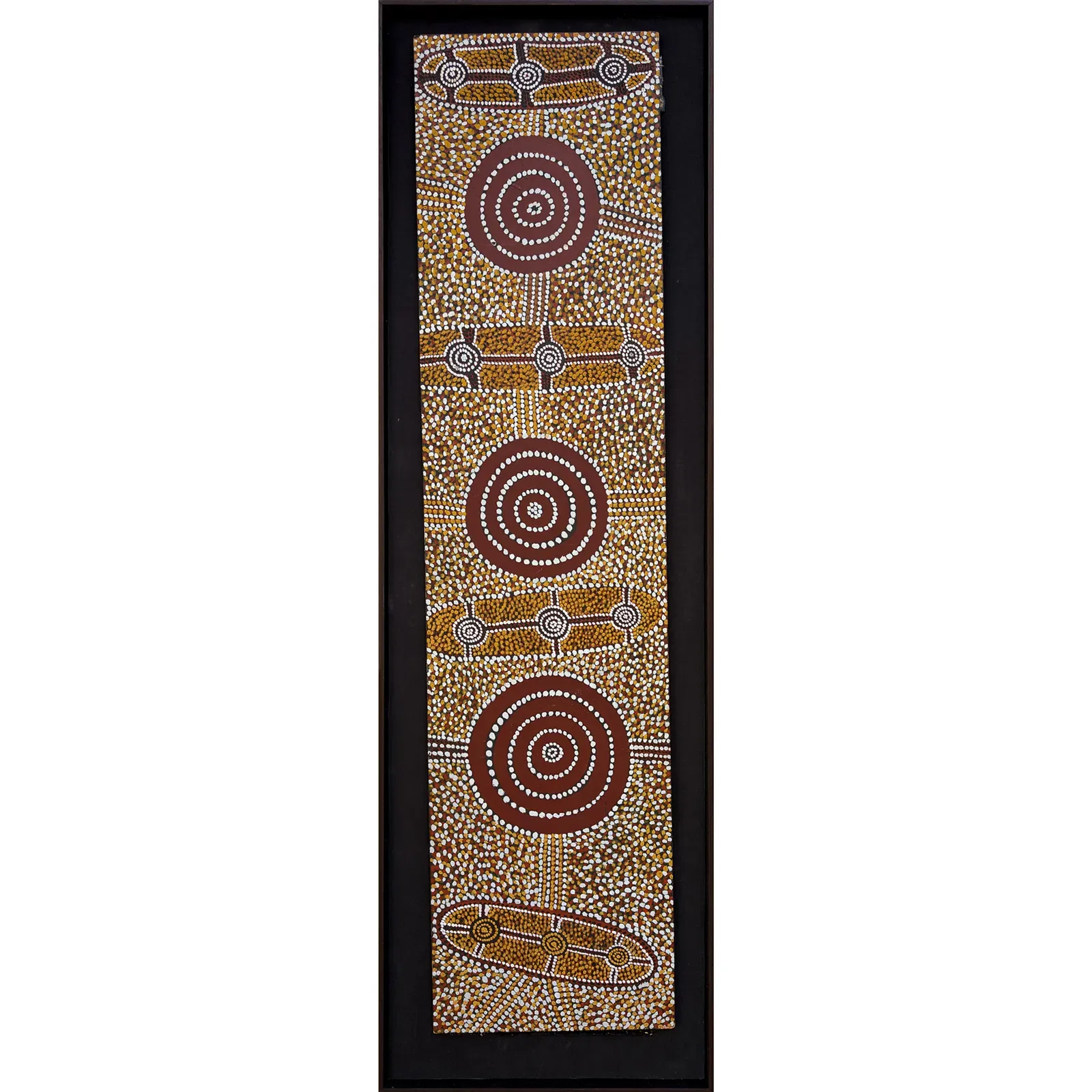
Origins of Soakages, 1973
synthetic polymer paint on composition board
92 x 22.5 cm
Est. $30,000 – $40,000
- Provenance
- Papunya Tula Artists Pty Ltd, Alice Springs, NT, Cat No. A730808 Private Collection, Vic Sotheby's, Fine Australian Aboriginal and International Paintings, Melbourne, Vic, 22 – 23 November 1999, Lot 478 Private Collection, Vic Sotheby's, Aboriginal Art, Melbourne, Vic, 26 July 2004, Lot 410 Private Collection, WA Thence by descent The Jory Family Collection, Qld Private Collection, Vic Accompanied by original Papunya Tula Artists Pty Ltd documentation card with hand-drawn annotated diagram
- Artwork story
- The Papunya Tula Artists documentation card adhered to the verso of this board records the artist as its custodian, and carries the following inscription in Bardon's hand: "The sandhills are shown small, the soak large. This reflects their importance to the Pintupi economy. The story tells of how the soaks came about. It is a man's story; the bullroarers warn women away." A diagram alongside identifies the elements: soakages from the Kintore Ranges at centre, sandhills flanking them, and the bullroarers — the oval forms with radiating lines — positioned at intervals along the vertical axis. The card is both documentation and object, a record of knowledge transferred directly from custodian to page in the earliest years of the movement. The compositional logic follows from the inscription precisely. Three large concentric circle soakages dominate the narrow vertical field, their deep red-brown rings expanding outward through a warm ochre ground worked throughout in dense dotting. The sandhills are rendered small as promised. The bullroarers, present and legible once the diagram is read, warn of ceremony. This board was painted in 1973 during the transitional period at Papunya when artists were producing larger, exhibition-format works on composition board. In Papunya: A Place Made after the Story: The Beginnings of the Western Desert Painting Movement (Miegunyah Press, 2004), Geoff Bardon observed that Anatjari worked with fine sable brushes to achieve crystalline precision in his paintings, noting that his compositions drew directly from the traditions of sand painting and body decoration [p. 73]. In the same volume, American anthropologist Professor Emeritus Fred Myers, who conducted extensive field work with Anatjari at Yayayi from 1973 to 1975, described his exploration of form as virtuosic [p. 74]. Anatjari was among the last Pintupi to leave his traditional country near Kulkurta, arriving at Papunya in 1966 after a Weapons Research Establishment patrol encountered his family in the desert. One of the original 1971 group of painters, he went on to become the first Western Desert artist acquired by the Metropolitan Museum of Art in New York.