Catalogues232 of 257
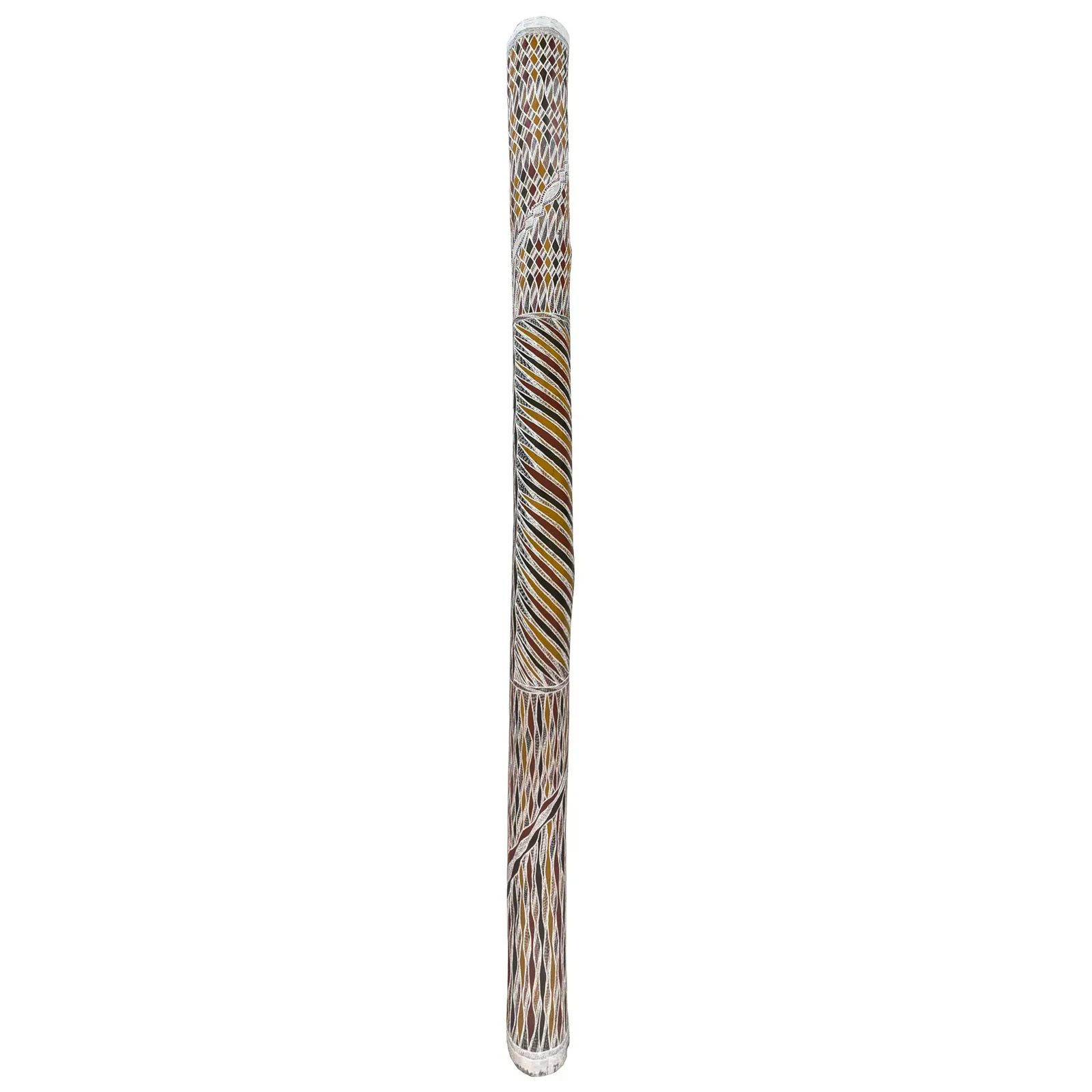 Click to enlarge
Sale 3 · Lot 84
Gunybi Ganambarr
b. 1973
- Region
- Arnhem Land
- Community
- Gäṉgaṉ
- Language group
- Yolŋu (Yolngu) – Ŋaymil (Ngaymil) clan
Baraltja, 2007
natural earth pigments on hollow log
303 cm
Est. $6,000 – $9,000
Hammer $5,000
- Provenance
- Buku-Larrŋgay Mulka, Yirrkala, NT, Cat No. 3213T Annandale Galleries, Sydney, NSW, Cat No. BLA443 Private Collection, NSW, acquired from the above Accompanied by certificates of authenticity from Buku-Larrŋgay Mulka, Yirrkala, and Annandale Galleries, Sydney
- Exhibited
- Wanyubi Marika & Young Guns II: bark paintings & ceremonial poles, Annandale Galleries, Sydney, NSW, 16 April – 10 May 2008
- Artwork story
- At the onset of the wet season, the Ancestral Lightning Snake Mundukul stands on its tail at the waterhole of Baraltja and spits lightning into the sky to herald the new season. The Buku-Larrŋgay Mulka documentation records this precisely: Mundukul tastes the freshwater flowing in from Gängan, the artist's homeland, and communiCates through its lightning with related serpents belonging to Yirritja clans to the north and south of Blue Mud Bay, their messages carried through the deep ocean. During the dry season, when the brackish mix of creek and tidal surge contaminates the waterhole, Mundukul lays down and its ribs form a fish trap at either end — a mythological account that mirrors exactly how the Dhalwaŋu fish these holes. Mundukul writhes the full 303 centimetres of this pole from either end, its path rendered in fine rärrk crosshatching in white, red and yellow ochre. Diamond forms move up the shaft from the freshwater of Gängan, shifting into thin ellipses where salt meets fresh — a formal translation of the story's central motif, the meeting of waters as a symbol of fertility. The pole takes its name from the flood plain that drains into Blue Mud Bay near the Dhalwaŋu saltwater site of Garraparra; this part of Dhalwaŋu lore is shared with the Madarrpa, their Märi clan, making Baraltja an object of inter-clan ceremonial significance as much as individual artistic expression. Ganambarr would go on to win the Telstra National Aboriginal and Torres Strait Islander Art Award in 2018 and enter the collections of the Metropolitan Museum of Art, New York. Exhibited at Annandale Galleries in 2008 as part of Young Guns II, this pole stands among the earliest major larrakitj of that trajectory.