Catalogues247 of 257
 Click to enlarge
Sale 3 · Lot 99
c.1927 – 1999
- Region
- Arnhem Land
- Community
- Yathalamarra
- Language group
- Yolŋu – Manharrngu
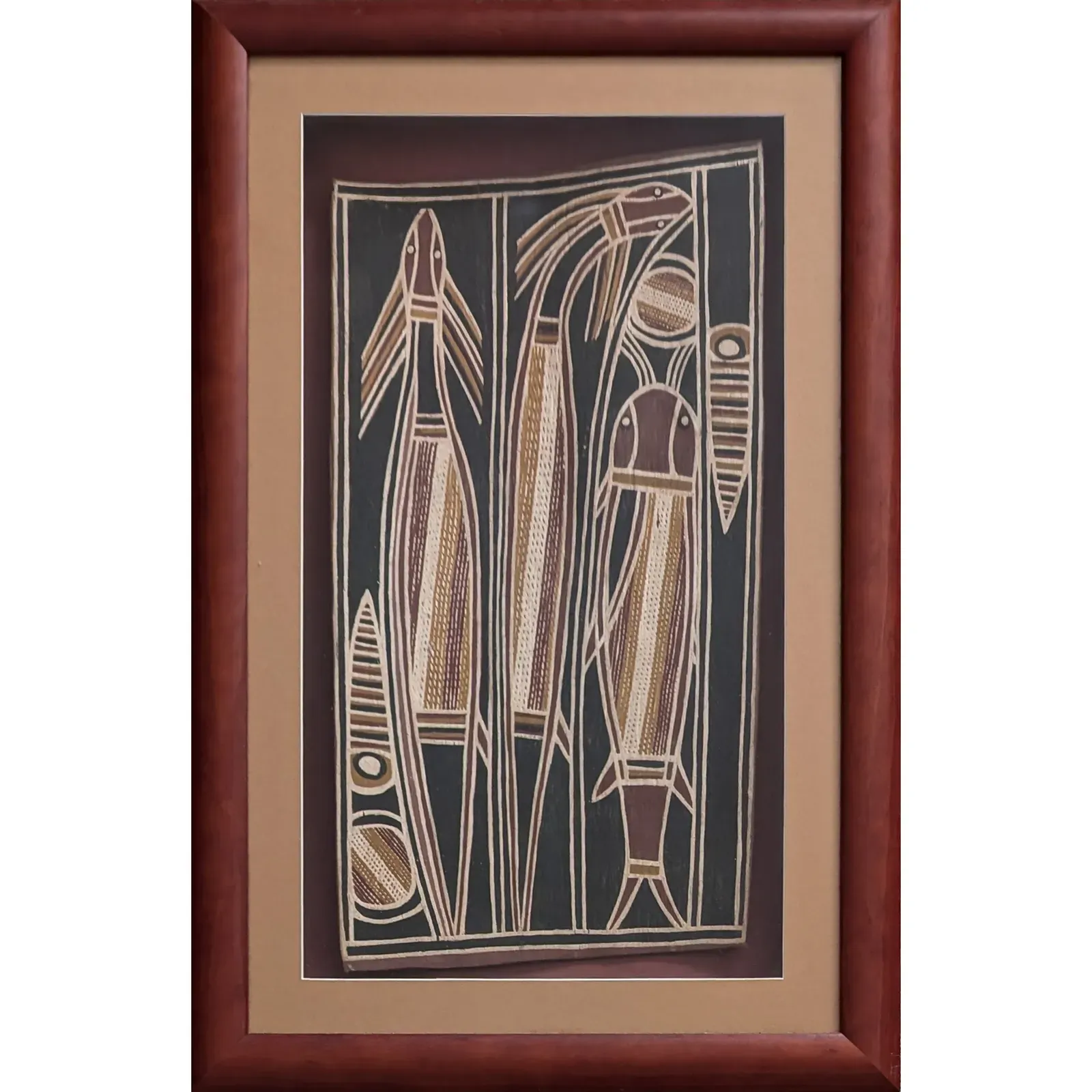
Creatures of the Arafura Swamplands, c.1990
natural earth pigments on bark
56 x 30 cm; 77 x 50 cm (framed)
Est. $1,000 – $2,000
Hammer $2,200
- Provenance
- Bula Bula Arts, Ramingining, NT, Cat No. obscured by frame Private Collection, NSW
- Artwork story
- In 1963 the Paris-based collector Karel Kupka brought a Malangi painting to the Musée national des Arts d'Afrique et d'Océanie. A representative of the Reserve Bank of Australia, visiting the collection, was so struck by the work that he requested permission to photograph it. When Australia converted to decimal currency in 1966, that image — Malangi's depiction of the funeral of Gurrmirringu — became the central motif of the one dollar note, without the artist's knowledge or consent. The dispute that followed became one of the first formal acknowledgments of Aboriginal intellectual property rights in Australia. Over four decades of practice, Malangi went on to become one of the most significant bark painters to emerge from central Arnhem Land, representing Australia at the São Paulo Art Biennial in 1983 and contributing ten hollow log coffins to the Aboriginal Memorial at the National Gallery of Australia in 1988. In 1996 he was awarded an honorary doctorate from the Australian National University. The aquatic subjects of his Manharrngu country — the rivers, billabongs and tidal waters of the Glyde River estate — run throughout his practice alongside the Gurrmirringu mortuary narrative. This small bark belongs to that body of work. Against a near-black ground, two large elongated creatures dominate the composition, their bodies filled with fine diagonal hatching in ochre, cream, and red-brown, vertical white lines dividing the ground into channels of water. One rises straight, the other curves at the neck. To their right a Catfish, rendered with the same precise economy, completes the grouping. Shell forms anchor the lower corners.