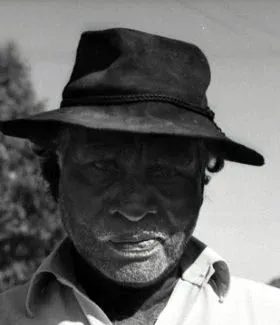
Freddie Timms
AAMI artist1946 – 2017
- Region
- Kimberley
- Community
- Warmun (Turkey Creek)
- Language
- Gija (Kija, Gidja, Kitja)
Region: Kimberley · Community: Warmun (Turkey Creek) · Language: Gija (Kija, Gidja, Kitja)
Freddie Timms began painting in 1986, inspired by the elder artists already painting at Frog Hollow, a small outstation attached to the community at Warmun, Turkey Creek. He was by then, forty-two years old and had lived an eventful life as a young stockman on stations throughout the East Kimberley region. Freddy was born at Police Hole in 1946 and followed in his father’s footsteps, becoming a stockman at Lissadell Station. At the age of twenty, he set out to explore and work on other stations. It was during this time that he met and worked alongside Rover Thomas who was to have a lasting influence on him. In 1985, he left Lissadell, to which he had returned after retiring from the physically demanding stockman’s life. He settled at the new community established at Warmun, where he worked as a gardener at the Argyle Mine. He eventually moved out to Frog Hollow with his wife Berylene Mung and their four children, taking a job as an environmental health worker and assuming responsibility for the general maintenance of the small community.
While in the company of elder artists such as Rover Thomas and Hector Jandanay, who were already painting and achieving notoriety at this time, Timms requested art materials from Joel Smoker, the first art coordinator at Waringarri Arts in Kununurra. Smoker visited the community on a regular basis and recognized Freddy’s potential in his first distinctive canvasses and confident grasp of the medium.In a career that spanned more than 20 years, Freddy Timms has become known for aerial map-like visions of country that are less concerned with ancestral associations as with tracing the responses and refuges of the Gidja people as they encountered the ruthlessness and brutality of colonisation. However, his political nature is characterized by more intimate interpretations of the experience rather than overtly political statements.
His first exhibition held at Deutscher Gertrude Street Gallery in Melbourne in 1989 was received with critical acclaim and included a superb masterpiece, Mandangala, North Turkey Creek 1990. In what appeared as a new and beautiful sense of irregular geometry, soft yet boldly defined blocks of colour depicted the area of Glen Hill and the Argyle Diamond Mine to the north of Turkey Creek. The fact that it now lay beneath water, having been flooded by the damming of the Ord River, made the work all the more poignant. There had been no consultation with the traditional Gidja owners. The places where he and his countrymen used to walk and camp, along with all its ancestral burial grounds and sacred places, were simply buried beneath the rising waters.
This underlying political dimension has remained implicit in Freddy Timm’s work throughout a career which has been punctuated by a number of politically explicit works. Another work, Whitefella-Blackfella, acquired by the National Gallery of Australia, overtly states the position of Aboriginal people in Australian society, placing ‘whitefella’ figures at the top, beneath which are painted Chinamen, then African and then finally ‘blackfella right down at the bottom’.
By the mid 1990’s Freddy had become a seasoned exhibitor having traveled to Melbourne once more to accompany and paint with Rover Thomas. He painted a large body of works for Kimberley Art Gallery through its association with the Warmun Community, including two works which currently hold the artist’s highest and third highest prices at auction. Both employ a broader, more colourful palette than the natural earth pigments widely adopted by other East Kimberley artists. This development in his work was widely perceived as a move away from traditional practice and was attributed, at the time, to the influence of Frank Watters, to whom the artist had been introduced by his mutual friend, Tony Oliver. Watters was widely reported as being concerned that Aboriginal artist’s be treated on equal terms as non-aboriginal artists and set about steadily building the value of his works as well as his public profile. His solo exhibition with Watter’s Gallery in 1999 explored the history of an Indigenous bushranger named Major who was shot by police in 1908, after killing whites at Blackfeller Creek. Major holds a strong place in Gidja history, much like Ned Kelly, but remains an ambiguous hero, as his knowledge of the bush reputedly led white men to Gidja camps leading to genocide. Timm’s depiction of Major was influenced by his visit to an exhibition of Sydney Nolan’s Ned Kelly series, evident in the squarish shape he gave to Major’s head. Timms eventually left Frank Watters and after a moderately successful show with Goold Gallery, left Sydney for Crocodile Hole to establish, with Oliver’s help, the Jirrawun Aboriginal Art Corporation. Having firmly established his reputation in the wider art world he produced works of consistently high quality since that time. Although he has yet to achieve a similar level of acclaim to that of the founders of the East Kimberley movement, Freddy Timms is foremost amongst those artists of the second generation. His was a unique Gidja perspective on the history of white interaction with his people. It is hard to think of another who expressed more poignantly through their art the sense of longing and the abiding loss that comes from the separation from the land that embodies one’s spiritual home.
© Adrian Newstead
Kofod, Francis, ‘Freddie Timms,’ Jirrawan Aborginal Artists Corporation
McDonald, John, 18 July 1998, Sydney Morning Herald: Interviewer and Author: Francis Kofod.
Ryan, J., 1993, Images of Power, Aboriginal Art of the Kimberley, exhib, cat., National Gallery of Victoria, Melbourne
Freddie Timms’ work first appeared at auction as early as 1995. He continued to produce works of great integrity and interest right up until his passing in 2017. By then he had established himself as the most important artist working in the East Kimberley. With his passing, and the demise of Jirruwun Arts, Freddie’s works have almost completely dried up in the primary market and are now principally sourced through the secondary market. While his clearance rate may have dropped from this high-water mark of 91% in the mid to late 2000’s, it is now a very respectable 70%.
Source provenance appears to mean little in determining the value of secondary market sales for works by Freddie Timms. Nor whether acrylic, powder pigment or natural earth ochres were used as the medium. Size is the major price determinant, along with the aesthetics of the image itself. Those works with a crisp clean contemporary look that achieve harmony and balance through a combination of shape and colour have sold successfully, while those in which bright contrasting colours combine with an unbalanced composition seem to fare badly. Interestingly, the last five years have seen seven of Timm’s top ten sales painted during the early 1990–1997 period, which appears to be a gathering preference among buyers.
The average price of his major paintings at auction (larger than 180 x 200 cm) is around $31,000, while works in the mid-range have sold for an average of only $8,500 (approx. 180 x 120 cm) and smaller works average just $5,500. Despite this, the artist’s fourth highest price measured just 120 x 160 cm: Mandangala, North Turkey Creek 1990, a wonderful painting produced for Waringarri Arts, sold for $52,200 in Sotheby’s July 2005 auction (Lot 45). The following year, My Country 1996, a work produced for Kimberley Art in Melbourne and comprising five 120 x 240 cm panels and executed in the artist’s more contemporary style, sold for $66,000 with Lawson-Menzies. This is still his top sale. (This same five panel work re-sold by private treaty through Cooee Art in 2019 for $100,000.)
In 2010 a new second place record was established for a work in the more traditional style and palette, with the sale of Top Country 1996 at Mossgreen for $53,479. In 2017, of the 12 works on offer, only three were passed in, with an average price of just under $12,000. In 2019, eight works sold out of 13 at an average price of $7,298, though this was well below his career average of $10,064. While paintings have sold predominantly in the 5 -$25,000 range for Timms, recent years have seen a rising trend, regularly stepping towards the top end and beyond this price range. In 2025, Untitled (120 x 160cm) was sold at Bonhams for $24,600, way above its estimate of 3 -$5,000. In 2022, the triptych (150 x 270cm), Puppydog Plain 1996, became his third top sale at $52,800 (Art Leven). Yet in 2021, The diptych (180 x300cm) Jack Yard 2005 dropped from number 6 to number 10 in top ten sales when it sold for $33,136 after achieving $39,040 in 2020, both with Deutscher and Hackett and both times estimated at 25 –$35,000!
Timm’s created a number of limited edition prints and works on paper during the last 15 years of his life, and these have sold for little more than their initial primary market retail price. Most recently (2025), Untitled (a 43 x63cm etching/aquatint ed. 24/50) sold for $675 at Theodore Bruce Auctioneers, Sydney. His record for an original painting on paper is $10,800, which was set in 2007 at Lawson-Menzies.
Overall, works by Freddie Timms have slowly but steadily improved in value and while they are unlikely to escalate rapidly into the future, his work will endure and steadily gain in status over time. With the ease of a true artist, Timms transcends the boundary between the old and the new.
Rank #25Cumulative AAMI 15.48
Annual AAMI rating by year — hover or tap a bar for the exact figure.
How the AAMI rating is calculated
The AAMI (Aboriginal Art Market Index) measures an artist’s auction performance each year. Each annual rating combines the value of works sold (total sales and clearance rate), the number of works offered, and the average price achieved — with adjustments that temper thin trading years and a rising annual price threshold, so results stay comparable over time. The yearly ratings are added together into an artist’s Cumulative AAMI score, which determines their rank in the index.