Eubena Nampitjin
AAMI artistc.1920 – 2013
- Region
- Western Desert
- Community
- Wirrimanu (Balgo)
- Language
- Purtitjarra; Mantjilytjarra; Wangkajunga (Wangkatjunga, Wangkajungka); Kukatja
Region: Western Desert · Community: Wirrimanu (Balgo) · Language: Purtitjarra; Mantjilytjarra; Wangkajunga (Wangkatjunga, Wangkajungka); Kukatja
Born at Yalantijirri near Well 33 on the Canning Stock Route, Eubena Nampitjin moved to the Catholic mission that had been established 5 years earlier near the northern reaches of Lake Gregory in 1948. In 1962 the mission moved to Wirrimanu (Balgo Hills) where there was a more permanent water supply and thereafter became a melting pot of tribal peoples drawn from the cusp of the Tanami and Great Sandy Deserts. The Wangkajunga, Walmajarri, Kukata, Walpiri, Ngarti and Djaru people congregated there as life became more and more difficult on their traditional land.
While the people of Balgo Hills heard of the emergence of the Papunya art movement from Pintupi when they visited the mission to take part in ceremony in 1971, their own art movement did not begin until the mid 1980’s. The confluence of up to 10 different Aboriginal traditions in this one community resulted in a degree of flexibility in the practice of law, art and ritual. Since many of the older generation left the desert as mature adults, the majority of their paintings relate strongly to their land and are expressed from a personal or experiential perspective.
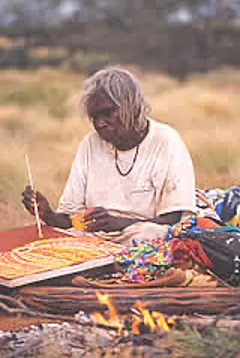
Eubena did not begin painting until the second art coordinator, Michael Rae, extended the opportunity to paint beyond the Adult Education Centre to the camps that had established themselves around the fringes of the mission. Canvases were delivered and collected on a weekly rotation and it was common for husbands and wives to complete canvases together. This was certainly the case with Eubena Nampitjin, who developed her aesthetic alongside her second husband, Wimmitji Tjapangarti. They began collaborating in 1988 and their art flourished under Rae’s guidance. Though Wimmitji and Eubena initially worked in earthy brown and red toning with areas of white dotting and lines, by 1989 they began experimenting with soft floral patterns transforming the complex dotting and compositions that characterise their work into delicately beautiful and opulent paintings. Their early works portrayed Dreaming sites, country, and ancestral travels in the most intimate cartographic detail and are, to this day, the very finest paintings that have ever emanated from the community. Whether these paintings were attributed to Wimmitji or Eubena was always simply a matter of chance. Canvases were delivered and names were transcribed on to the back prior to handing them to the artists. They were never attributed to both husband and wife. As the art centre flourished and demand for their paintings grew, Wimmitji began painting less and Eubena increasingly painted on her own. After the death of her daughter Ema Gimme Nungerayai in 1993, Eubena returned to Well 33 and did not paint again until encouraged to return to Balgo Hills two years later. From that time on she painted alone with larger, freer dots and a more gestural style executed with a palate of red, yellow and pink. In time these late career works became more akin to finger painting with fluid brushstrokes and only the occasional intimate section actually dotted with a stick.
While Balgo’s physical isolation has conferred the space to evolve a distinct and unique artistic style, Eubena’s own separation from her homeland has manifested as an art of absence, an act of homage, which has crystallised the poignancy of her country in her works. The sense of raw energy and spontaneity in her work with her trademark use of vibrant colour, bold patterning, and rough and ready handling creates an 'extraordinary sense of presence,' that overrides any connotations of the work as an object of anthropological significance and invites the viewer 'to appreciate pictures for their immediate visual impact as works of contemporary art' (McDonald 1995).
Eubena’s art transported her 'way into her country, re-inhabiting it brush mark by brush mark, like walking or breathing' (Mahood 2005: 18). She perpetually renewed this sense of country, tirelessly sitting in her customary position on the floor of the art centre, painting for hours on end. She stated 'I like painting from my heart … I like to do paintings, big ones, to keep my spirit strong. Really good. I don’t get tired doing big ones, sometimes I do them in one day. My spirit keeps me strong' (cited in Alexander 2004: V1).
© Adrian Newstead
Alexander, G. 2004. Balgo 4-04. Vega Press, Melbourne.
Cowan, J. 1999. Balgo: New Directions,’ Craftsman House, Australia.
McDonald, J. February 25 1995. ‘Bold Balgo is within Coo-ee.’ Sydney Morning Herald. Spectrum.
McCulloch, S. January 13-14 1996. ‘Colour in the Sand,’ The Australian Weekend Review: 5.
Mahood, K. June 2005. ‘Under the Skin,’ Artlink. Vol 25. No. 2: 14-18.
Watson, C. 1997. ‘Eubena Nampitjin and Wimmitji Tjapangarti,’ Stories: eleven aboriginal artists, Brodie, A. M (ed). Craftsman House, Australia.
Exhibitions
- Yilpinji2002 – 2003
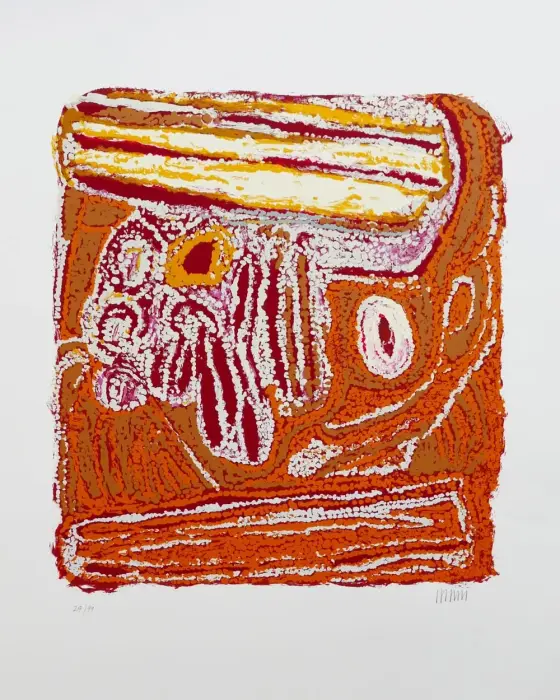
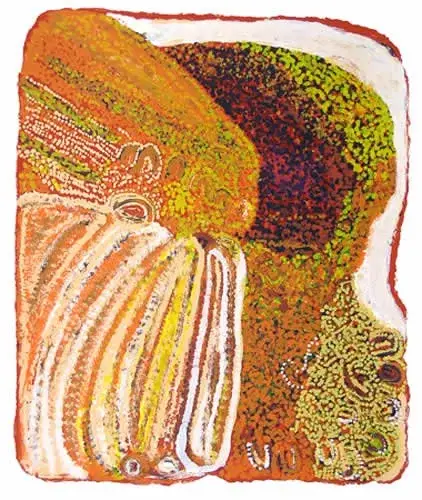
For a period towards the end of her life, Eubena was Balgo’s 'grand matriarch and number one painter' at the Warlayirti art Centre. Art production became increasingly dependent upon a dwindling band of older artists who were able to mentor younger artists and also command the high prices. Eubena’s paintings were always in great demand, both in Australia and internationally. For some time, it seemed that the older she became, the more she painted. When she passed away in 2013, she left a significant artistic legacy. The large volume of gestural, often fairly repetitive work, she produced over the last five years of her life, and the premium prices being charged for her work on the primary market, made the secondary market the better option for those seeking distinctive works at good value.
Eubena Nampitjin’s early works were painted with her husband, Wimmitji, and were often attributed to him. They are quite detailed in design, and the dots, mainly in yellow and white, are clearly distinguishable. Very few of Eubena’s paintings from this early period (around 1990), have come on the market and the demand for these works outstrips supply. Her record result for work created during this period, Ikara 1992, sold for $82,750 against a presale estimate of $40,000-60,000, with Sotheby in July 2004. It remained her top sale until as recently as 2023 and is now number two in her top ten sales. Eubena’s second highest price from this period was for a small work measuring just 100 x 75 cm. Wantaru/yintarnyu 1990. This painting sold for $52,200 against an estimate of $15,000-20,000 also in Sotheby 2004 sale. It is now number 4 in her top ten sales.
As her work differentiated from that of Wimmitji , and as she gained greater experience, her style gradually developed so that three distinctly different stylistic periods exist. The images which characterize Eubena’s middle period still tend to be full of detail, with an increasing use of red and more thickly and closely painted dots as well as the introduction and occasional use of black and green. Eventually, in her later and final period, the dots in her works have become so gestural and painterly in their application that they are more or less indistinguishable, and the colours have been confined to mostly red, yellow, pink and white. Eubena also combined blue with white in a number of works produced between 2007 and 2009. Eubena’s works from this final period, especially when large, exhibit a haptic rhythm that excites the beholder such that, even though there is quite a large supply from this period, the better images are likely to fetch very reasonable prices both on the primary and secondary market.
Eubena's fortunes at auction have been mixed, marked by troughs and peaks. In general, the more static the image and the smaller the work, the less value has been attached to it. At present, she has a 61 % sale rate and her price average in 2025 was $8,141 after a peak in 2023 where her average soared to $17,218. During that year, all ten works on offer sold, including her top sale ever; Midjul 2008 at Sotheby’s New York, surpassing its estimate (US$50 -$80,000) to sell for US$63,500 or A$95,523.
While 2004 was by far her most successful year in terms of turnover, generating $214,359 in sales, by 2010 there were signs of an overheated market for the works of an artist who was still actively painting at the time. Many of the failures carried estimates above $25,000 and as high as $80,000. This imbalance has since been remedied by the surge of interest in the <$25,000 range of paintings which dominate Eubena’s sales. 2024 saw 5 out of 6 sell and through 2025; seven out of ten paintings found buyers. Nevertheless, quality works can still command high prices. Good examples are, Near Jupiter Well in the Great Sandy Desert 1995, at Sotheby's in New York in 2019, it achieved $AUD50,712, her fourth best result, and Untitled 1992 from the Laverty Collection , which sold for $27,000 with Deutscher and Hackett in 2022, skipping way over its estimate of$3,500 to $4,500.
As with the work of other first generation of Balgo painters, Eubena’s early works are undervalued given their historical importance and aesthetic quality. This is unlikely to last now that she has passed away and works in the primary market have dried up. Just as 1970s Papunya works were replete with ceremonial knowledge and intimate detail, so too were 1980s Balgo Hills paintings. Over time, as the market becomes more knowledgeable, Eubena Nampitjin will be recognised as the ‘great matriarch’ of an artistic legacy that spread during her lifetime, from the Great Sandy Desert and the Canning Stock Route throughout the southern reaches of the Kimberley.
Rank #24Cumulative AAMI 15.59
Annual AAMI rating by year — hover or tap a bar for the exact figure.
How the AAMI rating is calculated
The AAMI (Aboriginal Art Market Index) measures an artist’s auction performance each year. Each annual rating combines the value of works sold (total sales and clearance rate), the number of works offered, and the average price achieved — with adjustments that temper thin trading years and a rising annual price threshold, so results stay comparable over time. The yearly ratings are added together into an artist’s Cumulative AAMI score, which determines their rank in the index.