 Click to enlarge
c.1922/ c.1925 – 2008
- Region
- Arnhem Land
- Community
- Mumeka
- Language group
- Kunwinjku (Gunwinggu, Gunwinjgu)
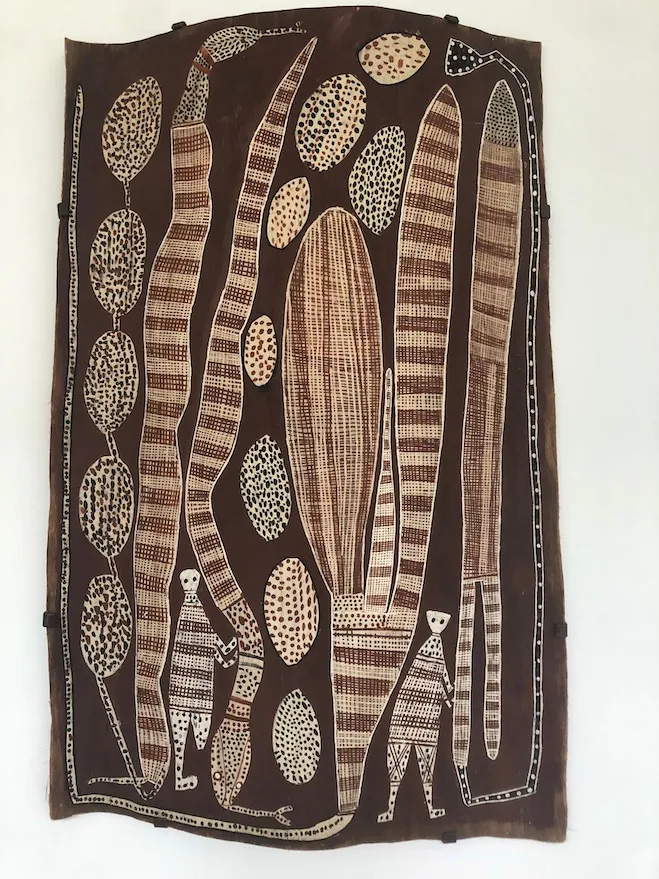
Mimi Spirits and File Snakes
natural earth pigments on bark
77 x 48 cm
$5,000
- Provenance
- Field collected Maningrida, NT Private Collection NSW
- Exhibited
- Bark Paintings 1930-2000, Cooee Aboriginal Art Gallery, NSW, July 2011 Black Art White Walls – The Anne and Adrian Newstead Collection (Australian regional gallery tour): Grace Cossington Smith Gallery, Wahroonga NSW, 23 January – 30 March 2014 Wagga Wagga Regional Gallery, Wagga Wagga NSW, 7 April – 12 June 2014 Walker Street Gallery, Dandenong Vic, 4 September – 8 October 2014 Moree Plains Gallery, Moree NSW, 1 December 2014 – 29 January 2015 Manning Regional Gallery, Taree NSW, 30 January – 15 March 2015 Burrinja Regional Gallery, Upwey Vic, 4 July – 28 September 2015 Brunswick Regional Gallery, Brunswick Vic, 16 October – 8 November 2015 Caloundra Regional Gallery, Caloundra Qld, 20 January – 28 February 2016 O Tempo dos Sonhos – The Time of Dreaming (Arte Aborígene Contemporânea da Austrália), Caixa Cultural Foundation & Casa Fiat de Cultura, touring 2018 – 2024: Brazil: São Paulo, Rio de Janeiro, Belo Horizonte, Fortaleza, Curitiba, Brasília, Salvador, Recife, Uberlândia Argentina: Buenos Aires, Córdoba Uruguay: Montevideo
- Artwork story
- Kubarkku has chosen not to adorn his figures with meticulous geometric rarrk, the crosshatching painting technique common throughout Arnhem Land, but prefers a barer, uneven form of crosshatching similar to rock markings found in the country near Kubumi where he lives. Large, uneven dots have been applied to the feet of the figures. Kubarkku's crosshatching comprises horizontal, vertical or sloping bands of red ochre, relieved by patches of black dots on white. The Mimi figures are shown as substantial spirits emerging from the rock country. He is one of the few men who remember the old artists of the caves and can give detailed interpretations of the figures and content of the cave paintings. The subject matter and stories are a direct continuation of the cave-art tradition, although his style of image-making is distinctive, particularly the rendition of his figures and crosshatching. His work has a raw, rough, and direct quality, in which the use of white dotted areas on black is a stylistic marker. His cross-hatching is open and unlabored.