Stockroom419 of 616
 Click to enlarge
c.1920 – 2013
- Region
- Western Desert
- Community
- Wirrimanu (Balgo)
- Language group
- Purtitjarra; Mantjilytjarra; Wangkajunga (Wangkatjunga, Wangkajungka); Kukatja
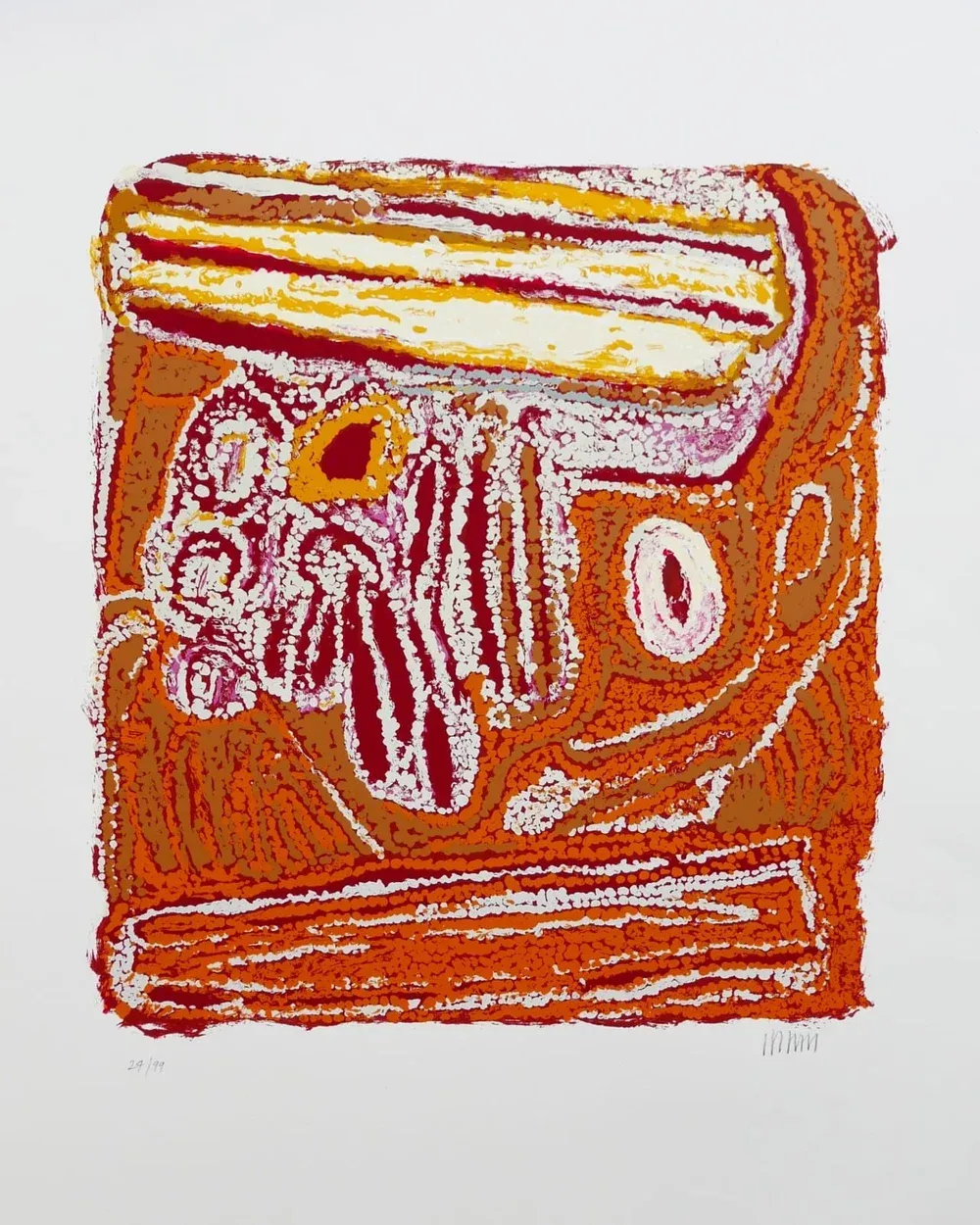
Nakarra Nakarra II – Seven Sisters Dreaming, 2003
original screenprint
$1,200
Secure payment via Stripe. Prices in AUD.
- Edition size
- 99
- Printer
- Theo Tremblay assisted by Barak Zelig
- Studio
- Editions NFP, Bungendore NSW
- Paper
- Magnani Pescia 300gsm
- Paper size
- 76 x 56 cm
- Image size
- 42 x 36 cm
- Framed
- No
- AAPN
- EN003
- Production notes
- Acetates created at Warlayirti Artists, Balgo Hills WA, June 2002. Print published Bungendore NSW, June 2003.
- Exhibited
- Yilpinji: Love Art and Ceremony, Australian Museum, Sydney; toured nationally and internationally (Australia, United States and Europe), 2002–2003. Curated by Dr Christine Nicholls; coordinated by Adrian Newstead for the Australian Art Print Network.
- Artwork story
- This is another version by Eubena Nampitjin of Nakarra Nakarra II Seven Sisters Dreaming. There are many interesting things about this Tjukurrpa or Dreaming narrative. For instance, in terms of cross-cultural crossovers, interestingly enough in Greek mythology this cluster of brilliant stars is also thought to comprise seven sisters, believed to be the seven mythical daughters of Pleione and the legendary Atlas. Another is the fact that it reveals Indigenous people’s detailed knowledge of astronomy as well as the strict moral codes within which they operate. There are many different versions of this Seven Sisters Dreaming narrative throughout Aboriginal Australia that are sung and painted – for example, the story and artistic representations of it extend as far south as the Ngarrindjeri people of the River Murray in South Australia. This particular Kukatja version encapsulates classic Yilpinji elements wherein people derive a kind of guilty pleasure at the “wrong skin union” but only as a kind of spectator sport that is ultimately condemned and socially outlawed in no uncertain terms. Furthermore, in the case of the Nakarra Nakarra Dreaming based near Wirrimanu (Balgo) Western Australia, women have particular rights and responsibilities in relation to the narrative and paintings whereas in some other Australian Indigenous societies others may have greater custodial rights. Balgo-based ceremonial leader Eubena Nampitjin provides a fine example of the Nakarra Nakarra Tjukurrpa in her work.