Catalogues199 of 257
 Click to enlarge
Sale 3 · Lot 51
c.1932 – 2021
- Region
- Western Desert
- Community
- Kintore (Walungurru)
- Language group
- Pintupi
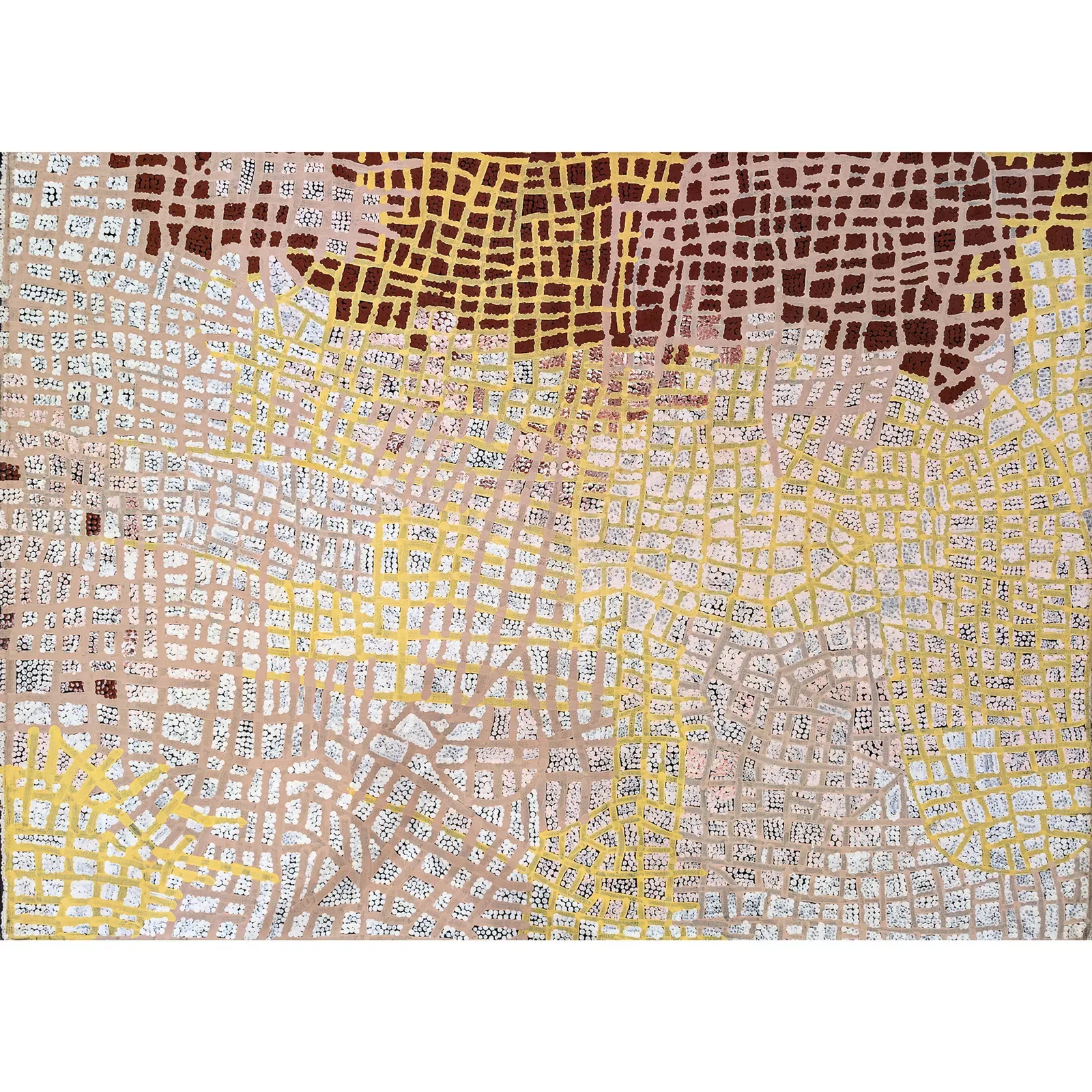
Sandhills in Tjuntupul
synthetic polymer paint on linen
122.5 x 165.5 cm
Est. $15,000 – $18,000
Hammer $9,000
- Provenance
- Ngintaka Arts, Adelaide, SA Flinders Lane Gallery, Melbourne, Vic, Cat No. FG022023.NN Private Collection Israel, acquired from the above Accompanied by a certificate of authenticity from Flinders Lane Gallery, and a folio of fourteen photographs of the artist creating the work
- Artwork story
- In her own words, Nungurrayi described her painting as an account of travelling through Country: "I am painting my home, my Country — women's Kanaputa story. Travelling along Irrututu, Tjuntupul, Marrapinti, Ngami, Wirrul." Tjuntupul is among the sites she knew most intimately from her years of walking that terrain, and Sandhills in Tjuntupul displays her topographic language at its most concentrated. The upper register is dominated by bold angular forms in near-black against warm buff, describing the rocky outcrops of Tjuntupul, while below them the Country opens into a vast undulating mosaic of interlocking shapes that shift in temperature from warm ochre at the centre to cool blue-white at the edges. Her iconography, centred on the tali (sandhills), puli (rocky outcrops), and punti (vegetation) of the Gibson Desert, is rendered here as a continuous interlocking field seen from above. Nungurrayi led a traditional nomadic life traversing that Country until April 1964, when she and her family joined the migration of Pintupi people making their way to the government settlement at Papunya. She participated in the Kintore women's collaborative painting project in 1994 before beginning to paint for Papunya Tula Artists in 1996. The full sister of George (Hairbrush) Tjungurrayi and Nancy Ross Nungurrayi, and the mother of Kenny Williams Tjampitjinpa, she is part of one of the most significant artistic families in the Western Desert tradition. The folio of fourteen photographs documenting the creation of this canvas places it within the rare Category of works whose making is as fully documented as their subject.