Catalogues200 of 257
 Click to enlarge
Sale 3 · Lot 52
Pepai Carroll
1950 – 2021
- Region
- APY Lands
- Community
- Pukatja (Ernabella)
- Language group
- Pitjantjatjara
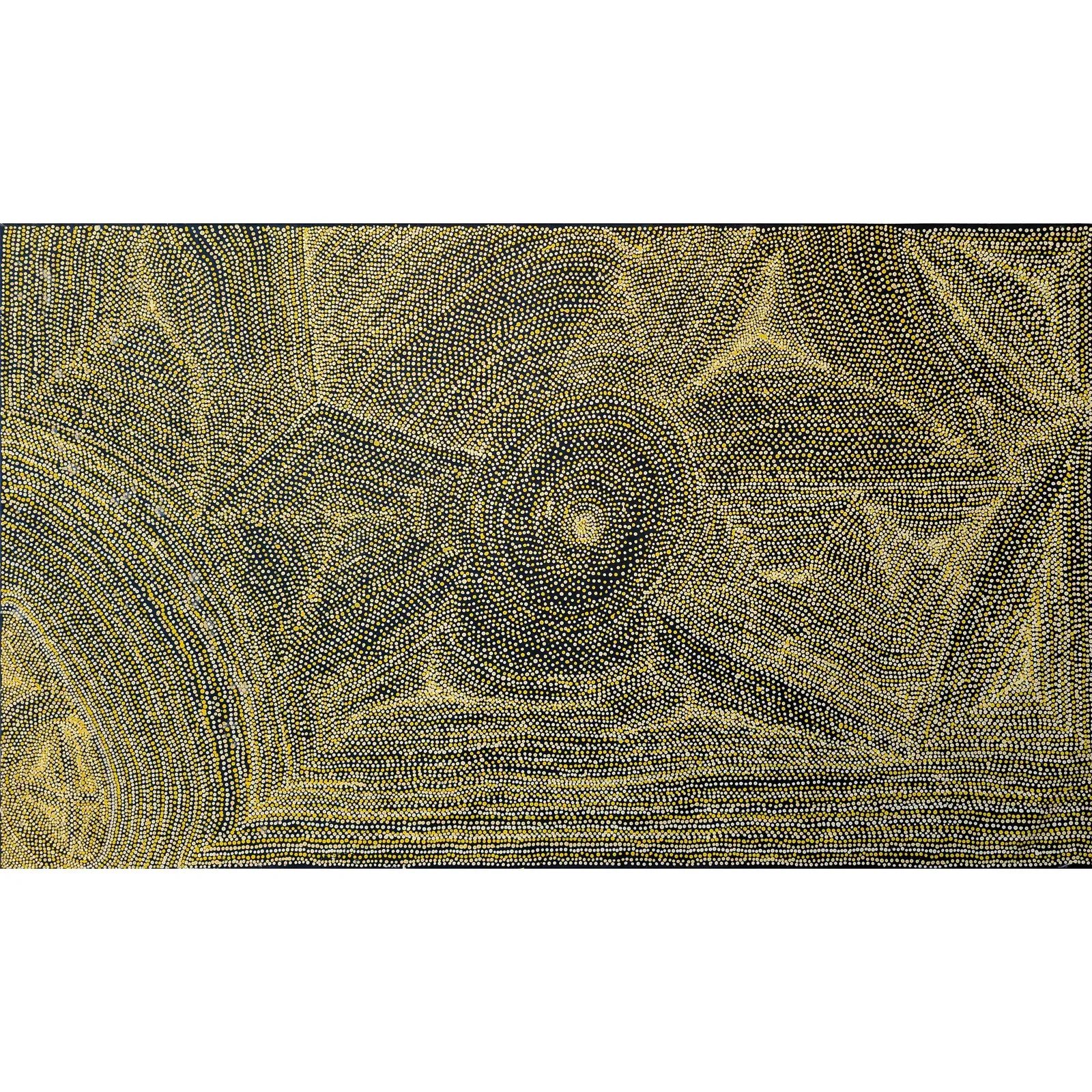
Warlangurru, 2010
synthetic polymer paint on linen
100 x 170 cm
Est. $8,000 – $12,000
Hammer $12,500
- Provenance
- Ernabella Arts, Pukatja, SA Cat No. 252-10PC Private Collection, NSW Menzies, Important Australian & International Art, Sydney, NSW, 9 April 2025, Lot 61 Private Collection Accompanied by a certificate of authenticity from Ernabella Arts
- Artwork story
- "Art is also a type of memory theatre for Pepai Jangala Carroll," wrote Professor Lisa Slade in the Catalogue for Magic Object: Adelaide Biennial of Contemporary Australian Art, Art Gallery of South Australia, 2016. "Carrying the recurring title of Walungurru, in this naming, like the act of painting and working in clay, is recuperative for Carroll, enabling him to call up Luritja/Pintupi country." Warlangurru is that act of calling up. The Ernabella Arts certificate records it simply: his father came from sand-dune country near Kintore in the NT, and this place is called Warlangurru. The composition is radically spare. Fine dots of warm gold applied to a near-black ground build into great sweeping arcs and concentric fields that converge on a single barely perceptible point at the canvas's centre. There is no horizon, no figure, no conventional pictorial anchor — only the accumulation of marks and the sense of a force drawing everything inward. The left edge holds a partial second circle, as though the canvas has captured one quadrant of a vastly larger pattern extending beyond its borders. The palette, gold on charcoal, is austere by the standards of Ernabella painting and gives the work a nocturnal gravity that sets it apart from Carroll's later, more chromatically expansive canvases. Carroll came to painting at Ernabella Arts only in 2009, having spent the previous decades as Chairperson, Director of Nganampa Health, and Community Constable — a man of deep public responsibility who turned to art late and with great urgency. In 2021 he became the first Indigenous artist selected for the JamFactory's ICON series, with a monograph launched by the South Australian Premier.