Catalogues228 of 257
 Click to enlarge
Sale 3 · Lot 80
c.1943 – 2023
- Region
- Western Desert
- Community
- Kintore (Walungurru)
- Language group
- Pintupi
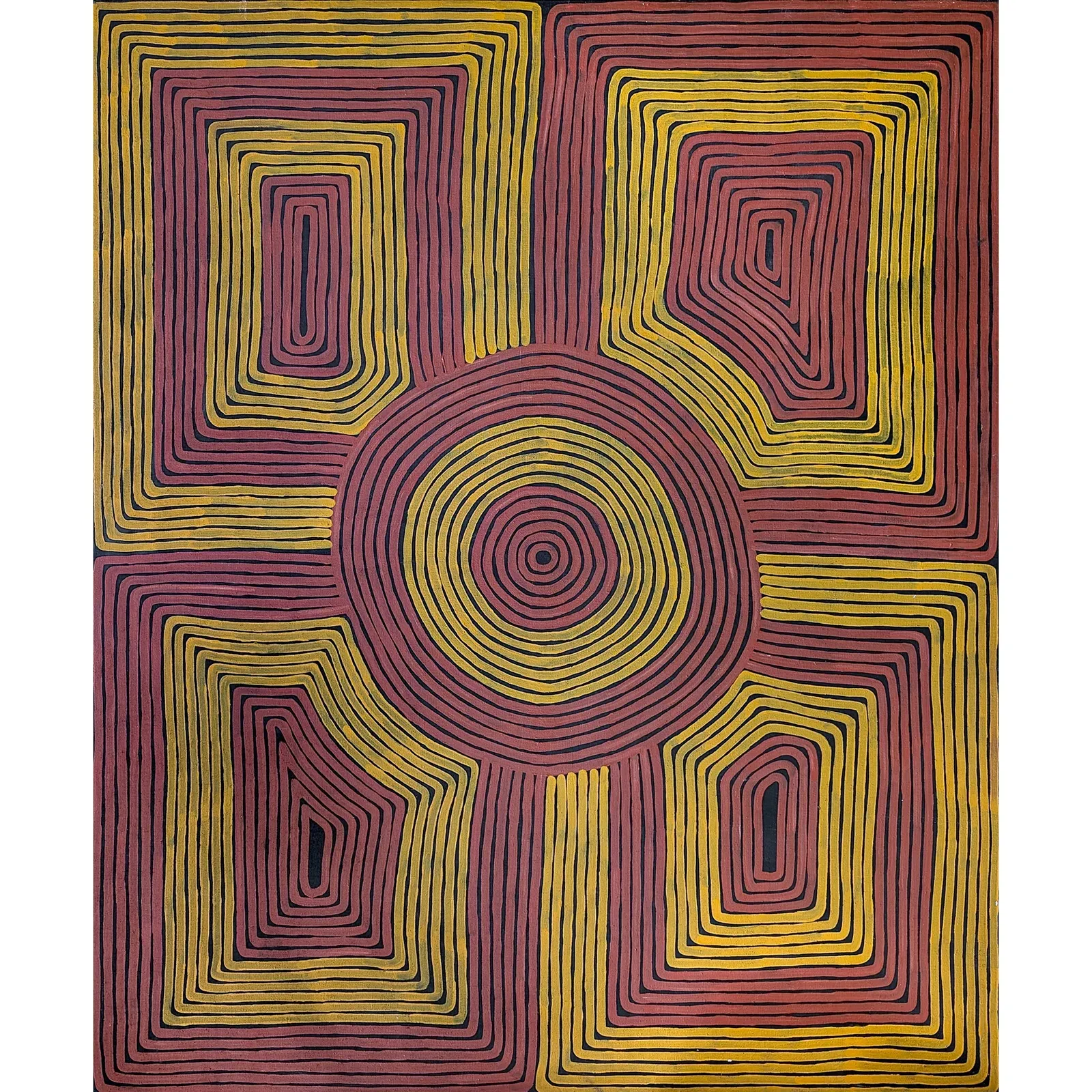
Tingari Cycle at Wilkinkarra (Lake Mackay), 1996
synthetic polymer paint on canvas
183 x 152 cm
Est. $20,000 – $30,000
Hammer $16,000
- Provenance
- Papunya Tula Artists Pty Ltd, Alice Springs, NT, Cat No. RT960446 Private Collection, Vic Sotheby's, Important Aboriginal Art, Melbourne, Vic, June 2011, Lot 164. Aboriginal Gallery of Dreamings, Melbourne, Vic, Cat No. AGOD7264 Private Collection, Vic, acquired from the above Accompanied by certificates of authenticity from Papunya Tula Artists Pty Ltd and the Aboriginal Gallery of Dreamings
- Artwork story
- Ronnie Tjampitjinpa was born at Muyinnga, approximately 100 kilometres west of the Kintore Range in Western Australia, the son of Minpuru Tjangala and nephew of Uta Uta Tjangala. As a child he travelled Pintupi country with his family before the drought of the 1950s brought them east to Ikuntji (Haasts Bluff) and eventually Papunya, where he was among the youngest of the men who began painting at the founding of the Western Desert art movement in 1971 and an original shareholder of Papunya Tula Artists. He moved to Walungurru (Kintore) in 1983, and it was back on his own country that his practice emerged in full. The Papunya Tula documentation records that the central roundel represents a freshwater spring on an island in the middle of Wilkinkarra (Lake Mackay), associated with two Tingari Men who met there for ceremonial purposes, each approaching from opposite sides of the lake. Since the events of the Tingari Cycle are secret and sacred, no further detail was provided by the artist. For Tjampitjinpa this was not inherited subject matter in the abstract: his family had moved through this Country on foot, and the sites he painted were places he had known since childhood. Across this large canvas, a single great concentric circle at centre radiates outward in alternating bands of deep red and luminous gold-yellow against a black ground, while four rectangular concentric forms occupy each corner, mapping the surrounding Country. The palette is stripped to its essentials, the composition achieving the clarity of a cartographic statement. This is the bold, scaled-up linear style that Tjampitjinpa pioneered after moving to Walungurru, a mode that came to define the Walungurru painters of the following decade. His work is held in the collections of the National Gallery of Australia, the Musée du quai Branly, Paris, and other major public and private collections nationally and internationally.