Catalogues229 of 257
 Click to enlarge
Sale 3 · Lot 81
c.1924 / c.1926 – 2013
- Region
- Western Desert
- Community
- Wayampajarti
- Language group
- Walmajarri
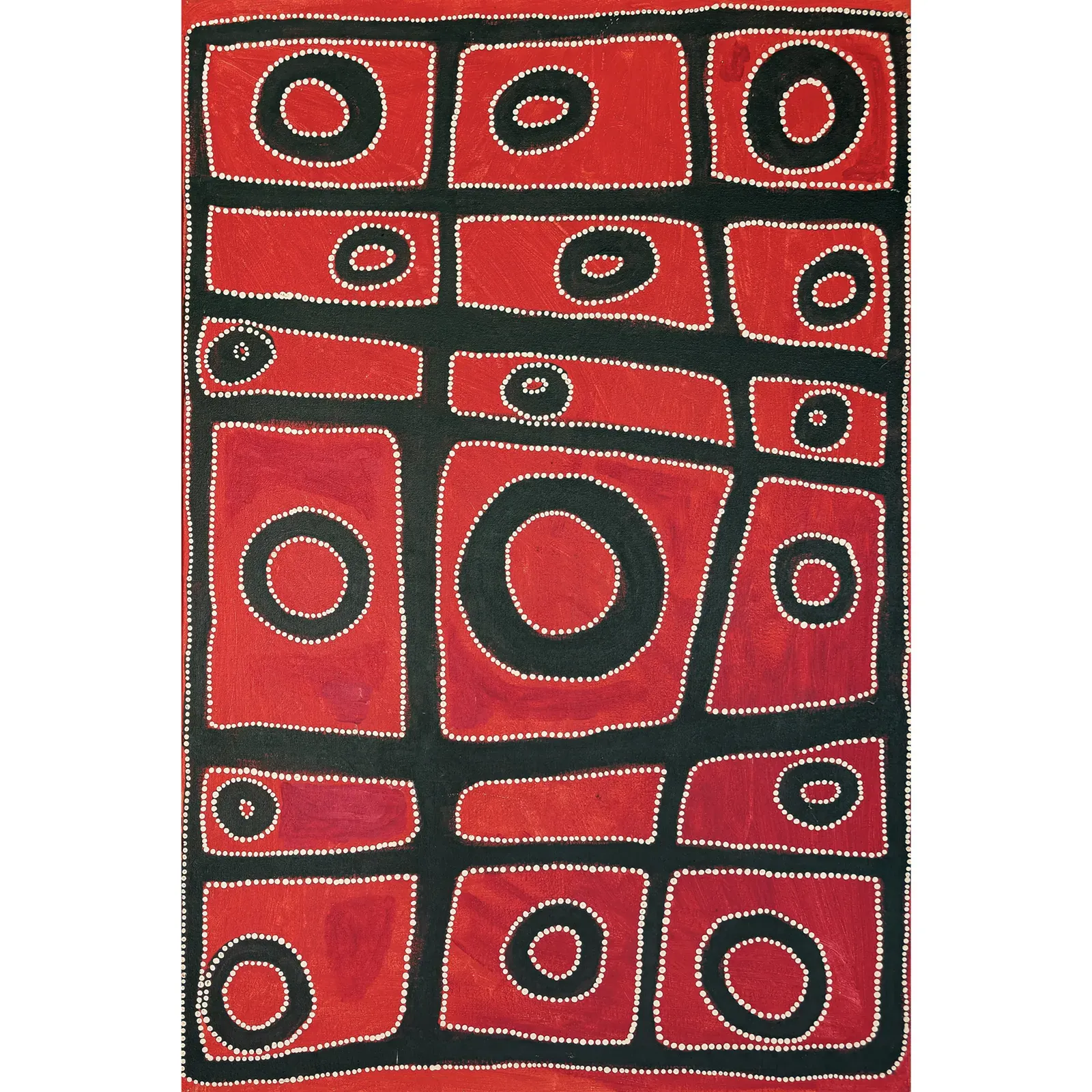
Untitled, 1994
synthetic polymer paint on canvas board
90 x 60 cm
Est. $2,500 – $3,500
Hammer $2,400
- Provenance
- Field Collected by the Luma Community Development Manager, Denise Goldie, 1994
- Artwork story
- Mawukura was born at a jiwari, a small billabong, near the waterhole at Wili in the north-western Great Sandy Desert, and spent his early life moving between the jila, the permanent waterholes, of his country: Tapu, Kurrjalpartu, Kayalijarti, Walypa, Wayampajarti, Kumpujarti and Witikarrijarti. He was nearly a man when his father took him to the station country to escape a large fire burning around Tapu. After going through law at Lumpu Lumpu he returned to the desert with his father-in-law for approximately five years before leaving the bush, possibly in the early 1960s, to work as a stockman on Nerrimah Station, the name by which he became known to the wider world. He came to painting only in the early 1990s, and his work is held in the National Gallery of Australia, the National Gallery of Victoria and the Art Gallery of Western Australia. This canvas, purchased direct from the artist in 1994, is among his earliest work. A grid of bold rectangular forms in deep red, each containing a concentric circle, is separated by thick black lines and traced throughout in white dots. The iconography is consistent with the waterhole country that dominated his practice across the two decades that followed.