

SYRON’S WAR
19 March 2026 – 23 April 2026
Opening 5.30pm Thursday 19th March
31 Lamrock Ave Bondi Beach 2026
A major retrospective exhibition of paintings created by the Biripi and Worimi elder, Gordon Syron, with works on loan from the National Gallery of Australia and the National Museum of Australia.
Curated by the highly respected Bunjalung elder Djon Mundine, this exhibition illuminates Gordon Syron’s formative role in the‘urban Aboriginal art movement’, and the strength of his representation in important collections, and includes works from the Syron archives which will be offered to collecting institutions and selected private collections.
We warmly invite you to attend the opening event at 5.30pm on Thursday 19 March. As places are limited, please register your interest to attend.
Gordon Syron has been an inspirational role model and is recognised as a seminal figure in urban and contemporary Aboriginal painting in prison in 1972 and, following his release, co-founded the visual and performing arts college, the EORA Centre, becoming its first visual arts teacher.
Amongst the many Indigenous artists who credit Syron with having been an important influence on their work are Queensland political satirist Gordon Hookey; National Aboriginal and Torres Strait Islander Award winner Richard Bell; Multi Media artist Karla Dickens; and painter, photographer, cartoonist, and graphic designer Adam Hill, winner of the Archibald Prize.
Following a period of seclusion during the 1980s his renewed interest and involvement in the politics & history of Aboriginal self-determination saw him paint a major series on the theme of Aboriginal Deaths in Custody. He later became the President of The Aboriginal Deaths in Custody Committee in Sydney.
Syron’s first retrospective, officially opened by Dr Vivien Johnson, was held in 1998, at the Australian Museum in Sydney. During that year he became artist-in-residence at the Humanist Society and, in 2000 ,he created a solo exhibition for the Humanist International Forum at the Law School of the University of Technology, Sydney.
Syron’s works were officially exhibited during the 2000 Sydney Olympics; in the Australian Pavilion at the 2004 Greek Olympics, and in the foyer of the Australian Pavilion at the 2008 Olympics in Beijing.
During 2009 Syron won the University of NSW College of Fine Art (COFA) award, and the NSW Parliament House Prize. The National Museum of Australia acquired a major collection of his works in 2010 and he was subsequently appointed Adjunct Professor of Indigenous Art at the University of Technology, Sydney.
Amongst many national and international collections of distinction that Gordon Syron’s works are held in, are the collections of the Sydney Maritime Museum, the Sydney Museum, the National Australian Museum, the Aboriginal Legal Service, the Aboriginal Medical Service, the Department of Aboriginal Affairs, the Aboriginal Arts Board, the University of Adelaide, Flinders University, the NSW Independent Commission Against Corruption, and the National Trust.
Syron has made a career of tackling the tough issues on the margin between cultures. He has primarily exhibited within the Aboriginal community of Redfern for more than 30 years.
The Artist
Featured Artworks
On loan from the National Museum of Australia
Not for sale
On loan from the National Museum of Australia.
Not for Sale 
On loan from the National Museum of Australia
Not for sale
On loan from the National Museum of Australia.
Not for Sale 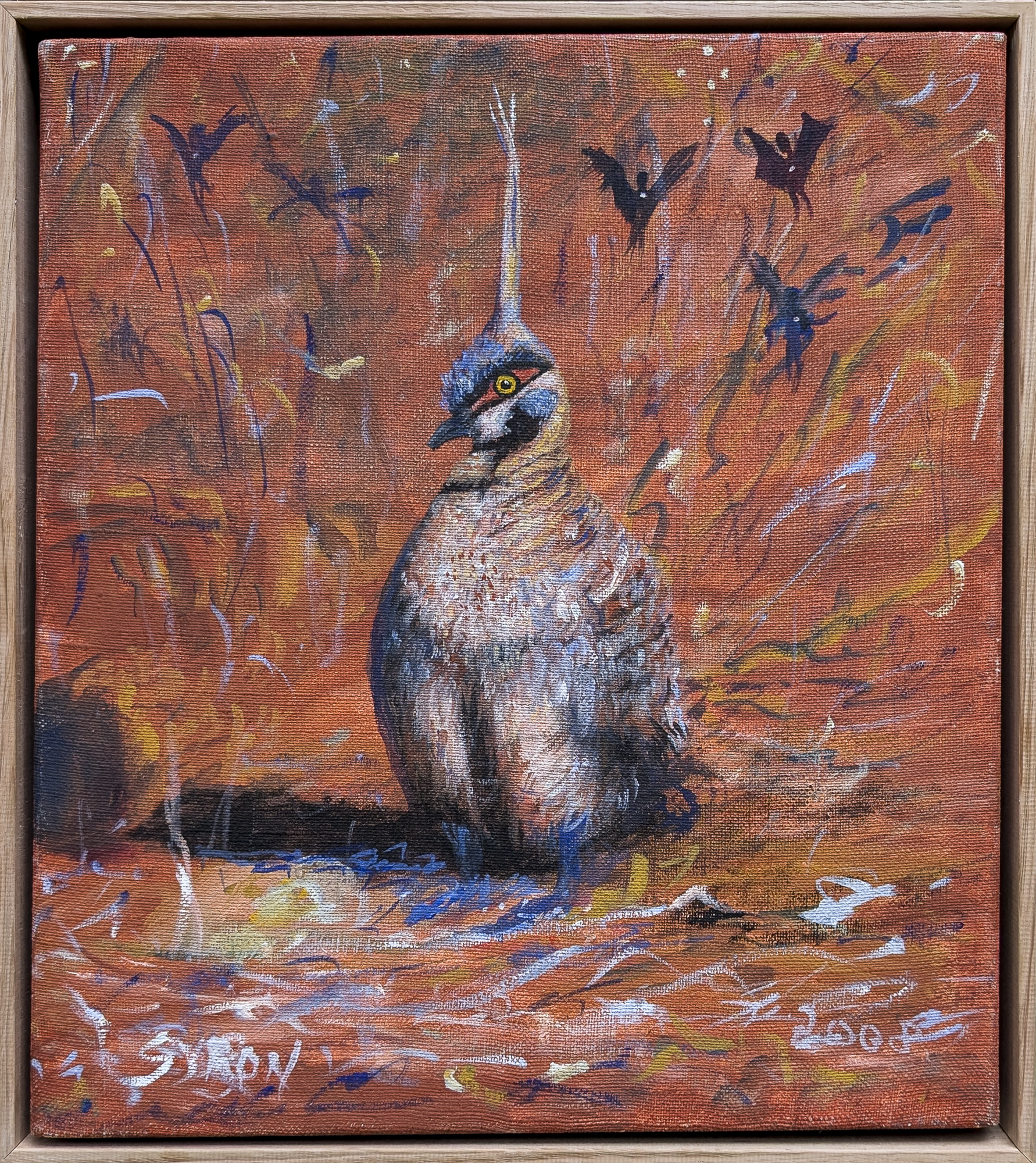
ARTWORK STORY
They were called spinifex pigeons. I was told by the locals that they had gone extinct. The redcoats ate them all and made pigeon pies. That’s why I painted the black fairies around them, to bring the spinifex pigeons back.
ARTWORK STORY
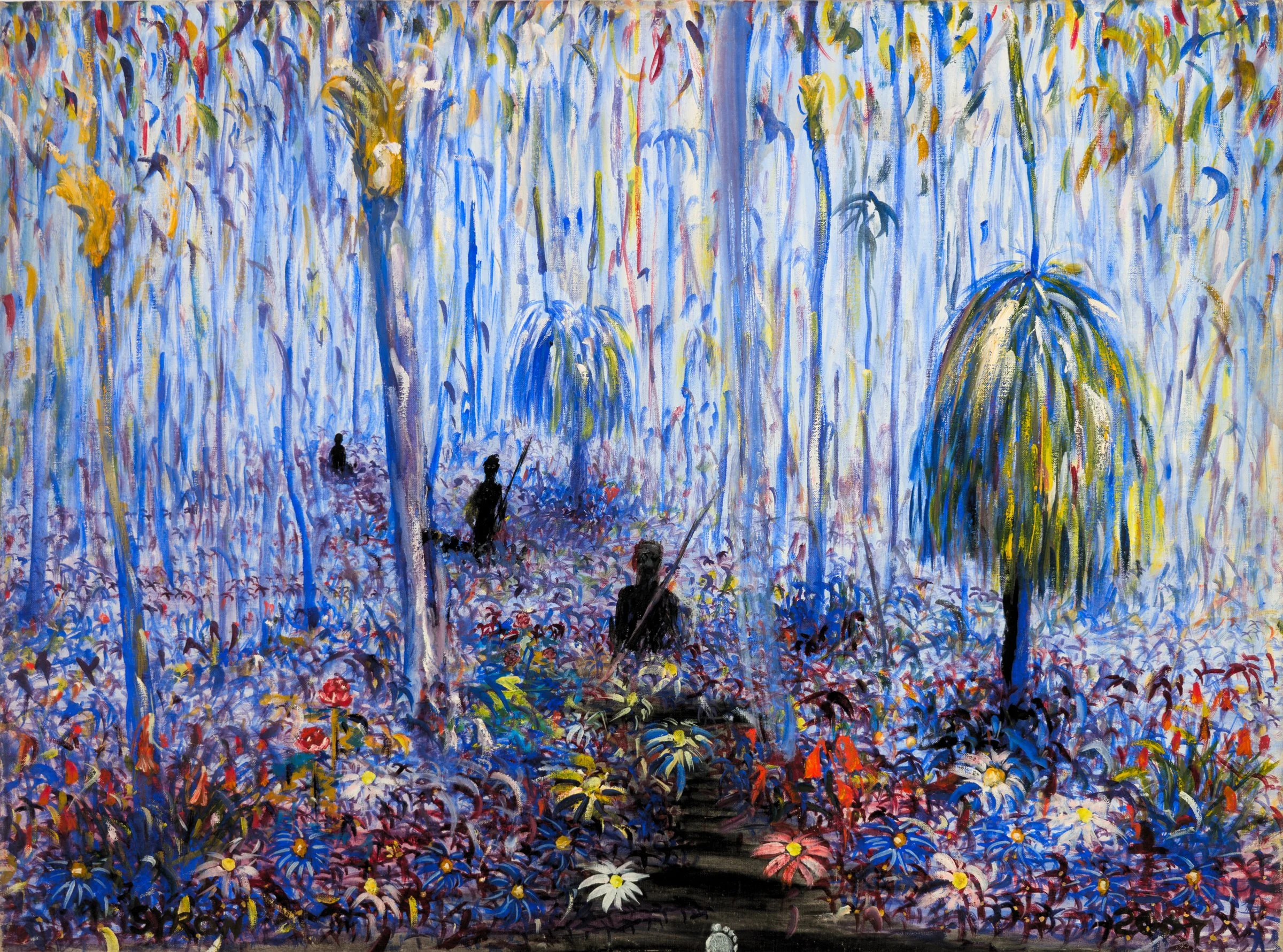
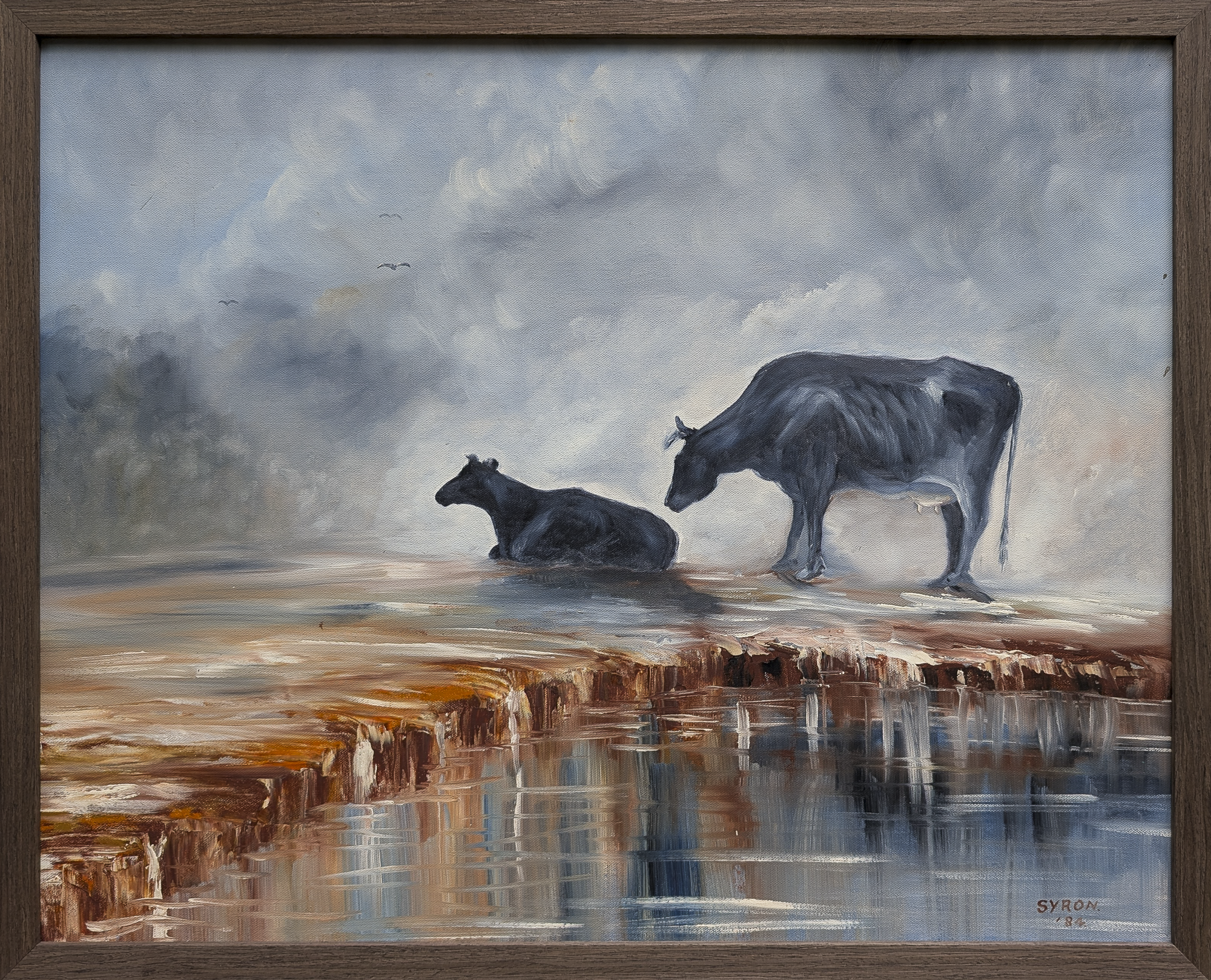
After hard work on the farm, I would fish and hunt. The cows would gather amongst the tall trees of the forest. It was hard to round them up to come to milking. We didn’t have electricity on the farm until I was fourteen so we had to milk the cows by hand. This painting shows my memories of the cows in the early morning fog.
Artist’s Collection
Not available for sale
Artist's Collection
Not for Sale 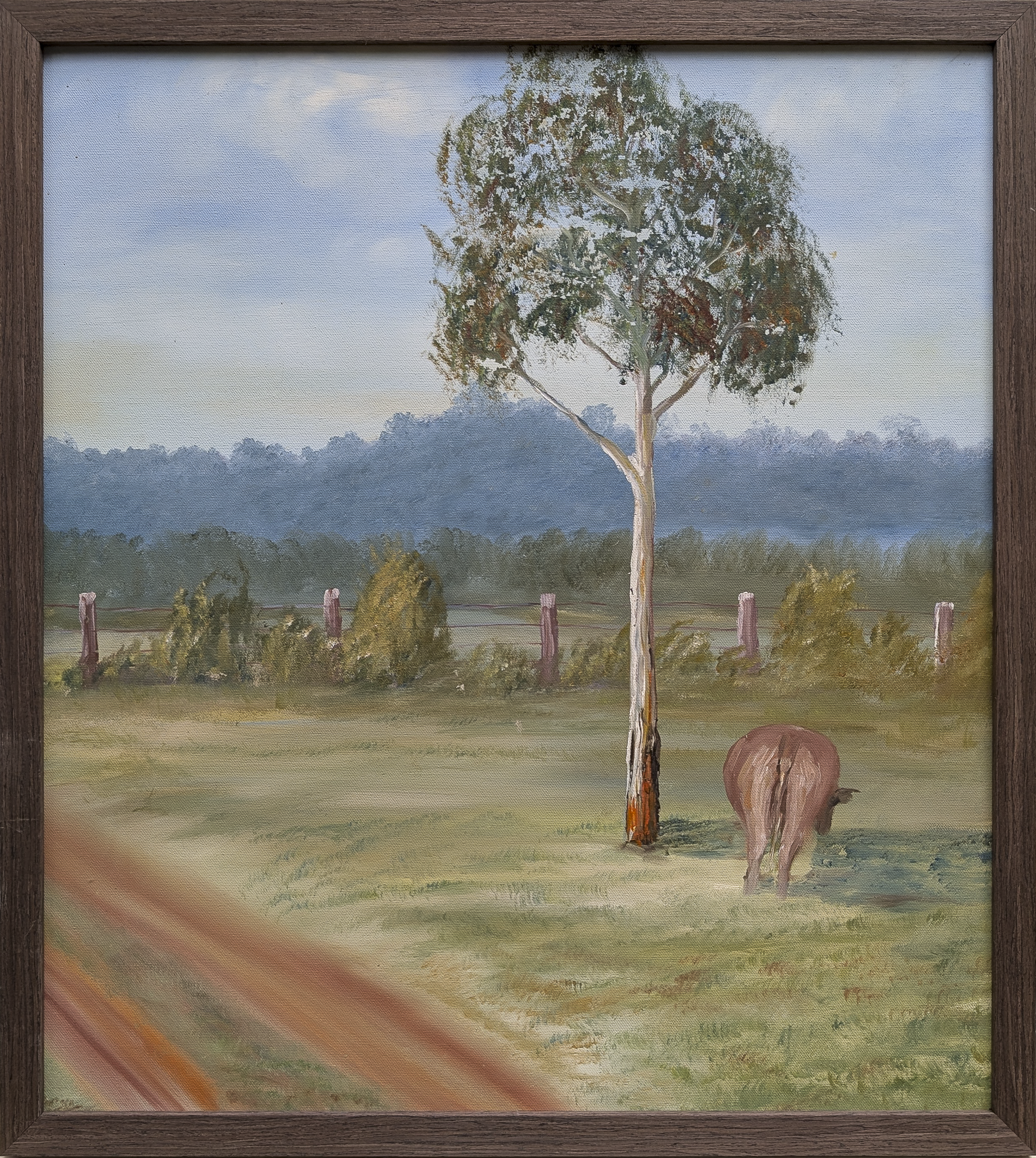
ARTWORK STORY
After hard work on the farm, I would fish and hunt. The cows would gather amongst the tall trees of the forest. It was hard to round them up to come to milking. We didn’t have electricity on the farm until I was fourteen so we had to milk the cows by hand. This painting depicts the cows grazing in the late afternoon.
ARTWORK STORY
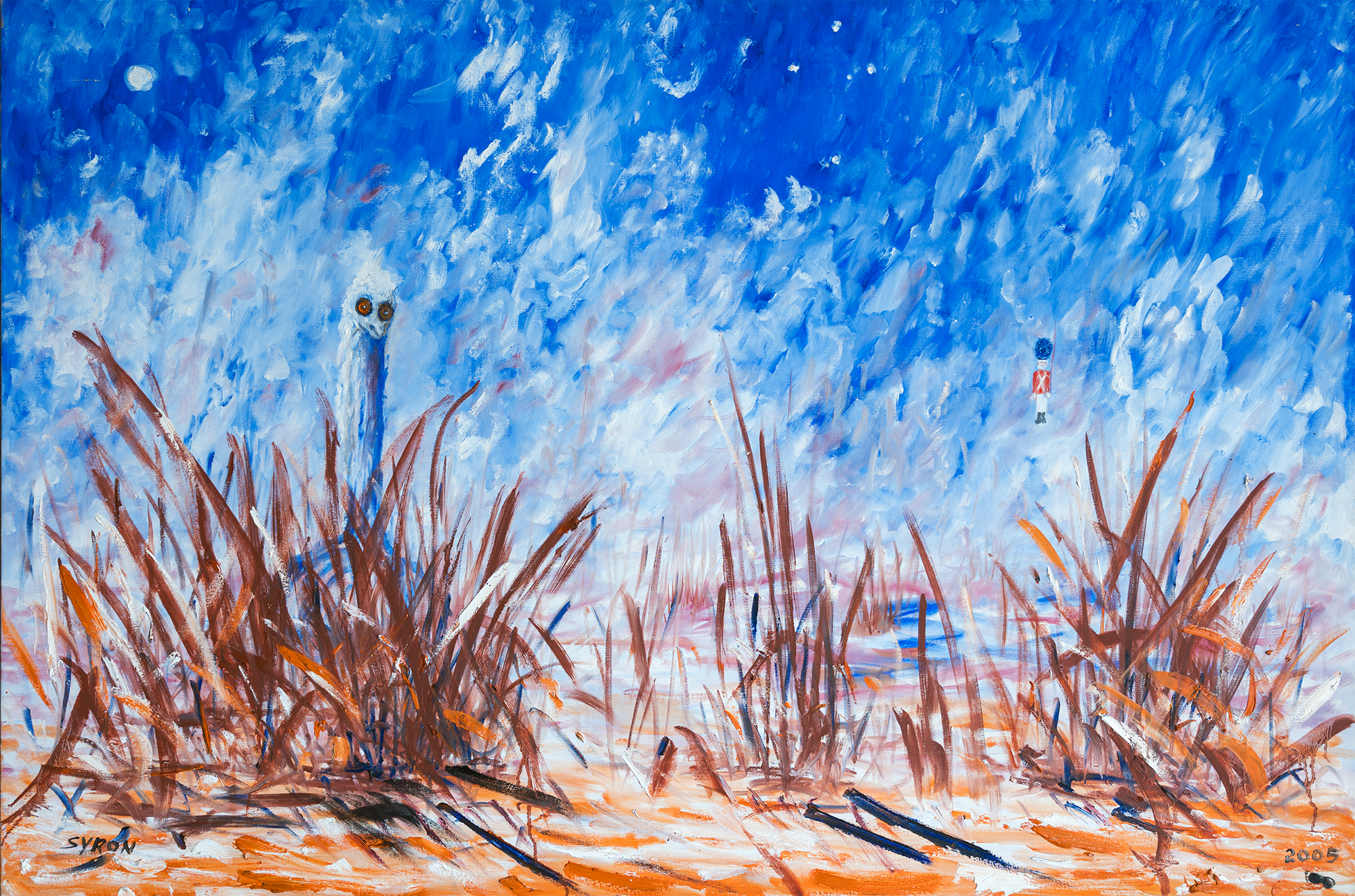
‘No Trees & Here Comes The Red Coats’ is a cry for the environment. Australia’s fragile ecosystem depends on a delicate balance, and the clearing of the land and decline of native wildlife disrupted the Country on which Aboriginal people depended. Syron recalled his grandmother telling him that when she grew up around Forster–Tuncurry there were emus everywhere.
In nature, the female emu lays the eggs and leaves, while the male incubates them, protects them from predators such as goannas, and raises the chicks, teaching them how to survive. Syron drew a parallel between this and the role of Aboriginal men in passing on knowledge to women and children. He painted this work just two years before the Northern Territory Intervention (Northern Territory National Emergency Response), at a time when Aboriginal men were increasingly misrepresented in public discourse.
The emu holds an important place in Aboriginal culture. In some traditions the Featherfoot, or Cleverfoot, could carry messages between places, while the powerful Kadaitcha man — an enforcer of tribal law — was said to wear emu feathers on his feet. In this way the emu symbolises both guardianship and the authority of Aboriginal law.
The Red Coat is tiny compared with the size of the emu, emphasisng that he does not belong there.
ARTWORK STORY
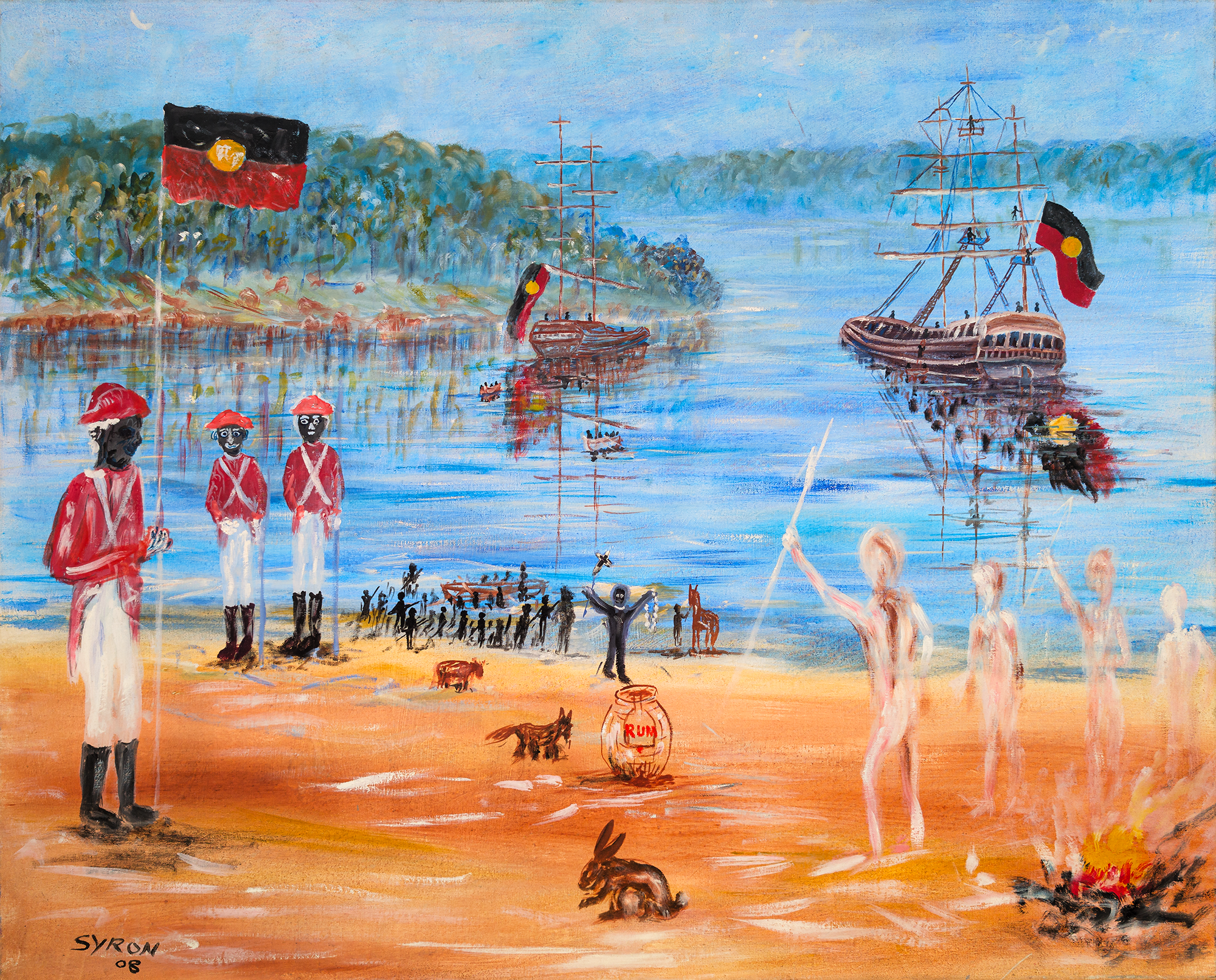
I don't paint dots. My strength in painting is political, I use satire and raw imagery to send a message that Australian History has left out the Aboriginal people and their stories.
Art is a way to convey and tell these stories. By turning around the picture for instance to dress Aboriginal people in Redcoats and black boots and have naked white people holding spears on the shore when the first fleet arrived- The Black Bastards Are Coming' well it makes people understand and see history in a different way.
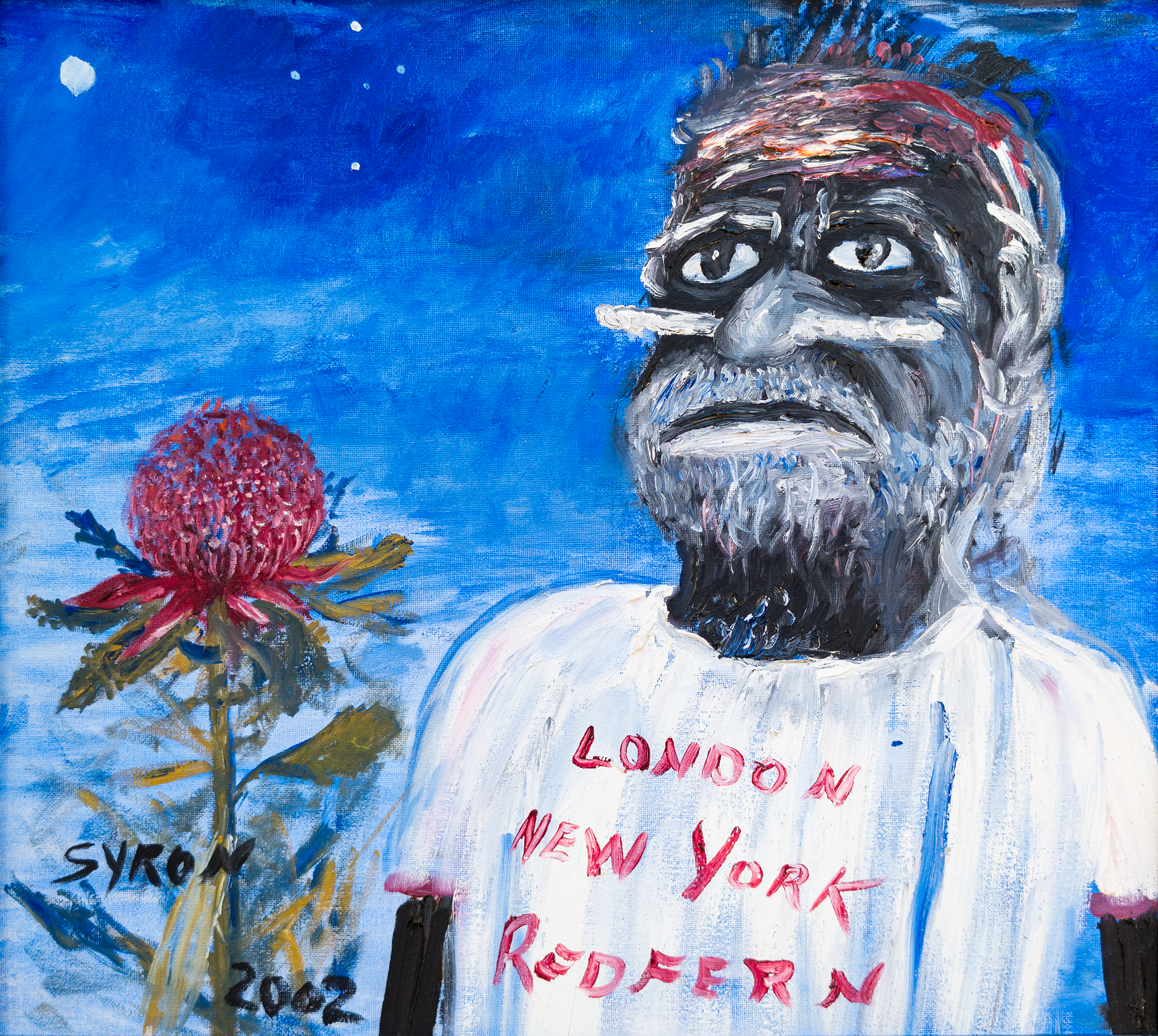
ARTWORK STORY
From a series on how a traditional Aboriginal comes to Redfern, to the ‘big smoke.’ He comes from the ‘bush’, to get a job, to see relatives and friends, to see Sydney and does he get a shock, at all them things.
The living conditions are better at home. He is caught in the crossroads of life, stranded, no money to get back home, no hope even for a job and what is left? If he stays in Redfern then the chance of going to jail is great. He can then have drugs and alcohol under police supervision.
The Dreaming Man is lost in time, the poor bastard. There are Dreaming Aboriginal Women too. Not just men. Kids, the whole lot too. There are a lot of Aboriginal people who dream. The truth is they used to own all this land. You gotta have a dream or you don’t go nowhere.
Self Portrait. Dreaming Man was created from many different perspectives. There is a sadness about this first one. Southern Cross shows it is Australia. The Waratah shows it is New South Wales. I used to see the Waratah on my brother Kevin’s boxing shorts. He held the NSW featherweight title.
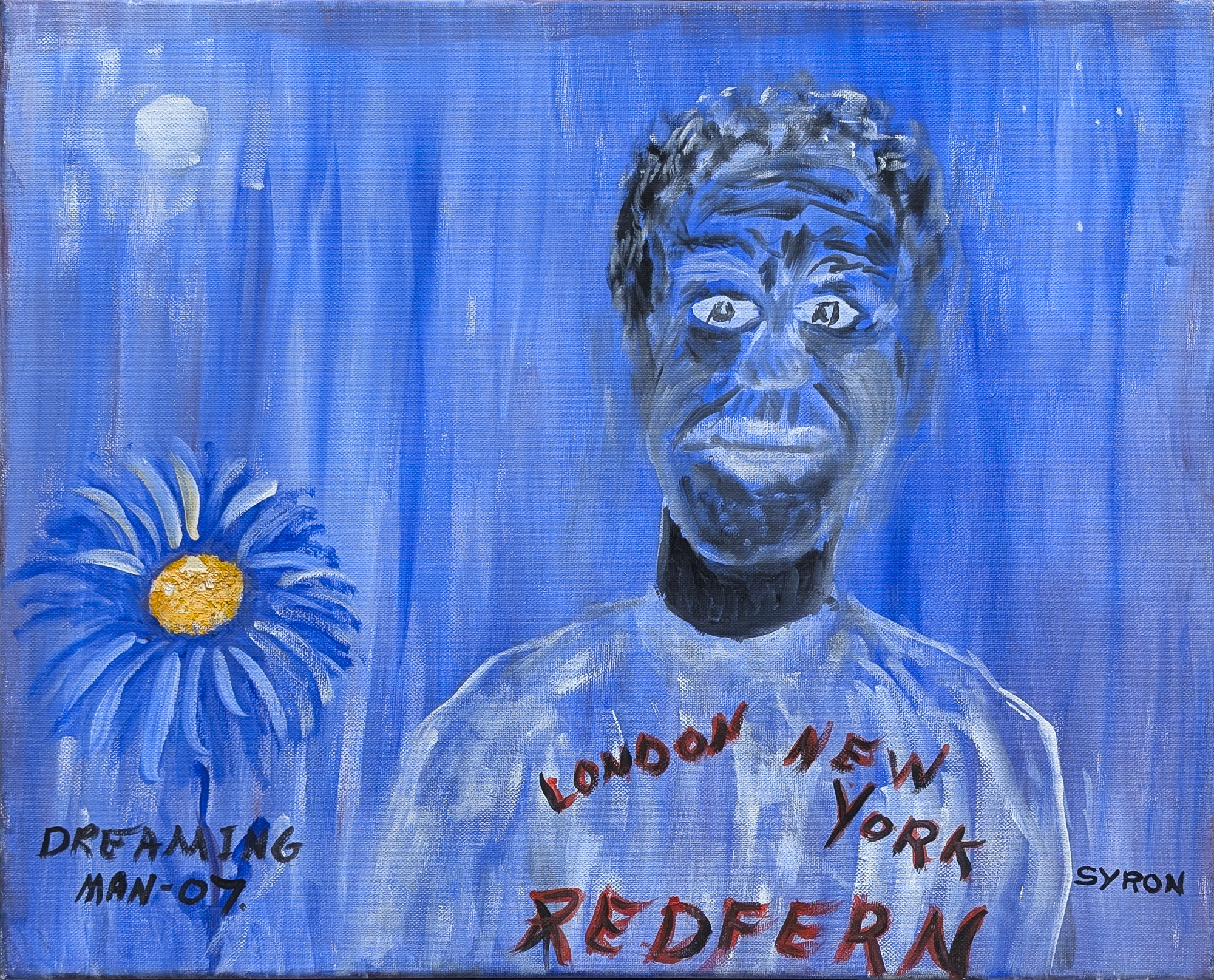
ARTWORK STORY
From a series on how a traditional Aboriginal comes to Redfern, to the ‘big smoke.’ He comes from the ‘bush’, to get a job, to see relatives and friends, to see Sydney and does he get a shock, at all them things.
The living conditions are better at home. He is caught in the crossroads of life, stranded, no money to get back home, no hope even for a job and what is left? If he stays in Redfern then the chance of going to jail is great. He can then have drugs and alcohol under police supervision.
The Dreaming Man is lost in time, the poor bastard. There are Dreaming Aboriginal Women too. Not just men. Kids, the whole lot too. There are a lot of Aboriginal people who dream. The truth is they used to own all this land. You gotta have a dream or you don’t go nowhere.
The Dreaming Man was created from many different perspectives. There is a sadness about this first one. Southern Cross shows it is Australia. The Waratah shows it is New South Wales. I used to see the Waratah on my brother Kevin’s boxing shorts. He held the NSW featherweight title.
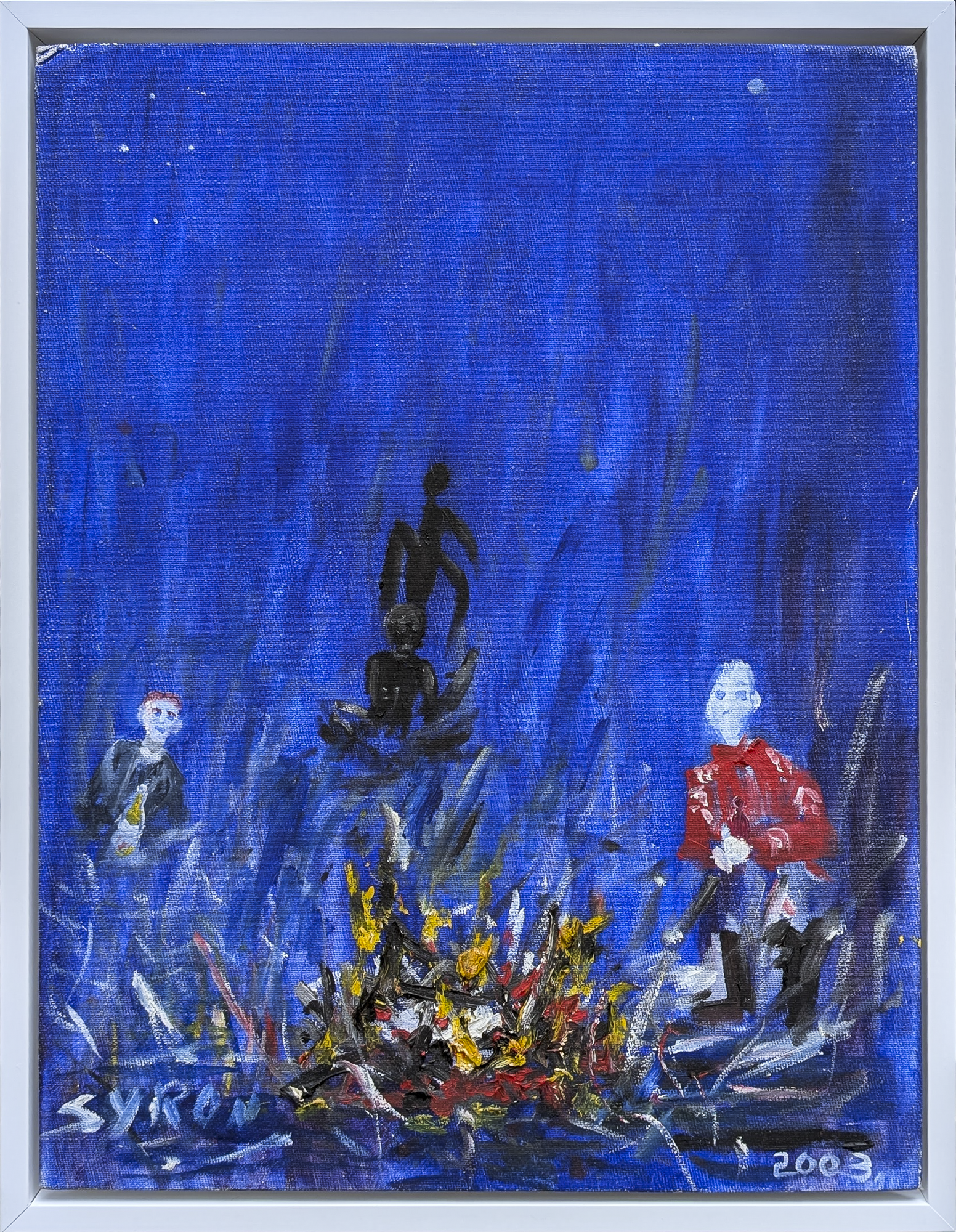
ARTWORK STORY
The Last Bottle shows the Preacher Man and a Red Coat seated around a fire sharing their bottle of alcohol. An Aboriginal man stands by, plotting the deaths of the preacher and the Red Coat.
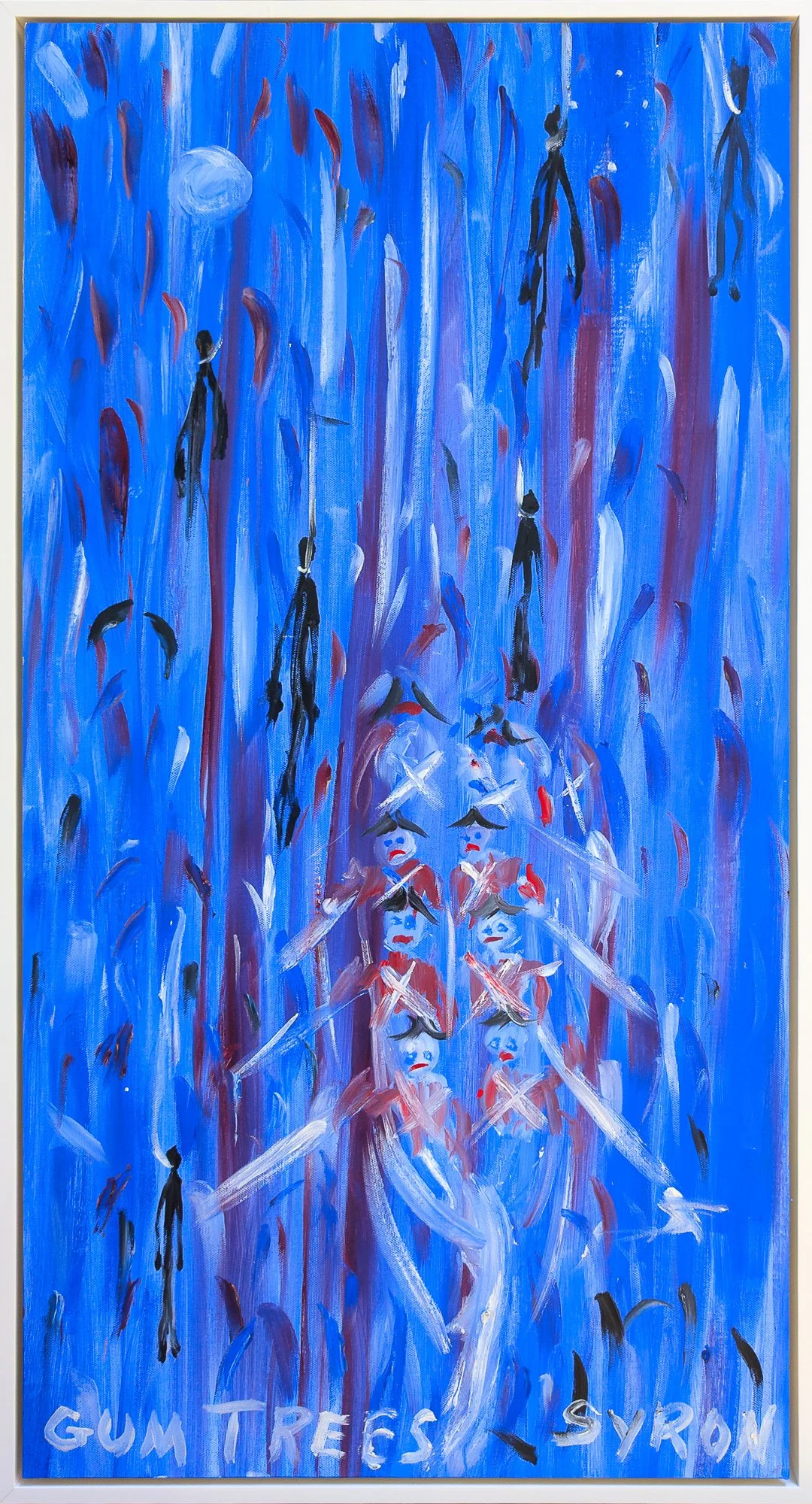
ARTWORK STORY
This work is part of the Invasion Day series. A party of invading Red Coats departs the shore by boat. In the background, Aboriginal men hang eerily, forming an almost waterfall-like cascade of bodies left behind in the wake of the Red Coats’ violence.
ARTWORK STORY
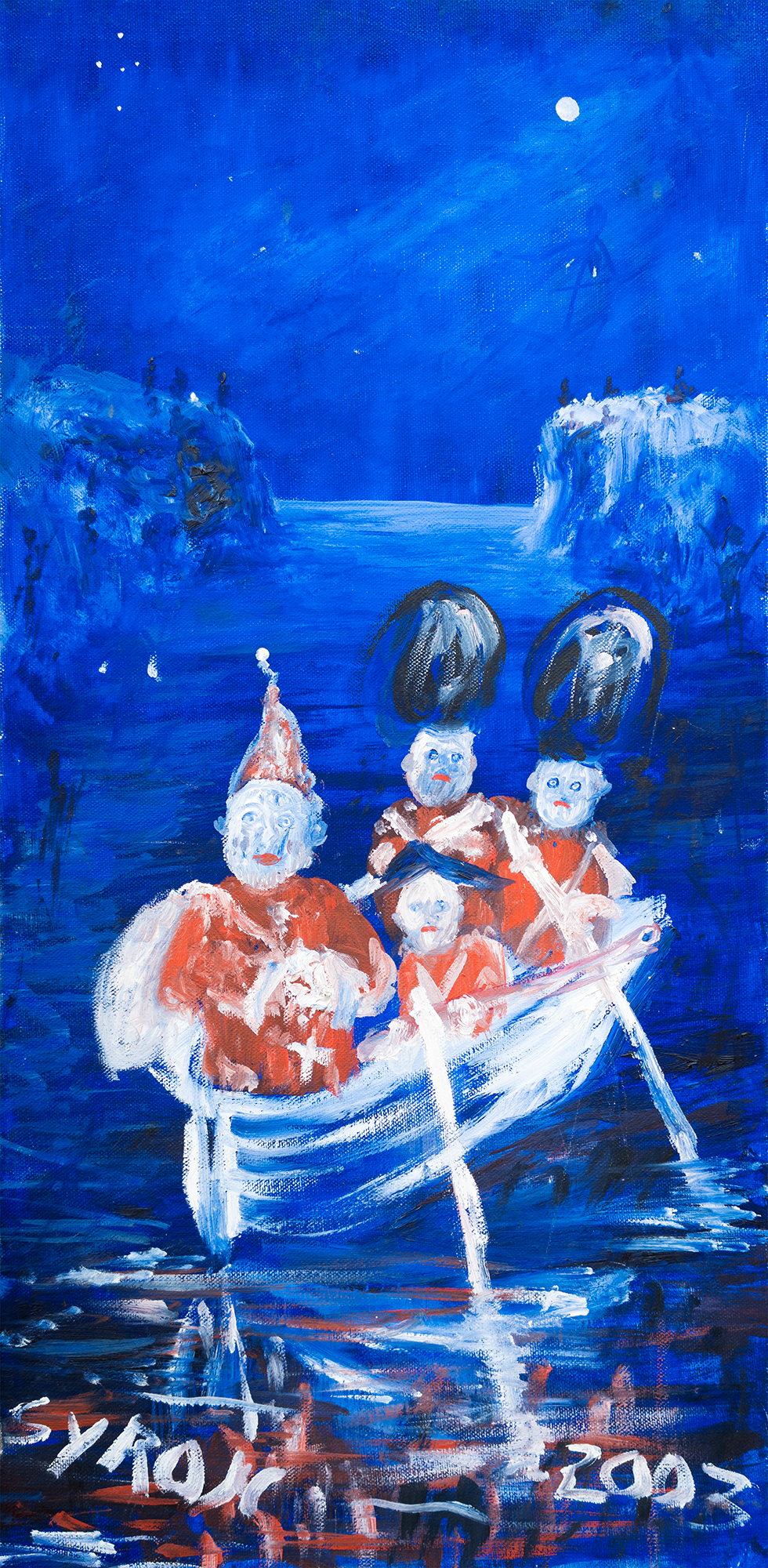
Four Red Coats, including Santa Claus who is wearing a religious cross, sail into the harbour under the moonlight, with blood reflected on the water’s surface near the shore. The Southern Cross shines at the left, while Aboriginal figures stand watching from the cliffs as the invaders arrive to massacre and take the land. Gordon nicknamed this painting “Santa is a Red Coat”.
ARTWORK STORY
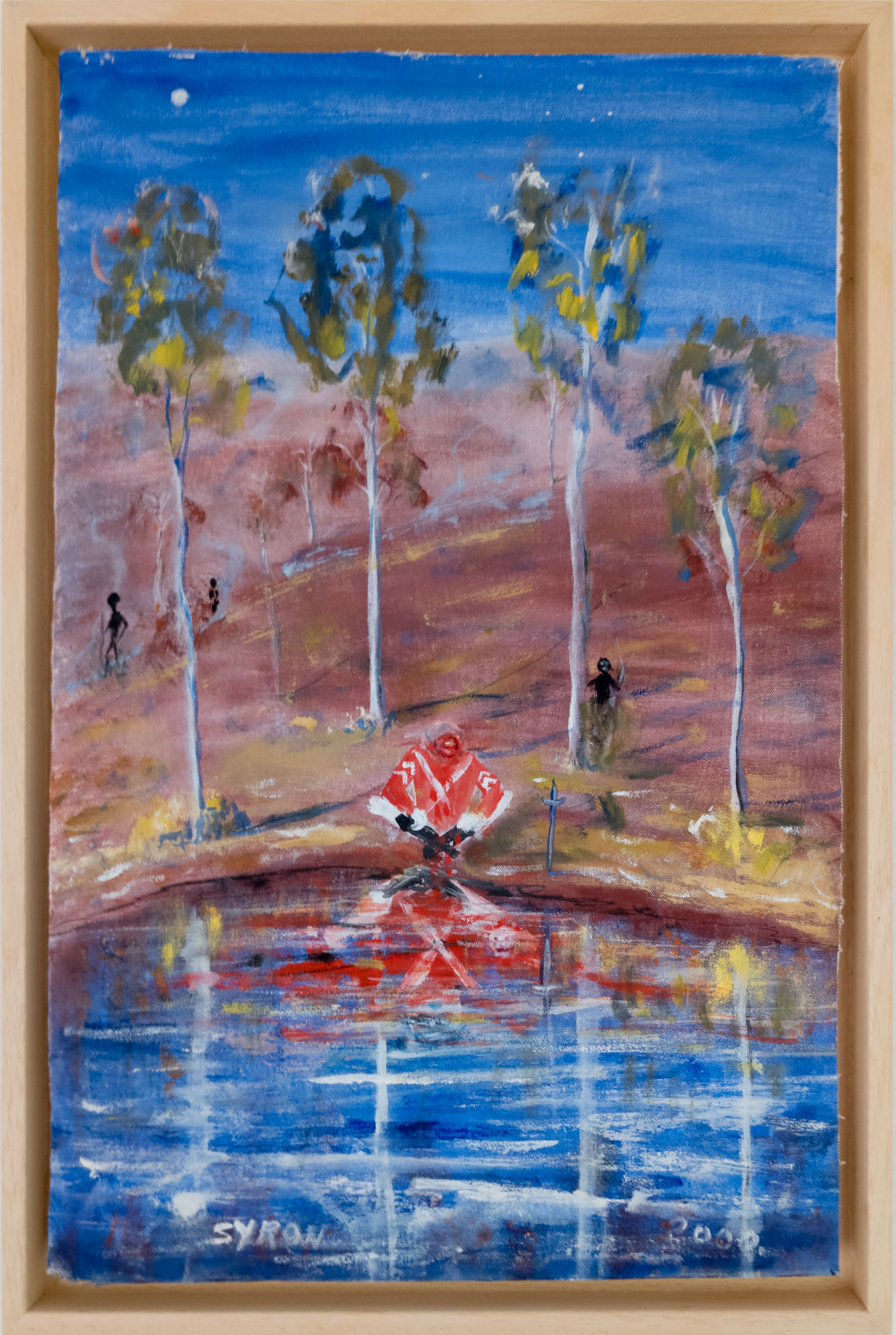
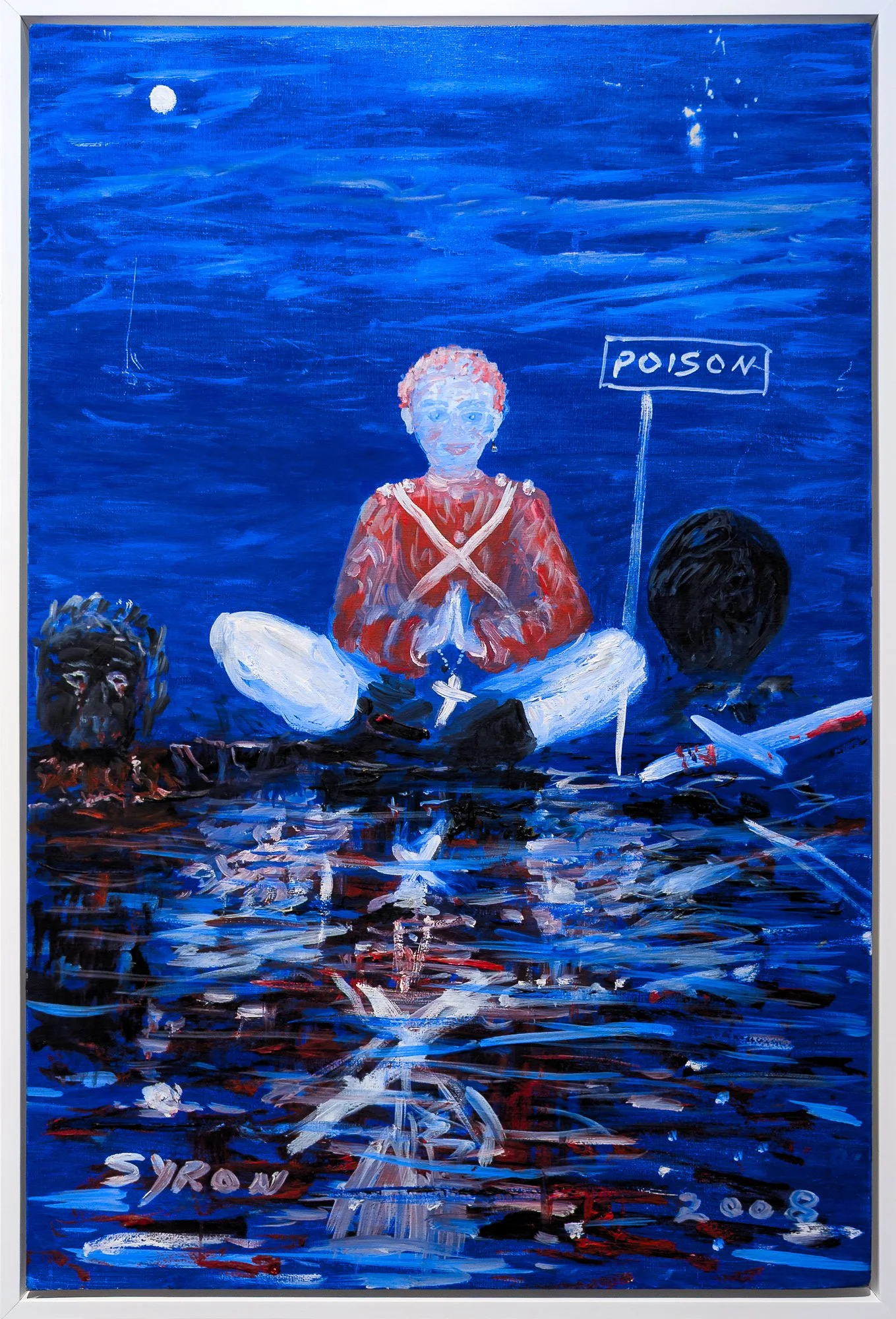
Aboriginal people stand nearby as the Redcoat pours poison (arsenic) into their precious waterhole or billabong. This painting depicts the final solution to do away with the Aborigine so the squatters could take over the land easily. A sign was probably put up to warn other white men but as Aboriginal people as well as wildlife could not read this was an effective plan to exterminate the Aboriginal population.
ARTWORK STORY
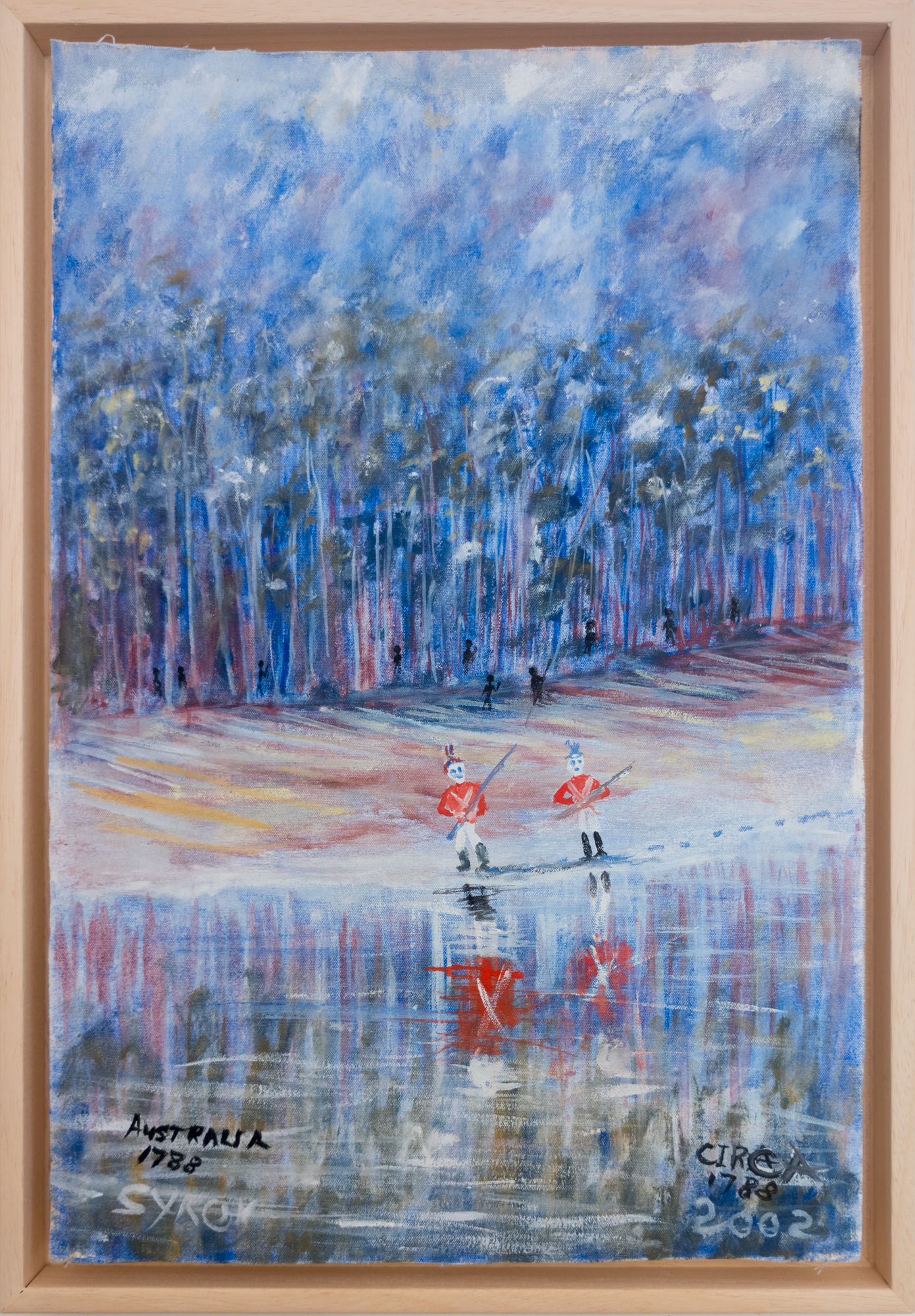
Aboriginal people stand nearby as the Redcoat invade their precious waterhole or billabong so the squatters could take over the land easily. A sign was probably put up to warn other white men but as Aboriginal people as well as wildlife could not read this was an effective plan to exterminate the Aboriginal population.
ARTWORK STORY
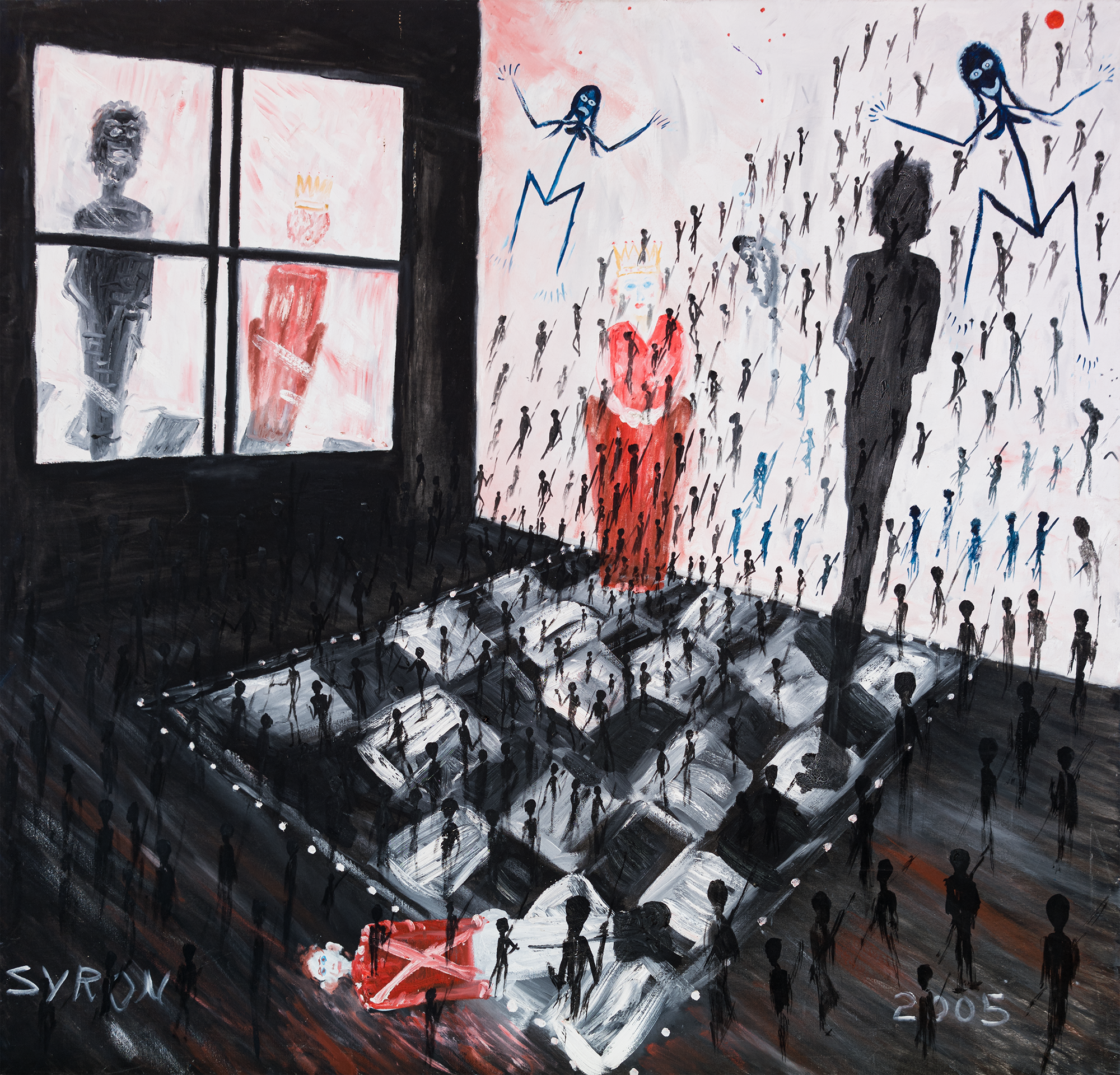
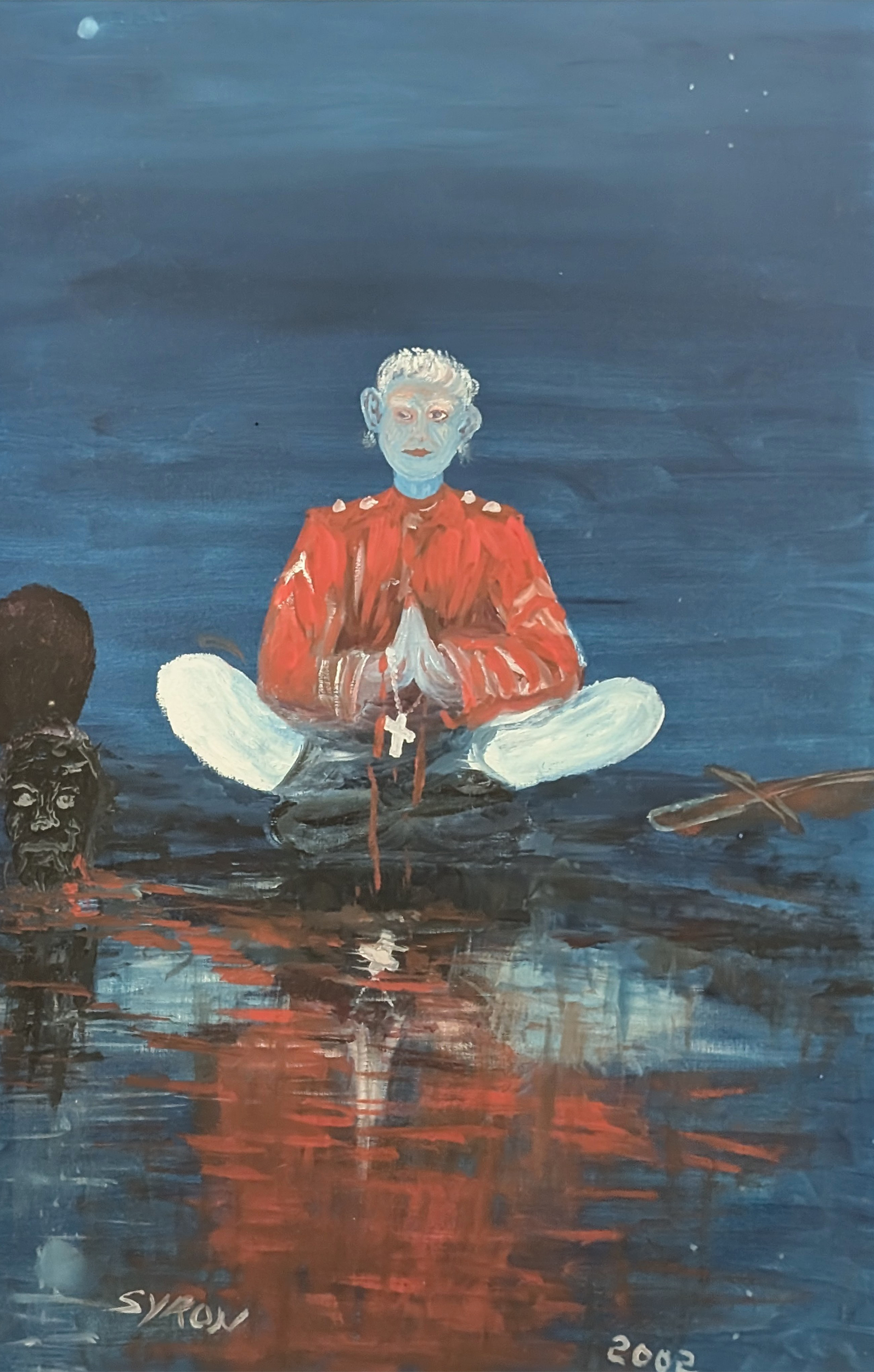
Mimi Spirits look over the Queen of England’s shoulder asking are you looking after and keeping safe from harm all the people in your colonies?
The reflection tells the story …
ARTWORK STORY
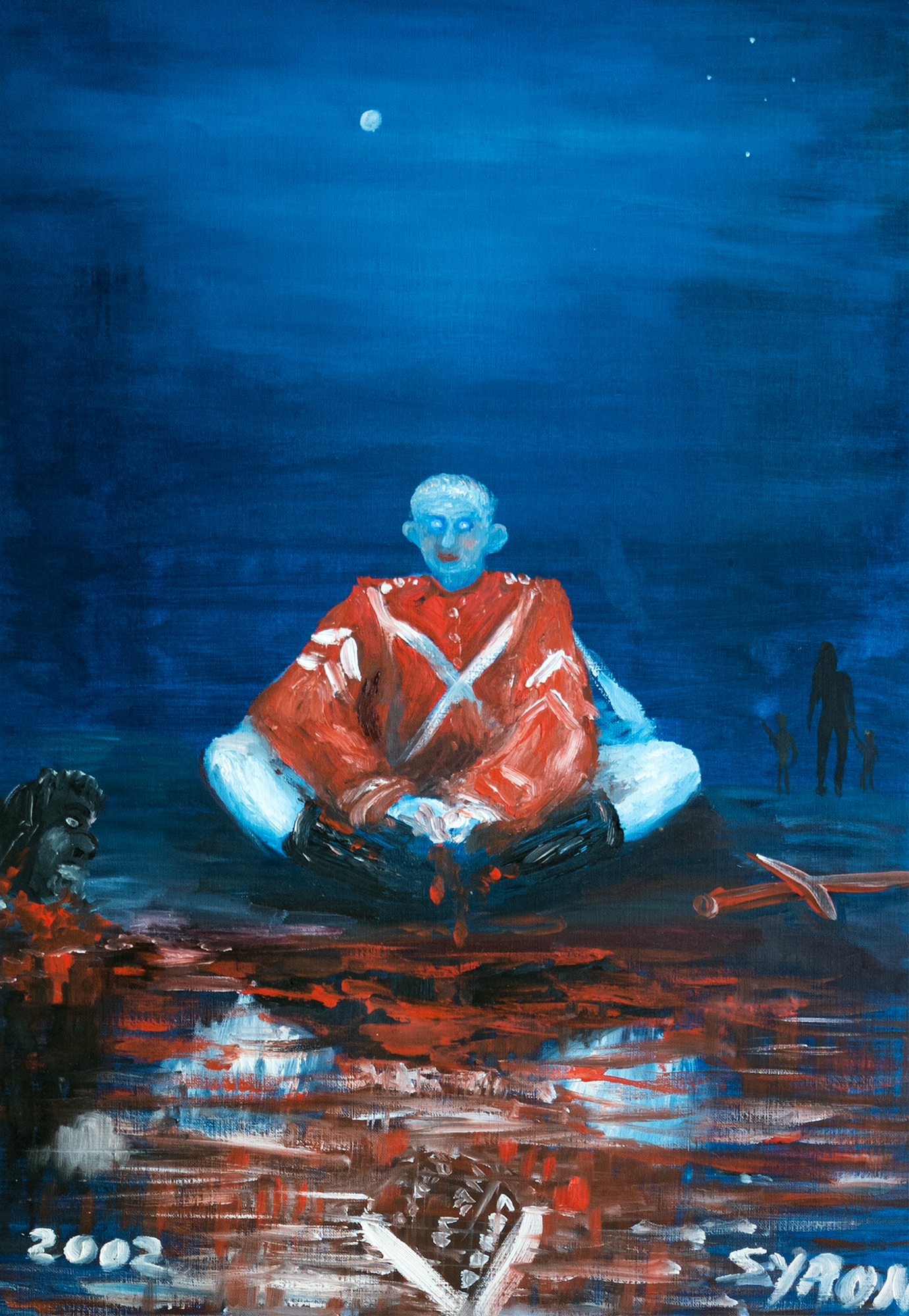
I want to show the negative feelings of the Aboriginal people, the truth is the way it was. The white master race came and took our land and did not even have the courtesy to ask us or buy it. They said we weren't even human beings when they claimed our land as 'terra nullius'.
Blood from a recent massacre is reflected on the water’s surface in the evening moonlight, while the severed head of an Aboriginal man floats in the water. The Red Coat has just washed his hands in the blood and is admiring the reflection of his uniform and Christian cross in the water.
I wanted to make the Aboriginal people in control of the land and when the ships arrived the Aboriginal people were along the shoreline and they told for them to go away. Terra Nullius was used as a valid reason to claim Australia and I dispute that claim using this painting as proof.
ARTWORK STORY
I want to show the negative feelings of the Aboriginal people, the truth is the way it was. The white master race came and took our land and did not even have the courtesy to ask us or buy it. They said we weren't even human beings when they claimed our land as 'terra nullius'. British law is alright for the British but Aboriginal law, customs, language, dance, Mimi spirits have been around a lot longer than 'British law'."
I wanted to make the Aboriginal people in control of the land and when the ships arrived the Aboriginal people were along the shoreline and they told for them to go away. Terra Nullius was used as a valid reason to claim Australia and I dispute that claim using this painting as proof.
ARTWORK STORY
I want to show the negative feelings of the Aboriginal people, the truth is the way it was. The white master race came and took our land and did not even have the courtesy to ask us or buy it. They said we weren't even human beings when they claimed our land as 'terra nullius'. British law is alright for the British but Aboriginal law, customs, language, dance, Mimi spirits have been around a lot longer than 'British law'."
I wanted to make the Aboriginal people in control of the land and when the ships arrived the Aboriginal people were along the shoreline and they told for them to go away. Terra Nullius was used as a valid reason to claim Australia and I dispute that claim using this painting as proof.
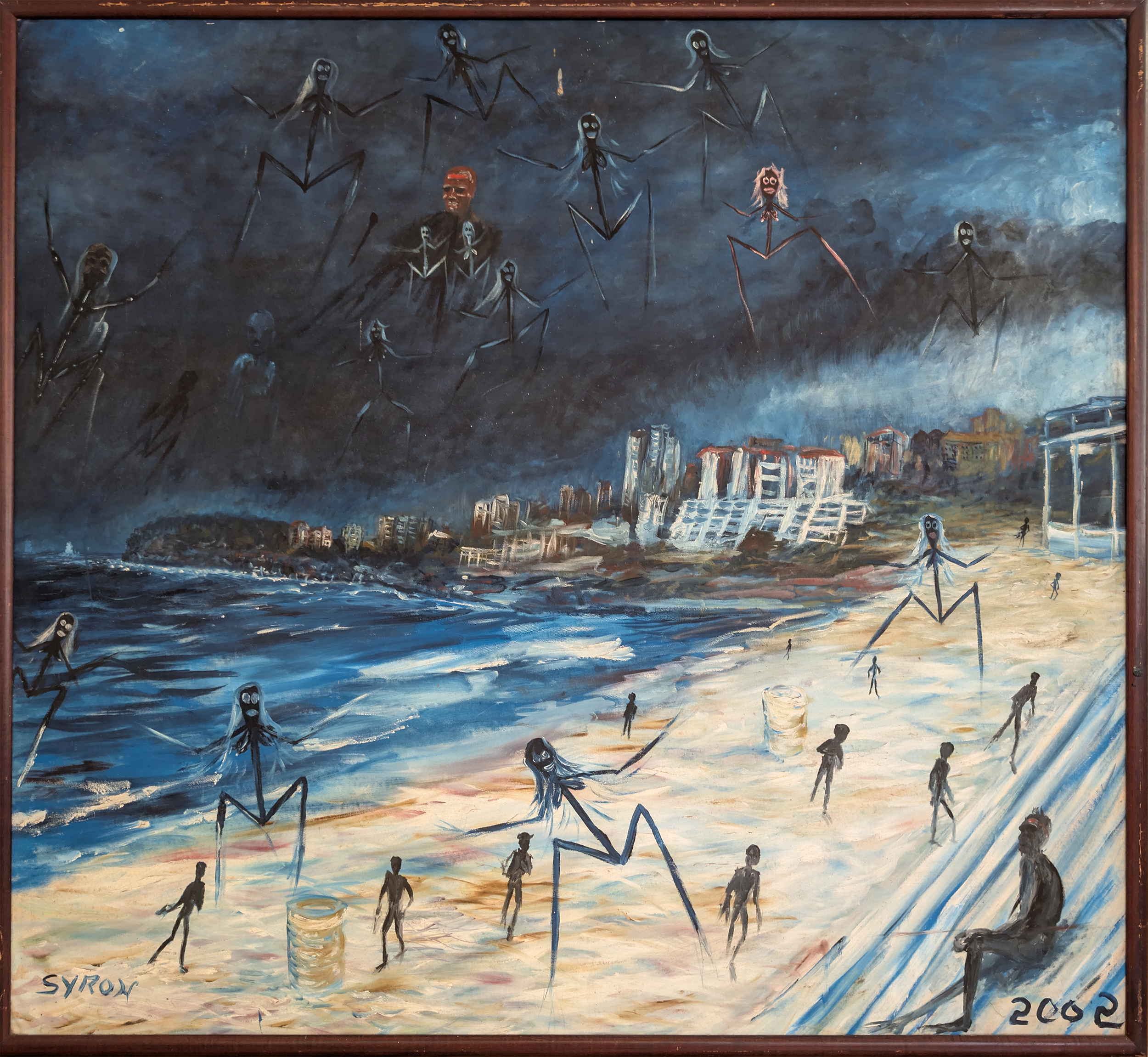
ARTWORK STORY
When Gordon painted Bondi - Black Beach, he was in pain about Bondi Beach. He talked about how a long time ago, this beautiful, breathtaking beach belonged only to Aboriginal people and how much the loss of it was painful to Aboriginal people and still causes pain for this loss, to Aboriginal people. How many people actually think wow, it must have been beautiful before colonisation? Gordon talked of how the cutting down of the trees to build a town, houses, then hotels must have angered and shocked the local Aboriginal people so many years ago. And how the commercialisation of the beach as a tourist spot over the generations the Aboriginal people have been shut out of their dreaming, their songlines, their Corroboree site where ceremonies were held, a meeting place named Bondi which is an Aboriginal word meaning.
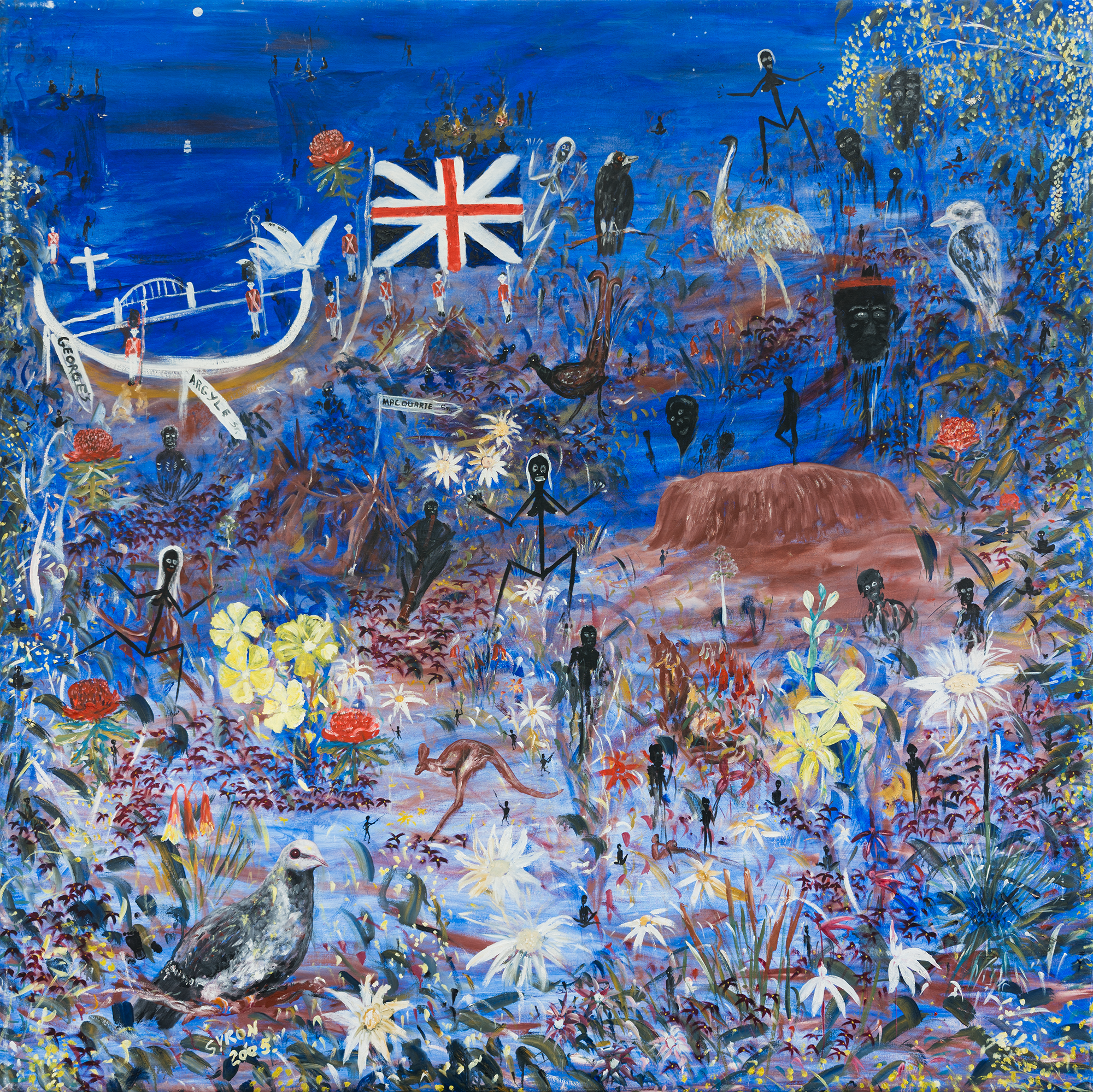
ARTWORK STORY
Depicted in the top left corner of this painting are miniature Redcoats, a cross (representing death) and the British flag, flanked by a Mimi Spirit.
As they advance from the North and South Heads of Sydney Harbour, past the Harbour Bridge and the Sydney Opera House, named streets lead to a gunyah — an Aboriginal dwelling.
Aboriginal people appear throughout the scene, alongside detailed birds and flowers. Waratahs, the NSW State flower, dot the landscape and flannel flowers with delicate points droop across the terrain.
Ayers Rock, officially renamed Uluru in 2002, dominates the outback landscape and represents remote Aboriginal communities, accompanied by wildlife including emu, kangaroo and birds. Female Mimi Spirits take giant steps as they guard the sky.
This painting tells the story of colonisation, the dispossession of Aboriginal people, and how this beautiful land was cleared.
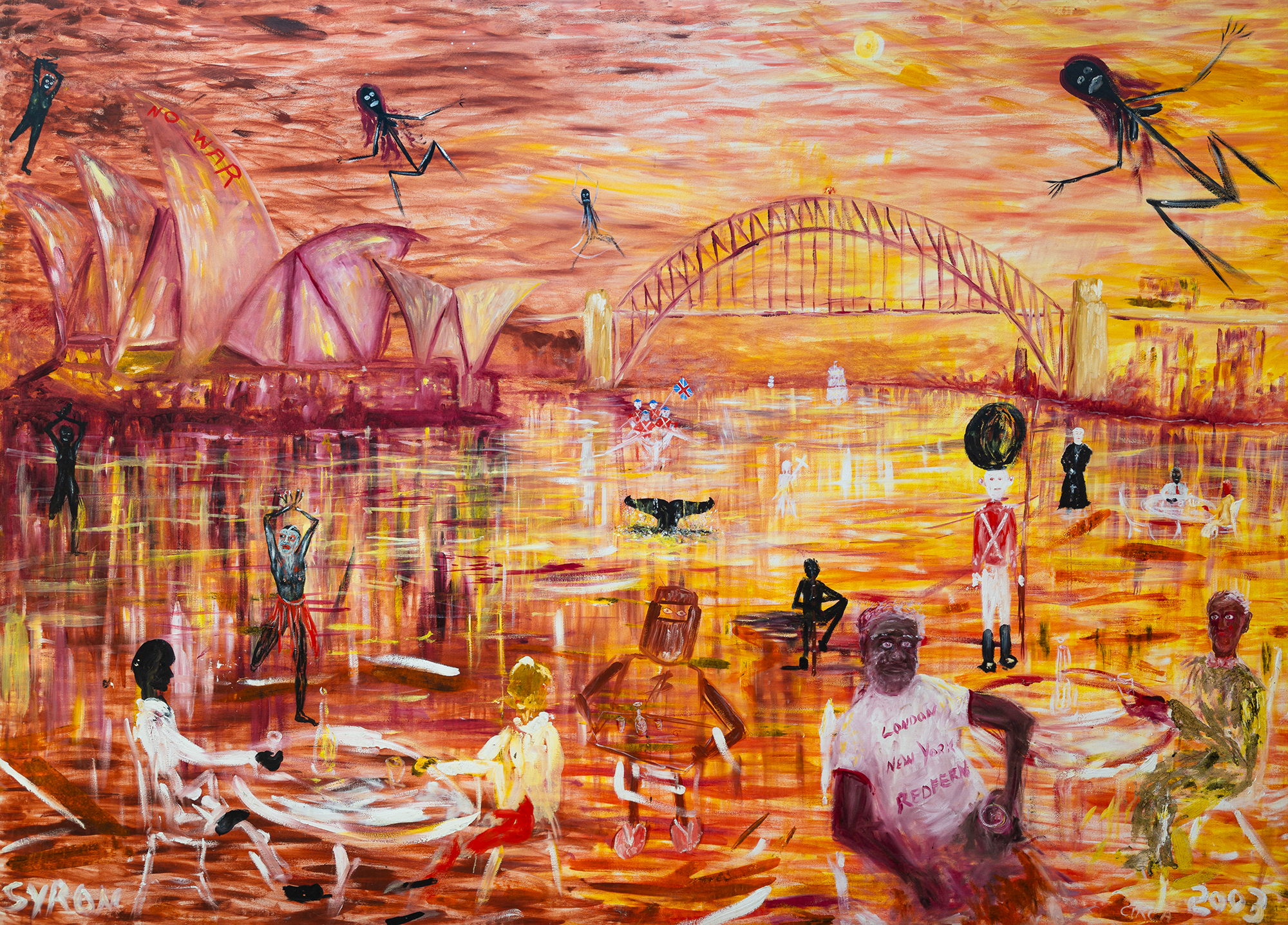
ARTWORK STORY
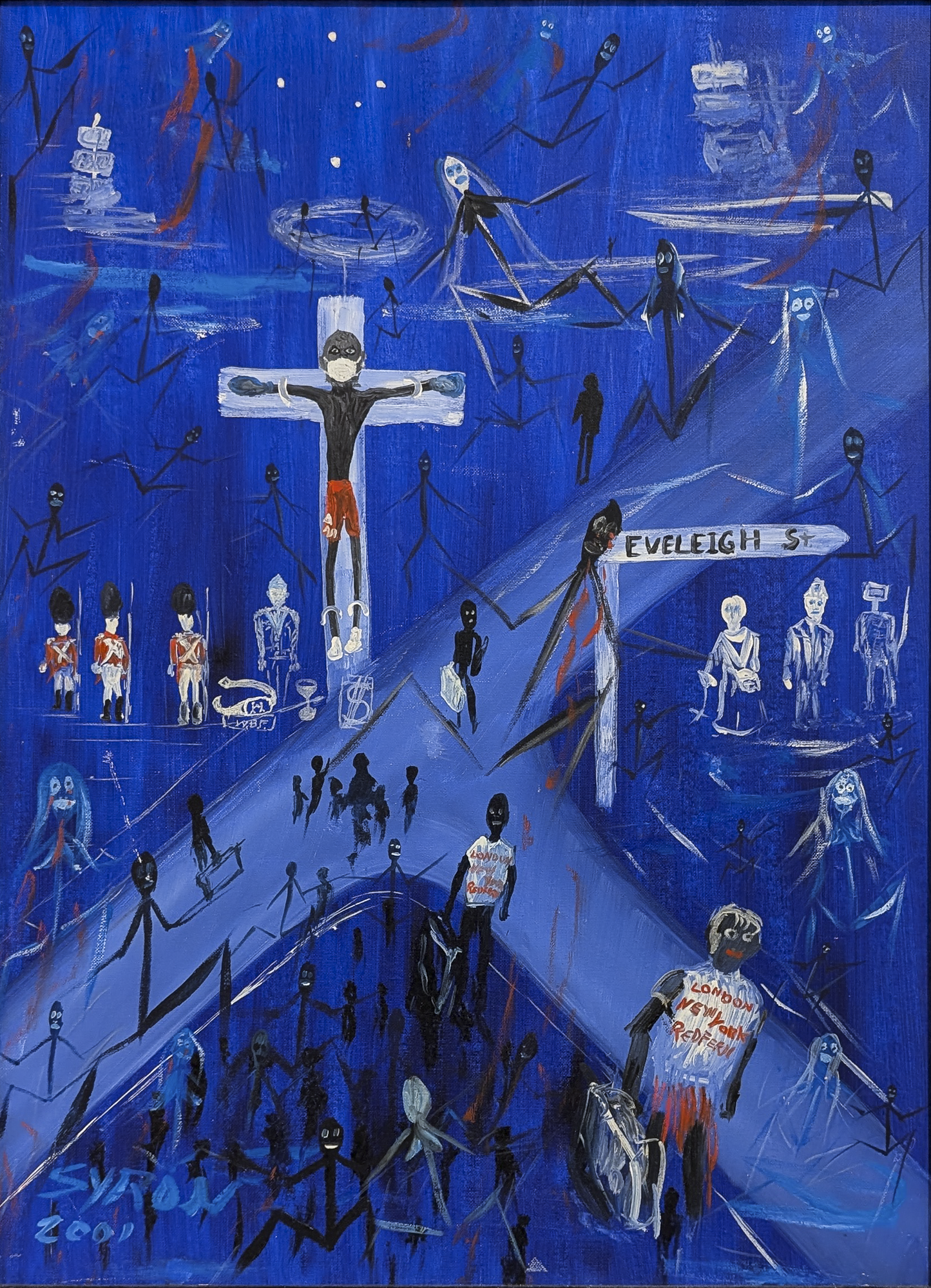
I live above my gallery in Redfern, only seven minutes by bus from the most beautiful harbour in the world. The year is 2003. Sydney — following the success of the 2000 Olympic Games — is a wonderful place to live.
The sunsets on the edge of Sydney Harbour are an artist’s dream. The orange and burnt yellow and the glowing ochres are imprinted on my mind forever. It is as if the clouds have opened and heaven has appeared
In the foreground of this painting is a self-portrait of myself and my wife-to-be the following year, Elaine. We are seated at a table with a cold drink in hand. Nearby are other tables served by Ned Kelly, one of our national icons. Aboriginal people dominate the scene. In the foreground is another table with Gary Foley sporting a shirt marked,
London
New York
Redfern
I use this theme in my series of paintings to give credit to Redfern as the cradle — or the bridge — between the traditional Aboriginal community and my heroes, who in the 1970s and 1980s, established the Aboriginal Legal Service, the Aboriginal Medical Service, Land Councils, Aboriginal Childrens’ Service, Black Theatre and Murawina (a child care centre run by three Aboriginal women, Mrs Bostock, Mrs Ingram and Mrs Merritt).
In 2003 Sydney Harbour was still clean following the enormous clean-up undertaken for the Olympic Games, and a whale even wandered into the warm waters and performed for journalists and tourists in front of the Sydney Opera House.
That same year a brave soul climbed onto the top sail of the Opera House and wrote “NO WAR”. I was impressed. It was a death-defying act of passion and conviction.
On March 19, the United States declared war on Iraq and Australia followed, sending troops as well.
The Sydney Harbour Bridge is an Australian icon in it’s own right. A strong and beautiful dancer represents NAISDA and Bangarra. Friendly female Mimi spirits dance in the sky and the children are safe tonight. A pale moon is rising. The Redcoat stands guard, ever present since colonisation. The preacher man and others hover nearby, and the Holy Cross hangs in the background, always present.
A year earlier, in 2002, Chika Dixon, a respected Elder and activist, officially opened my museum in Darlinghurst on Oxford Street. Four generations of Chika’s family — Rhonda, Nadeena and her children — danced and sang on the street and into the gallery. It had been thirty years since I received a life sentence in the Darlinghurst Court across the street, next door to Clover Moore’s office.
Oxford Street is the centre of Sydney’s nightlife and the restaurants are packed. Darlinghurst is not far from the harbour. I grew up on the Coolongolook River, so I love the water and I especially love the most beautiful harbour in the world: Sydney Harbour.
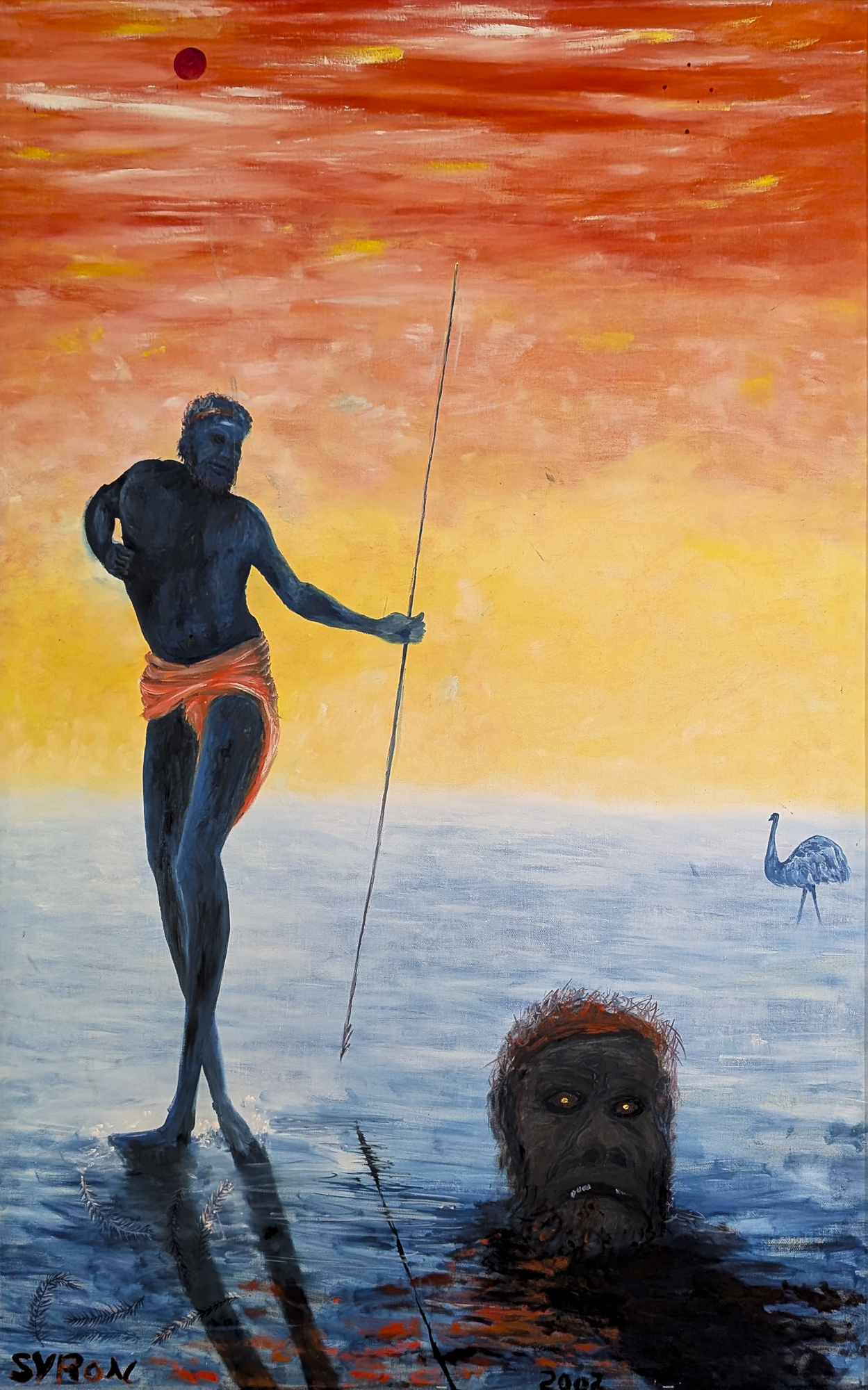
ARTWORK STORY
The Gadachi Man has magical powers and collects heads at dawn after a massacre to prevent the Redcoats taking the heads back to England. He wears emu feathers tied to his feet to cover or brush away his tracks. Also called Cleverfoot or Featherfoot meaning one to be trusted. In this painting he is running with the emus who shield him and he can change into an emu and back again.
ARTWORK STORY
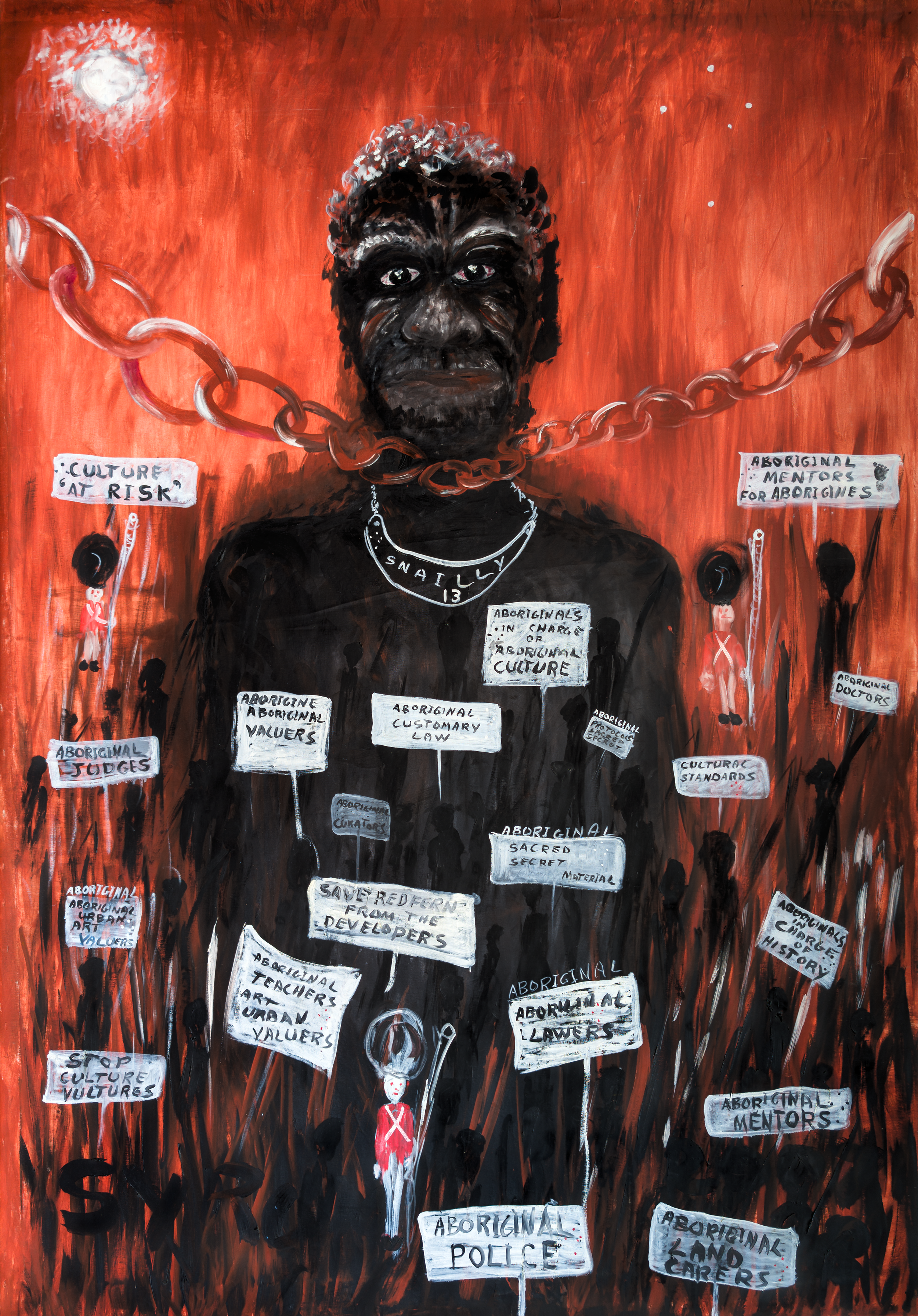
The title of this self-portrait, Snailly 13, references a brass breastplate held in The Keeping Place collection, engraved ‘Snailly, King of the River Paroo.’ The number 13 refers to the prison identification number by which Gordon Syron was known during his incarceration — a system that stripped inmates of their personal identity and further dehumanised them.
At the centre of the composition is the artist’s own naked, chained body. The inscriptions painted across the figure function as both personal testimony and political commentary. The word ‘culture’ appears repeatedly, alongside phrases such as ‘Culture Vultures’, referencing the colonial forces — often symbolised by the Redcoats — who first imposed physical chains on Aboriginal people and later more insidious mental and cultural restraints.
Painted messages across the body further articulate the artist’s vision for cultural self-determination. The phrase ‘Aborigines In Charge Of Aboriginal Culture’ calls attention to the many restrictions historically imposed on Aboriginal people—such as bans on speaking language, practising ceremony, or living according to traditional law. Through this declaration, Syron asserts the necessity for Aboriginal leadership in cultural, legal, and historical representation.
ARTWORK STORY
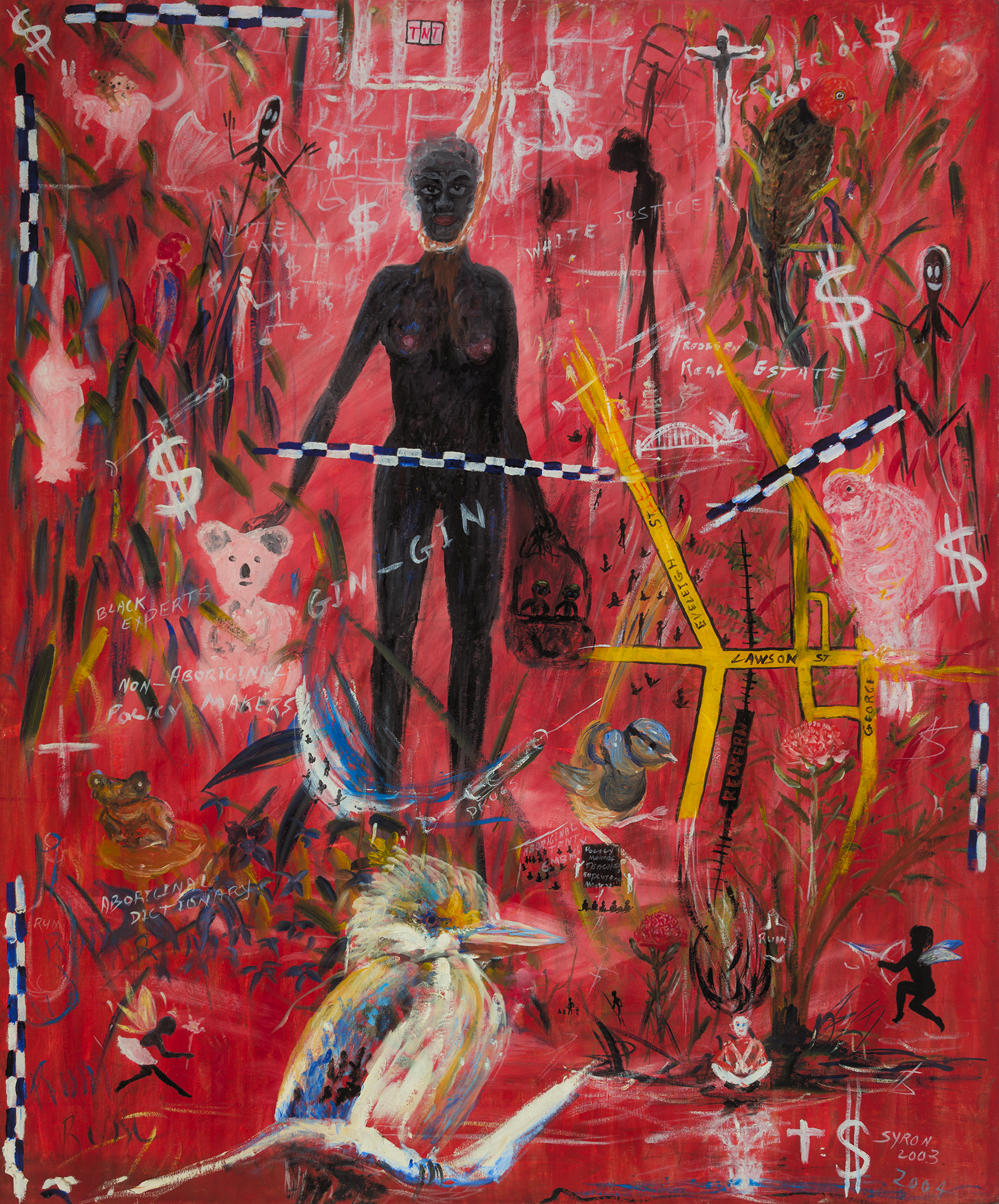
First exhibited in Black Deaths in Custody at the Balmain Community Centre in 1993, this work belongs to a group of nineteen paintings informed by the findings of the Royal Commission into Aboriginal Deaths in Custody. The exhibition was supported by the Aboriginal Arts Board of the Australia Council, and the works were later presented at NSW Parliament House in 1996 in an exhibition curated by Jane Raffan.
Like others in this group, Gordon depicts the gravestone of the individual named in the title. He learned of these stories through trial transcripts and official records, which he accessed while giving testimony to the Royal Commission itself.
This work reflects Syron’s bleak prediction that the number of Aboriginal deaths in custody would continue to rise, often as the result of imprisonment for minor offences, including the non-payment of driving or parking fines.
ARTWORK STORY
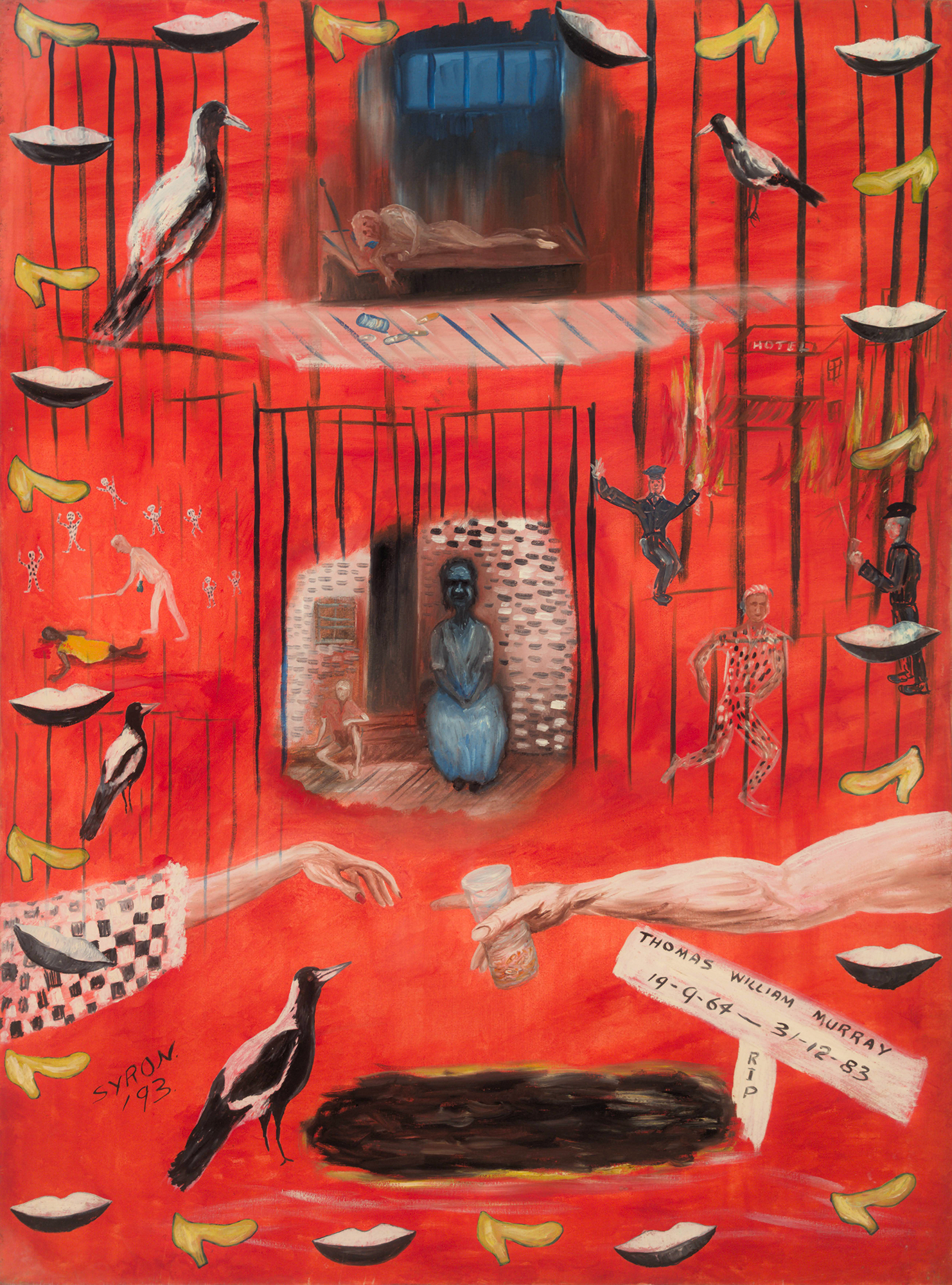
First exhibited in Black Deaths in Custody at the Balmain Community Centre in 1993, this work belongs to a group of nineteen paintings informed by the findings of the Royal Commission into Aboriginal Deaths in Custody. The exhibition was supported by the Aboriginal Arts Board of the Australia Council, and the works were later presented at NSW Parliament House in 1996 in an exhibition curated by Jane Raffan.
Like others in this group, Gordon depicts the gravestone of the individual named in the title. He learned of these stories through trial transcripts and official records, which he accessed while giving testimony to the Royal Commission itself.
Catalogue cover image for Syron’s War | Gordon Syron Retrospective, 19 March - 23 April 2026.
ARTWORK STORY
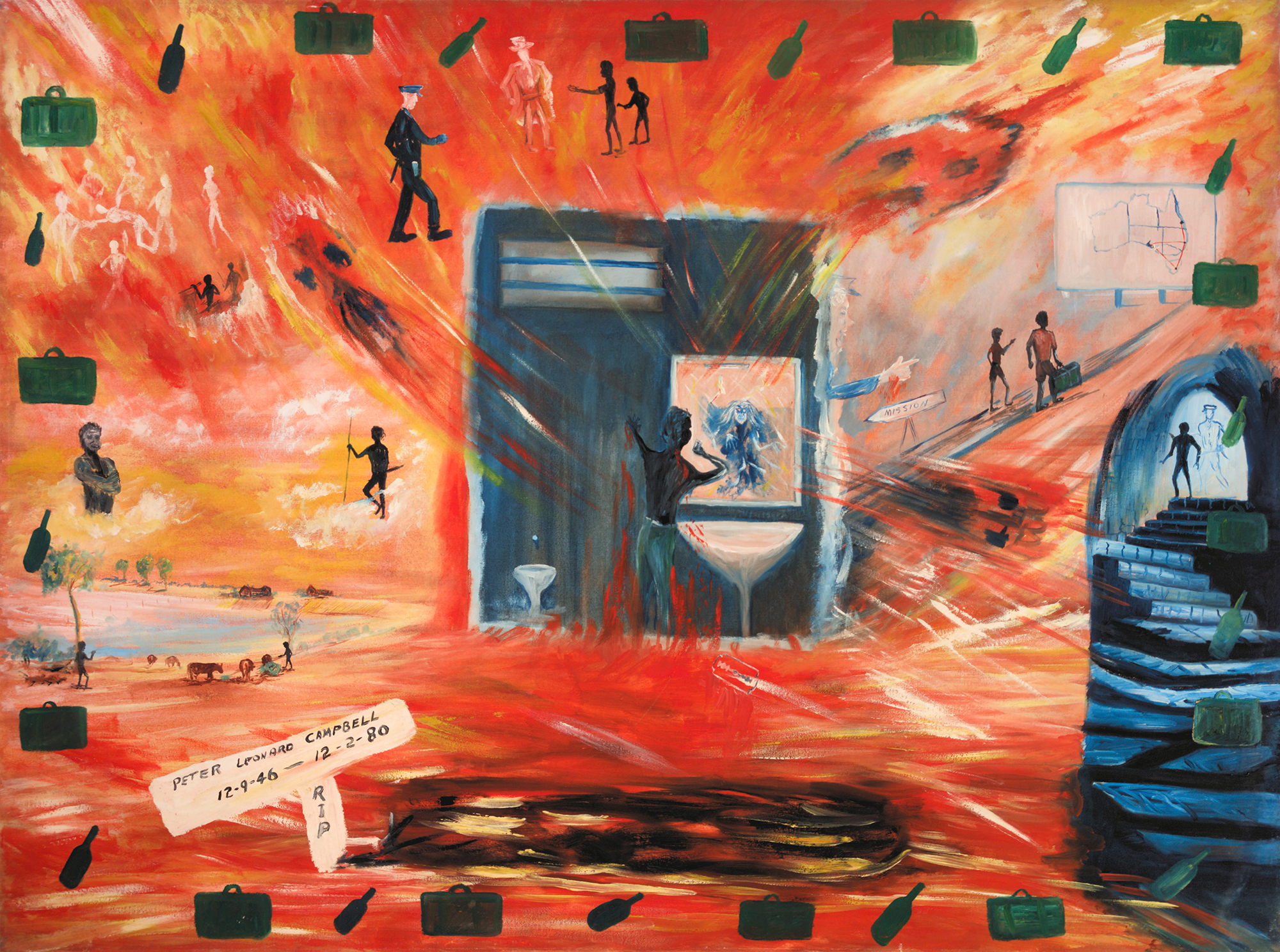
First exhibited in Black Deaths in Custody at the Balmain Community Centre in 1993, this work belongs to a group of nineteen paintings informed by the findings of the Royal Commission into Aboriginal Deaths in Custody. The exhibition was supported by the Aboriginal Arts Board of the Australia Council, and the works were later presented at NSW Parliament House in 1996 in an exhibition curated by Jane Raffan.
Like others in this group, Gordon depicts the gravestone of the individual named in the title. He learned of these stories through trial transcripts and official records, which he accessed while giving testimony to the Royal Commission itself.
The figure in this painting is shown looking into the mirror of his prison cell bathroom, where a deranged spirit is reflected back at him. A forceful explosion radiating outwards from the cell evokes the broader violence and turmoil surrounding imprisonment.
In the background to the right, two figures follow the direction of a sign reading Mission, carrying their luggage towards a map of an idealised Australia, suggesting the false promise of a better life. To the left, a policeman floats in the sky, while a colonially dressed white man turns his head away from two Aboriginal figures with their hands outstretched, reinforcing the presence of authority, indifference and exclusion that underpins the scene.
In the bottom left corner, Aboriginal figures are shown on Country beside grazing cattle and a waterhole, recalling a peaceful way of life that once was.
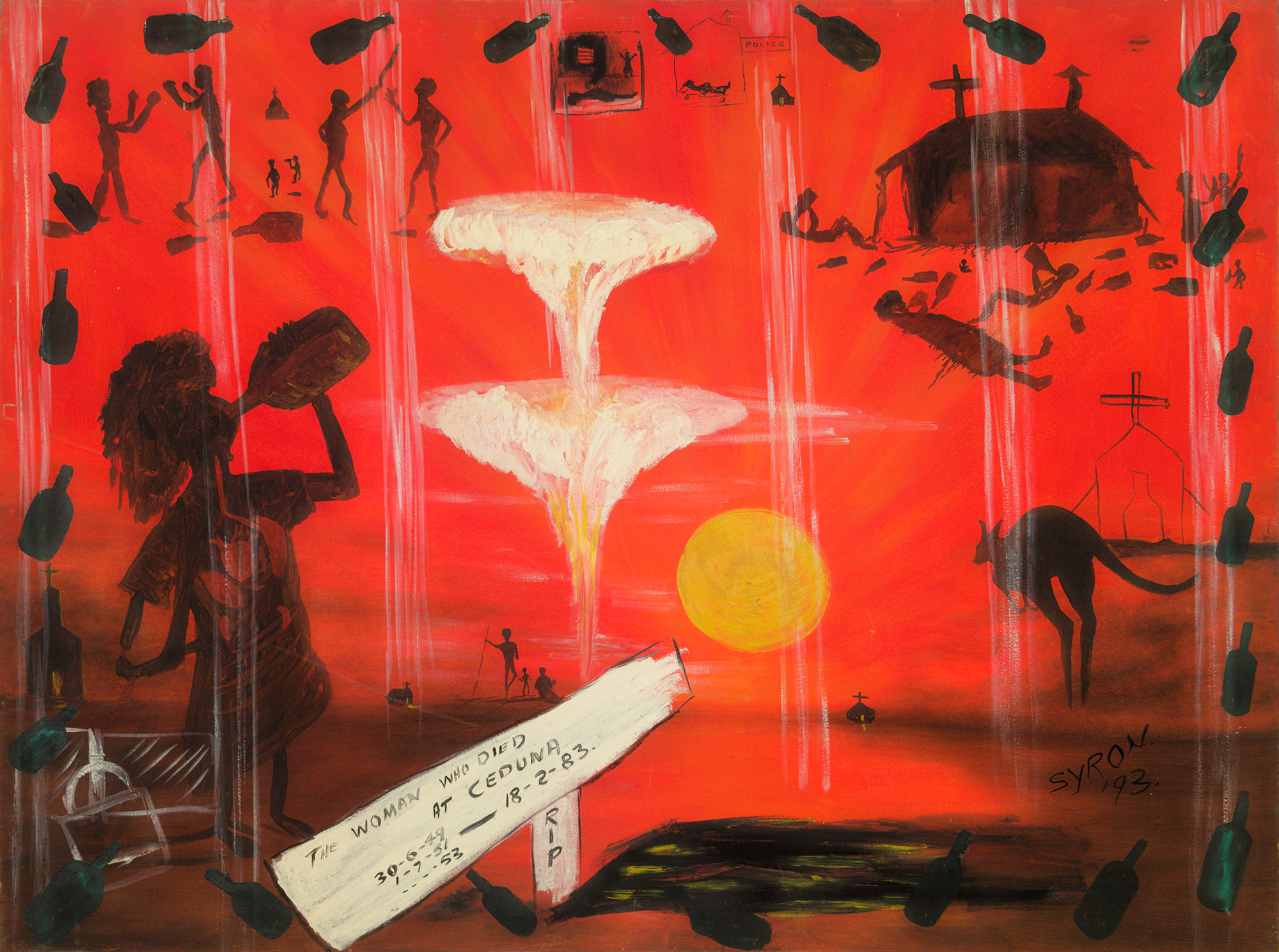
ARTWORK STORY
First exhibited in Black Deaths in Custody at the Balmain Community Centre in 1993, this work belongs to a group of nineteen paintings informed by the findings of the Royal Commission into Aboriginal Deaths in Custody. The exhibition was supported by the Aboriginal Arts Board of the Australia Council, and the works were later presented at NSW Parliament House in 1996 in an exhibition curated by Jane Raffan.
Like others in this group, Gordon depicts the gravestone of the individual named in the title. He learned of these stories through trial transcripts and official records, which he accessed while giving testimony to the Royal Commission itself.
On loan from the collection of the National Gallery of Australia
ARTWORK STORY
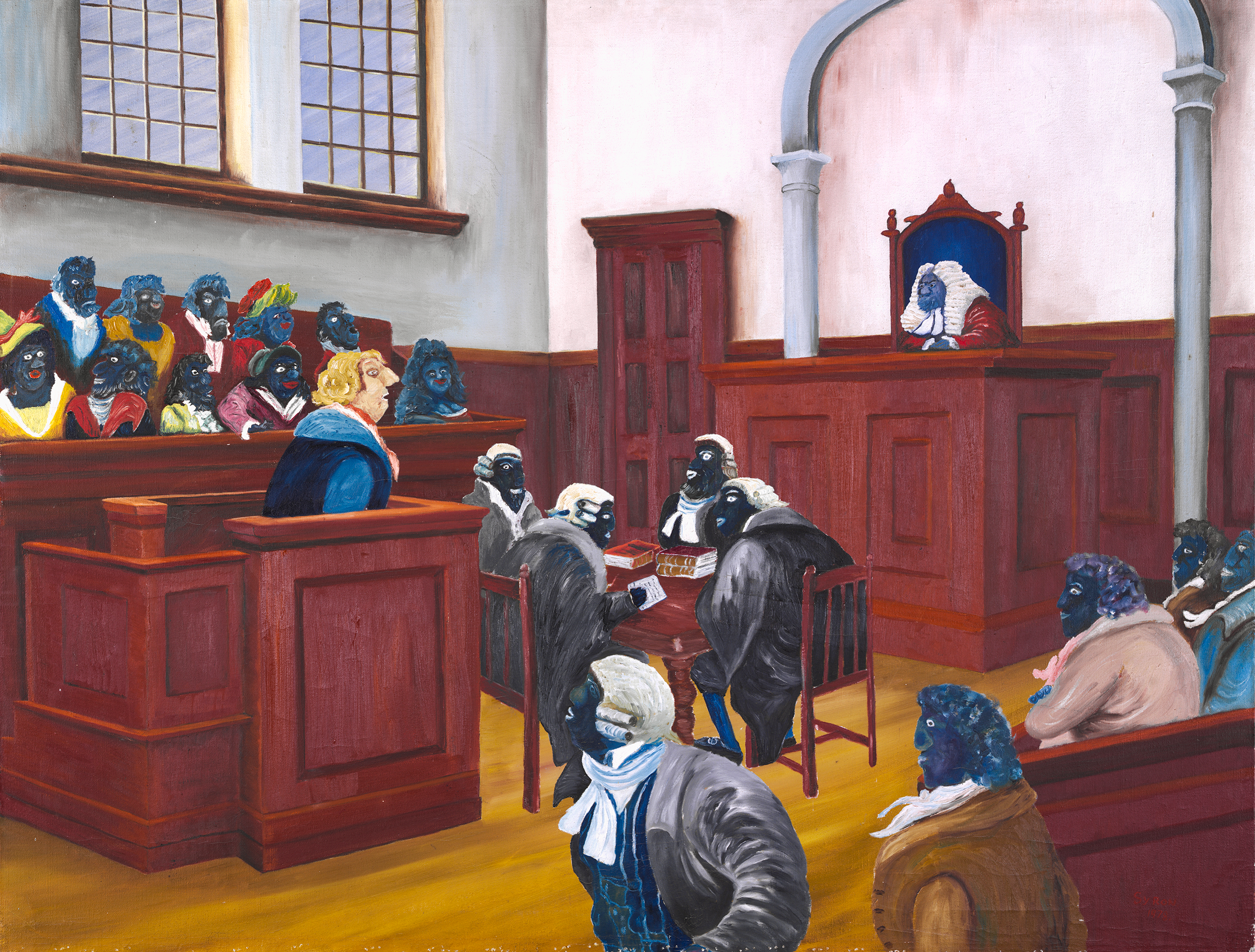
This painting was created in Long Bay Gaol and first hung in the artist’s prison cell while he was serving a life sentence for a death that resulted from tribal retribution.
It was first shown publicly at Murawina (meaning ‘Black Woman’) — a childcare centre on Eveleigh Street, Redfern — in 1978–79. The exhibition was organised by three of the seminal women working with children on ‘the Block’: Mrs Bostock, Mrs Merritt and Mrs Ingram. The Block was a hotbed of political tension at this time, yet according to the artist:
‘Not one car was touched. All who came were safe. Many law people attended. I came out of prison for the evening to attend my own art exhibition and a prison officer accompanied me. He said, “Just call me Jack for the evening instead of Sir!”’
The painting was initially exhibited under the title The Real Australian Story. Reflecting on its subject, the artist later stated:
‘I believe I would not have been sentenced at all, had I been judged by an Aboriginal jury. In British law a man is judged by his peers.’
In explaining the background to this work, Syron said:
‘This painting is my most meaningful work. It is the story of my life. This trial happened to me. I challenged the jury system of Australia. I asked that I be judged by my peers, and your peers are your equals. I asked to have some Aboriginal people on my jury. One lawyer said that I wasn’t black enough to be black and the other lawyer said that I wasn’t white enough to be white. They then argued this point in front of me for some time. Both my parents were Aboriginal. It was such an insult to me and my family. I was judged by an all-white jury. (If you are a pink fella then according to British law and now Australian law you are entitled to have a pink person on the jury.) I served a life sentence.’
The painting instantly struck a chord with Aboriginal audiences given the high rates of incarceration at the time.
Today the disparity has grown even more stark: Aboriginal people make up roughly one-third of the prison population in New South Wales while representing just over 3% of the state’s population.
On loan from the National Gallery of Australia.
Not for Sale 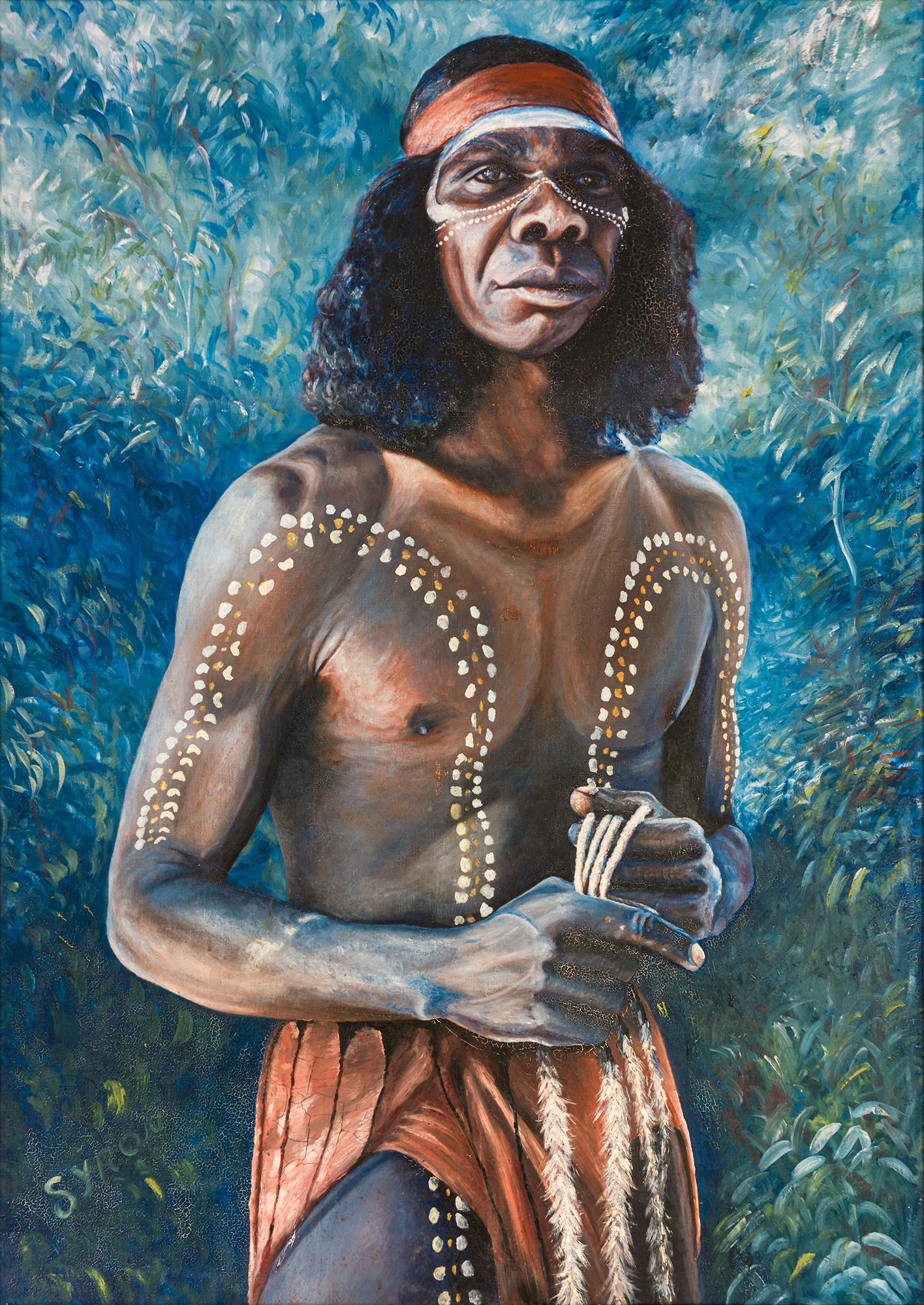
ARTWORK STORY
This portrait of David Gulpilil AM was painted in 1988 as Syron’s entry for the Archibald Prize. This painting was returned to a devastated Syron, 40 paintings were hung but even though it was the Bicentennary Celebratory Year of 1988, it was not selected).
PRICE
Price on application to adrian@newsteadart.com
ARTWORK STORY
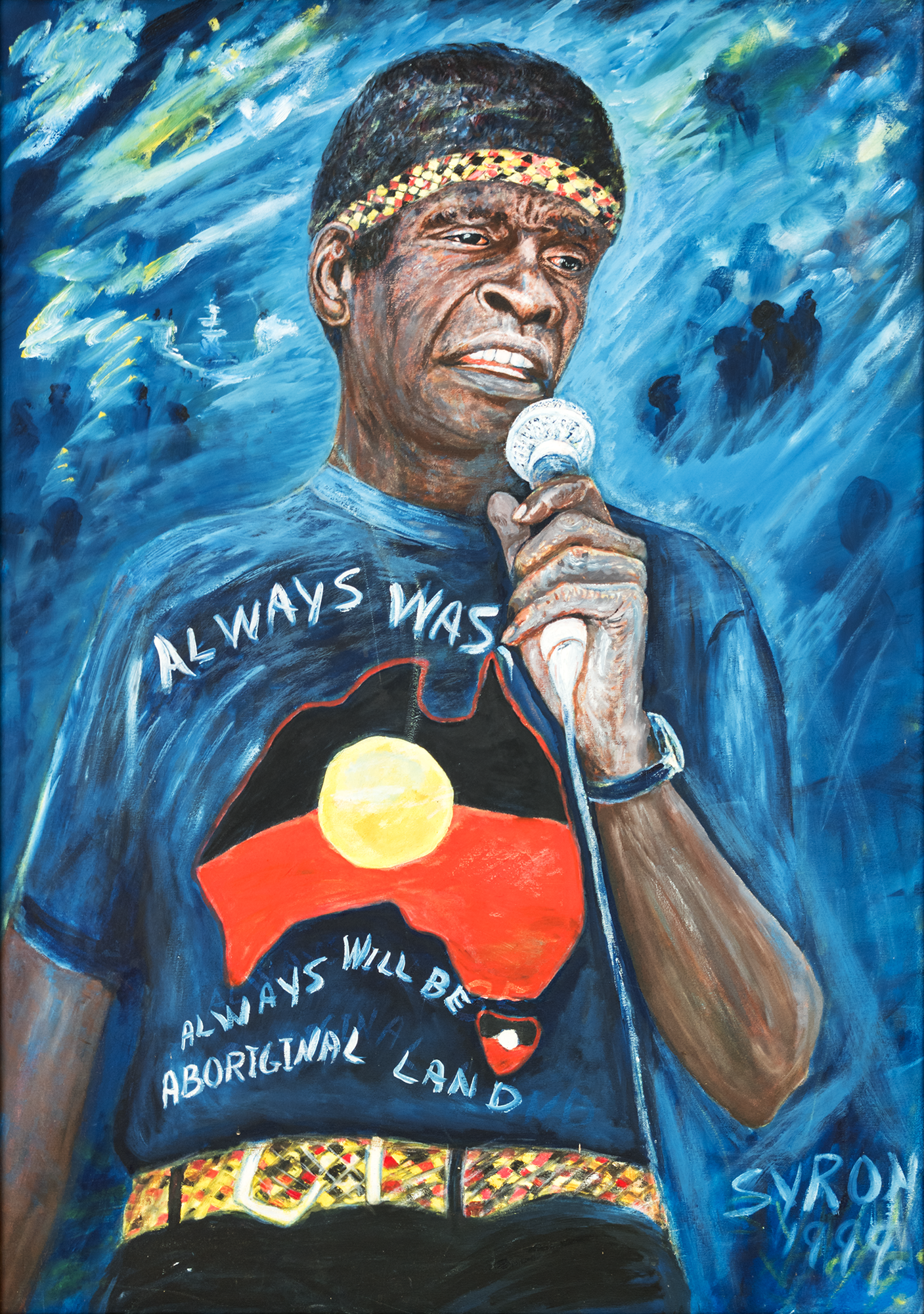
George was from Elcho Island and the front man of the famous Warumpi Band. He was brought up in a traditional way and knew language. Syron identified with his personal story of spending time in prison. This portrait was painted after George sang at Survival Day Concert January 26, 1999. His shirt read ‘Always Was Always Will Be Aboriginal Land’.
PRICE
Price on application to adrian@newsteadart.com
ARTWORK STORY
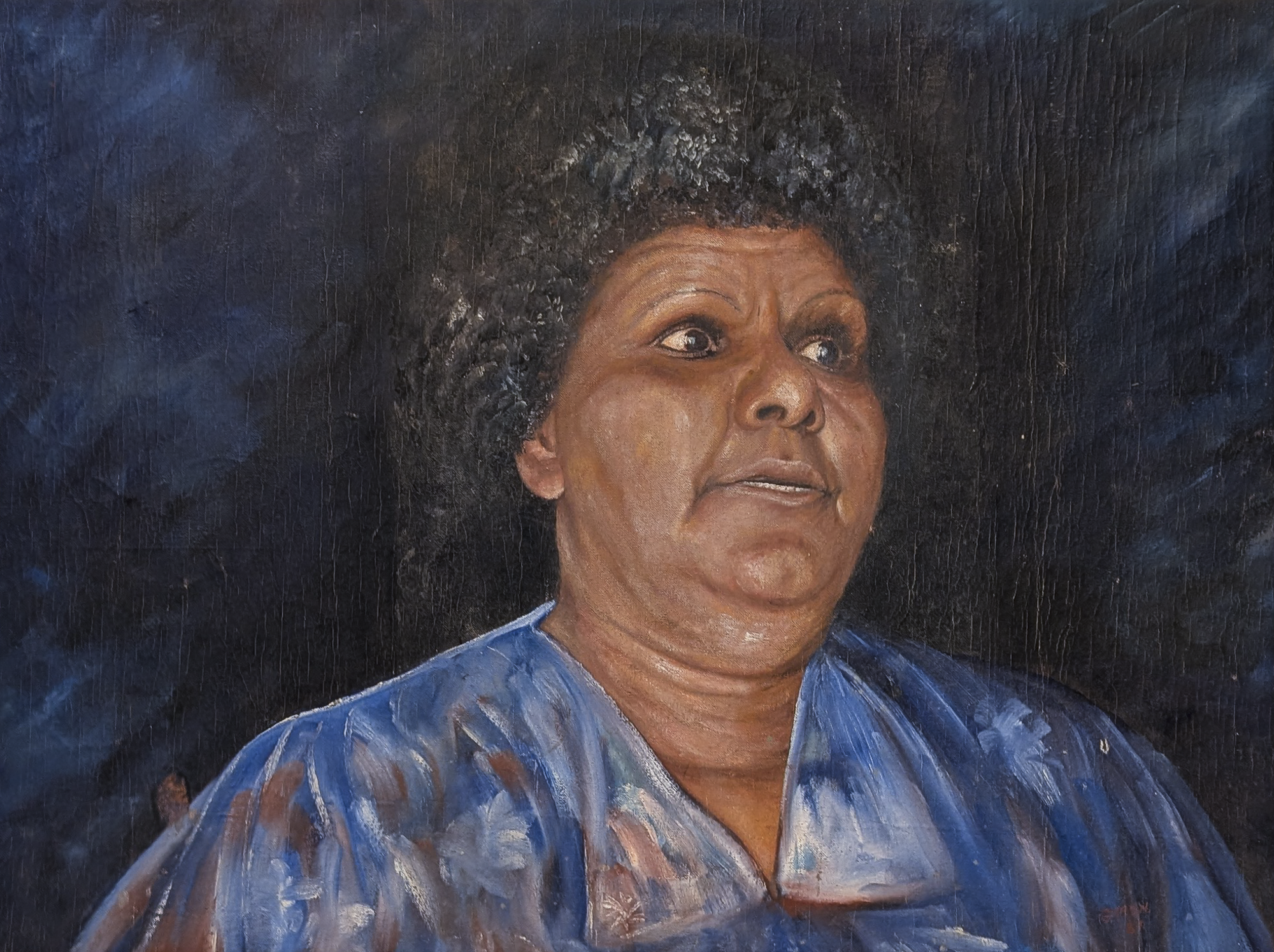
I was in maximum security prison when Mum Shirl first visited me in 1973. She had principles. I fought against graft and corruption and went to prison for it. Mum Shirl didn't cut no ice. She didn't care which uniform you had on, she didn't cop it.
She was a strong woman and was fair. She was straight. She fought for reform. She couldn’t read or write because she was epileptic and didn’t to school but she was respected by the prison officers and by 'One and All'. She was motivated by prisoner's rights - nobody else cared. People didn't know what went though my head when I did this painting I felt close to her.
*Mum Shirl had a state funeral at St Mary's Cathedral. The above statement formed part of a handwritten letter by Gordon, which was placed underneath a different portrait of Mum Shirl painted by Syron (Mum Shirl, 1998) for the Archibald Prize. The painting was not hung.
PRICE
Price on application to adrian@newsteadart.com
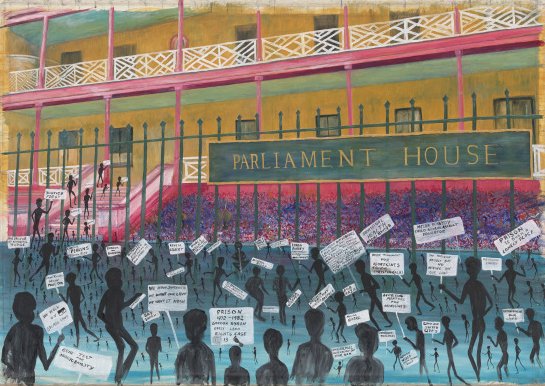
On loan from the National Museum of Australia
Not for sale
On loan from the National Museum of Australia.
Not for Sale 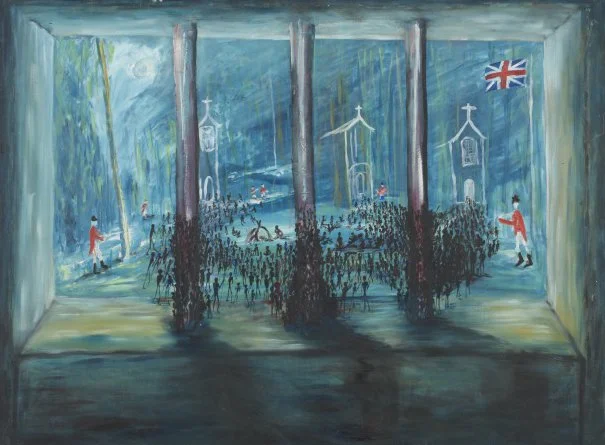
On loan from the National Museum of Australia
Not for sale
ARTWORK STORY
Gordon Syron Painted while in prison.“ This painting is unsigned because prison is such a lonely place. This painting is my prison window that I looked at for 10 years and I saw history through these bars that the redcoats brought to us; disease, rum, religion and death and destruction for my culture.
Gordon Syron is widely considered the father of the Urban Aboriginal art movement. He taught himself to paint during a decade serving time in gaol during the 1960s. This lithograph was his first experiment with printmaking.
Looking through the bars on the window of his gaol cell he could see a church and graveyard - potent symbols of Aboriginal dispossession and the death of culture - a recurrent theme in his painting. The metal bars have an inner and outer layer. Like a person who manages to retain their humanity and survive under terrible adversity they are soft on the outside but case-hardened down the centre. There is no escape other than through the imagination. A depressing thought - represented by the gravestone which has been substituted for the missing piece of bar.
On loan from the National Museum of Australia.
Not for Sale 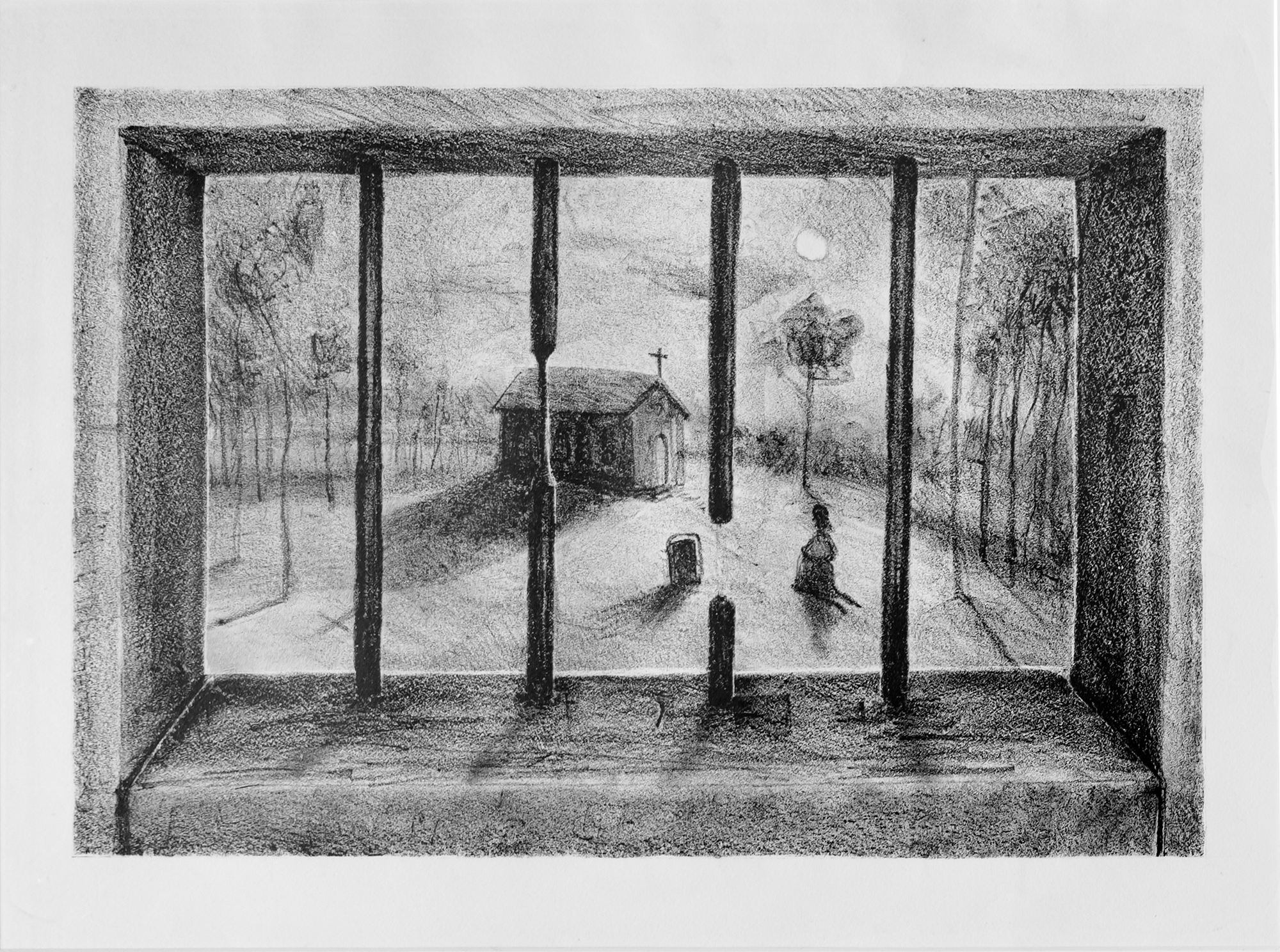
ARTWORK STORY
Gordon Syron Painted while in prison.“ This painting is unsigned because prison is such a lonely place. This painting is my prison window that I looked at for 10 years and I saw history through these bars that the redcoats brought to us; disease, rum, religion and death and destruction for my culture.
Gordon Syron is widely considered the father of the Urban Aboriginal art movement. He taught himself to paint during a decade serving time in gaol during the 1960s. This lithograph was his first experiment with printmaking.
Looking through the bars on the window of his gaol cell he could see a church and graveyard - potent symbols of Aboriginal dispossession and the death of culture - a recurrent theme in his painting. The metal bars have an inner and outer layer. Like a person who manages to retain their humanity and survive under terrible adversity they are soft on the outside but case-hardened down the centre. There is no escape other than through the imagination. A depressing thought - represented by the gravestone which has been substituted for the missing piece of bar.
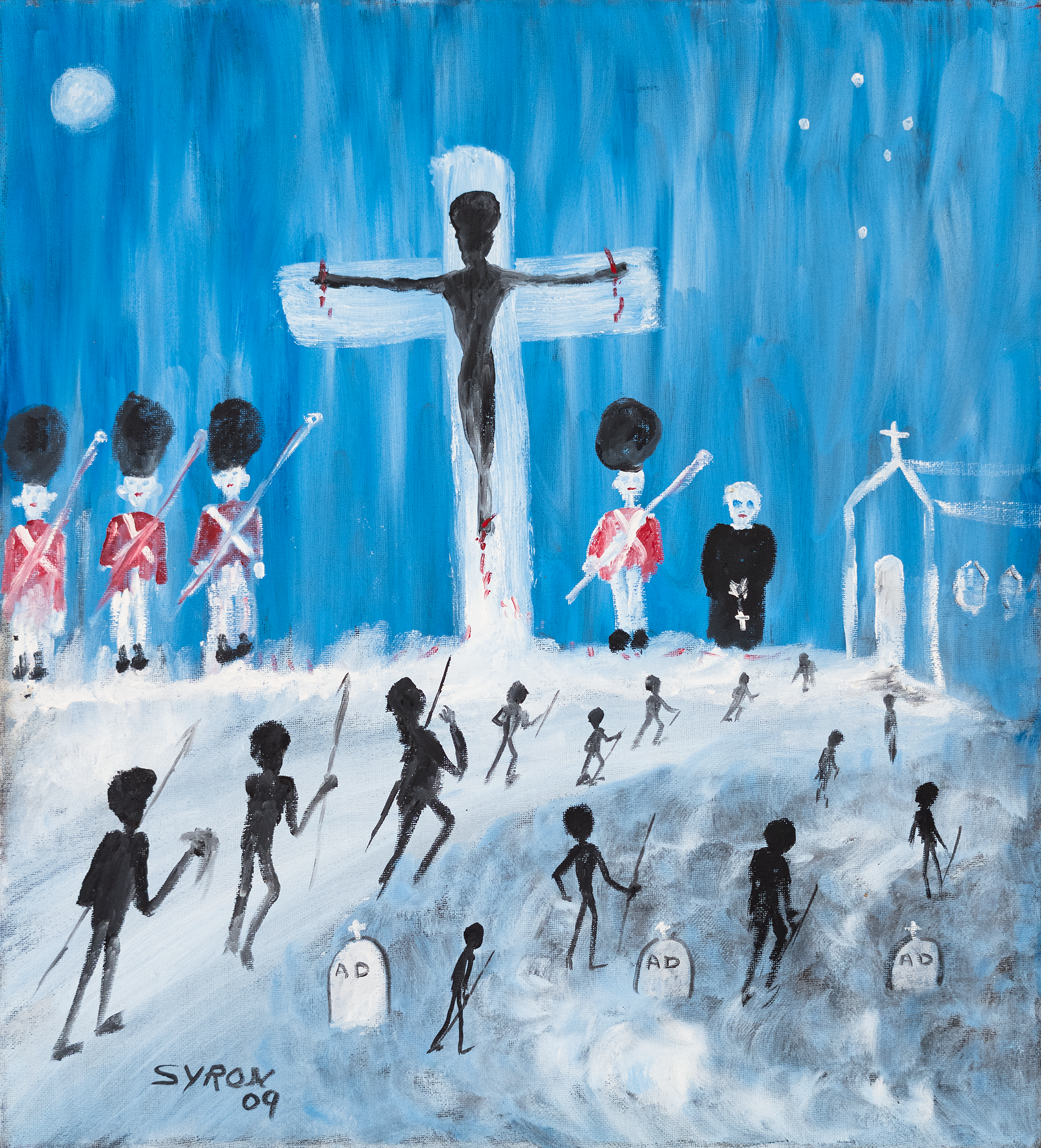
ARTWORK STORY
What is the gender of God?
Is God a man or a woman?
I ask is God black or white or pink or yellow?
As Aboriginal men are herded onto the mission, they are expected to surrender their spears in a pile at the gate. Some refuse, holding their spears in defiance. The Redcoats stand by, while the Preacher man patiently waits for the Aboriginal people to come into the church to be converted to Christianity and be saved from their sins. There are three tombstones in the foreground and the southern cross is visible in the top right corner.
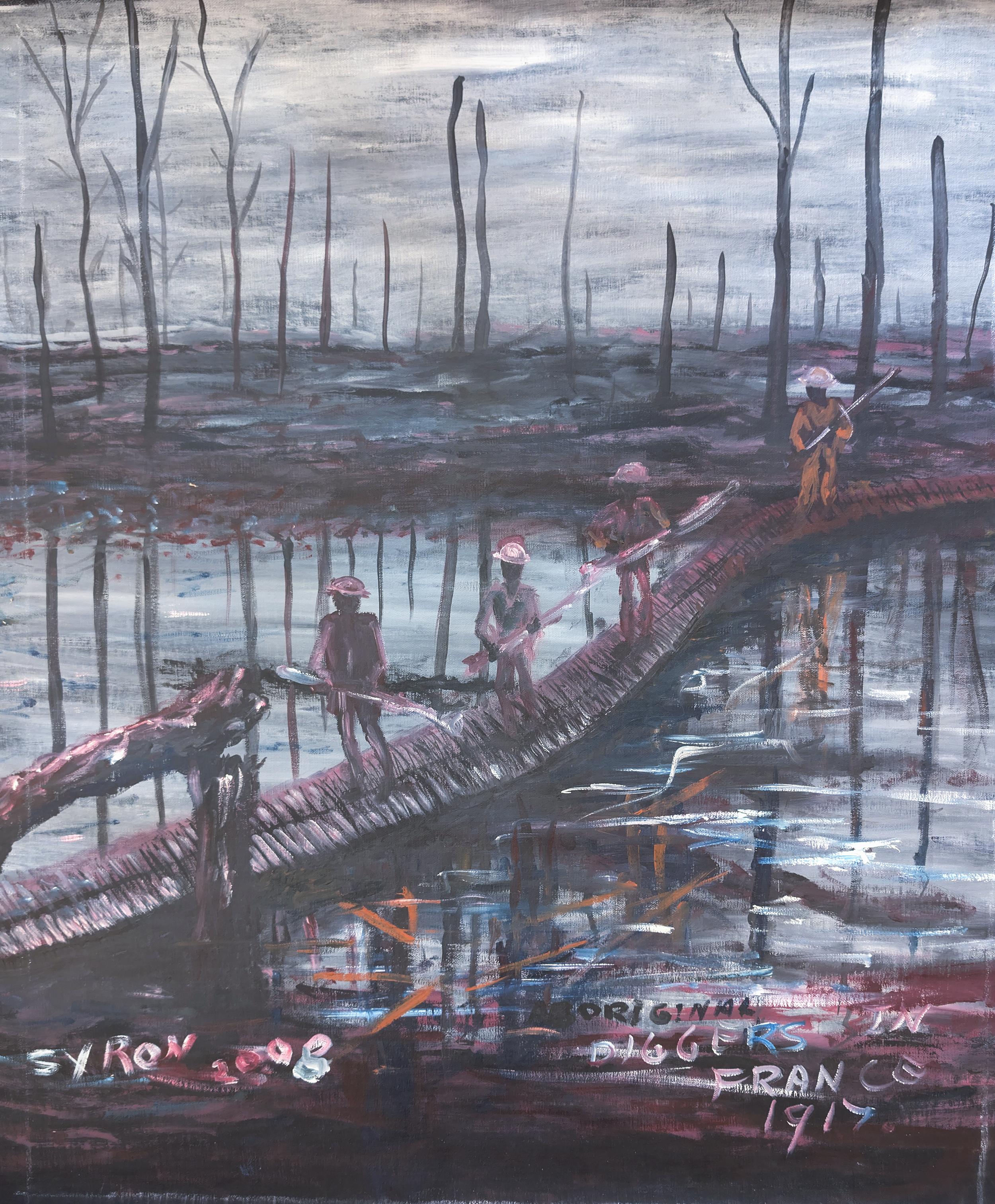
ARTWORK STORY
This work from the Aboriginal Diggers series reflects the long and often overlooked history of Aboriginal people who served in Australia’s wars, yet returned home to little or no recognition for their service. Many Aboriginal men enlisted in World War I despite facing discrimination in their own country. Some could not read or write and were required to sign with an X when enlisting.
Although many Aboriginal men fought alongside other Australians, they were denied the rights, respect and benefits granted to non-Indigenous soldiers after the war. When Aboriginal diggers returned home, they were not granted the parcels of land promised to them and given to white returned soldiers. Many were not even provided with train or bus fares to get home, and were pushed to the margins of welcome home celebrations. Their loyalty and sacrifice were not met with equal treatment.
The series also connects this history to the Coloured Diggers March, a significant annual Anzac Day event held in Redfern, Sydney, which honours the service and sacrifice of Aboriginal and Torres Strait Islander servicemen and servicewomen. The march became an important act of remembrance and protest, recognising Aboriginal servicemen whose contributions had long been overlooked.
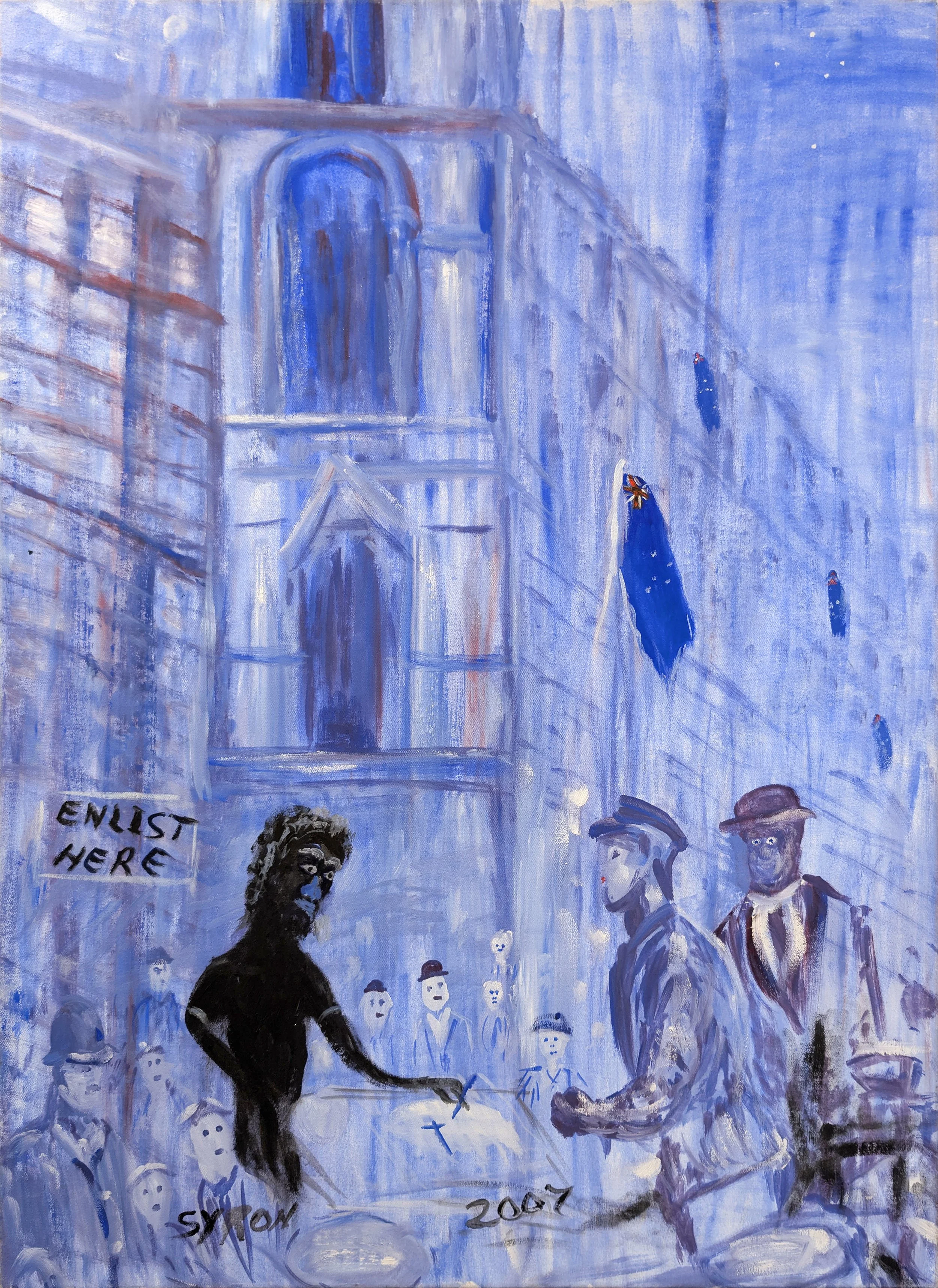
ARTWORK STORY
This work from the Aboriginal Diggers series reflects the long and often overlooked history of Aboriginal people who served in Australia’s wars, yet returned home to little or no recognition for their service. Many Aboriginal men enlisted in World War I despite facing discrimination in their own country. Some could not read or write and were required to sign with an X when enlisting.
The painting speaks to the injustice of the promises made to Aboriginal servicemen that were never honoured. It depicts an Aboriginal man standing before Sydney Town Hall, marking his signature, an X, as he signs up to serve.
Although many Aboriginal men fought alongside other Australians, they were denied the rights, respect and benefits granted to non-Indigenous soldiers after the war. When Aboriginal diggers returned home, they were not granted the parcels of land promised to them and given to white returned soldiers. Many were not even provided with train or bus fares to get home, and were pushed to the margins of welcome home celebrations. Their loyalty and sacrifice were not met with equal treatment.
The series also connects this history to the Coloured Diggers March, a significant annual Anzac Day event held in Redfern, Sydney, which honours the service and sacrifice of Aboriginal and Torres Strait Islander servicemen and servicewomen. The march became an important act of remembrance and protest, recognising Aboriginal servicemen whose contributions had long been overlooked.
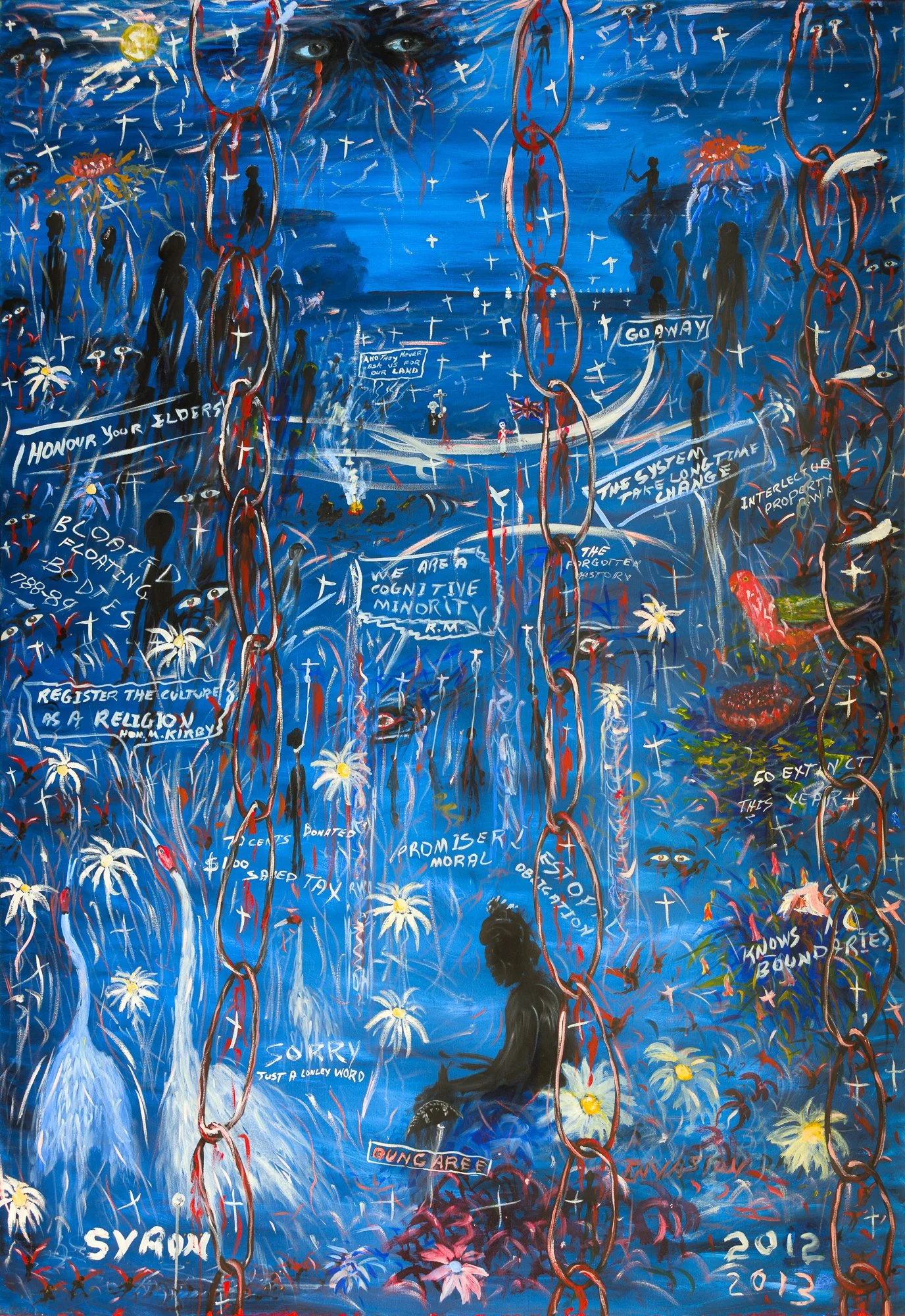
ARTWORK STORY
Syron worked on this painting for two years – it is a huge, angry painting pointing at a failed colonisation of Australia.
The floating bloated bodies refer to the smallpox deaths which spread from the Sydney community further into bush and cleared the land for the squatters to move in. The painting is dotted with Syron’s love of flannel flowers and waratahs, which are rarely seen in the wild but came from his family’s land.
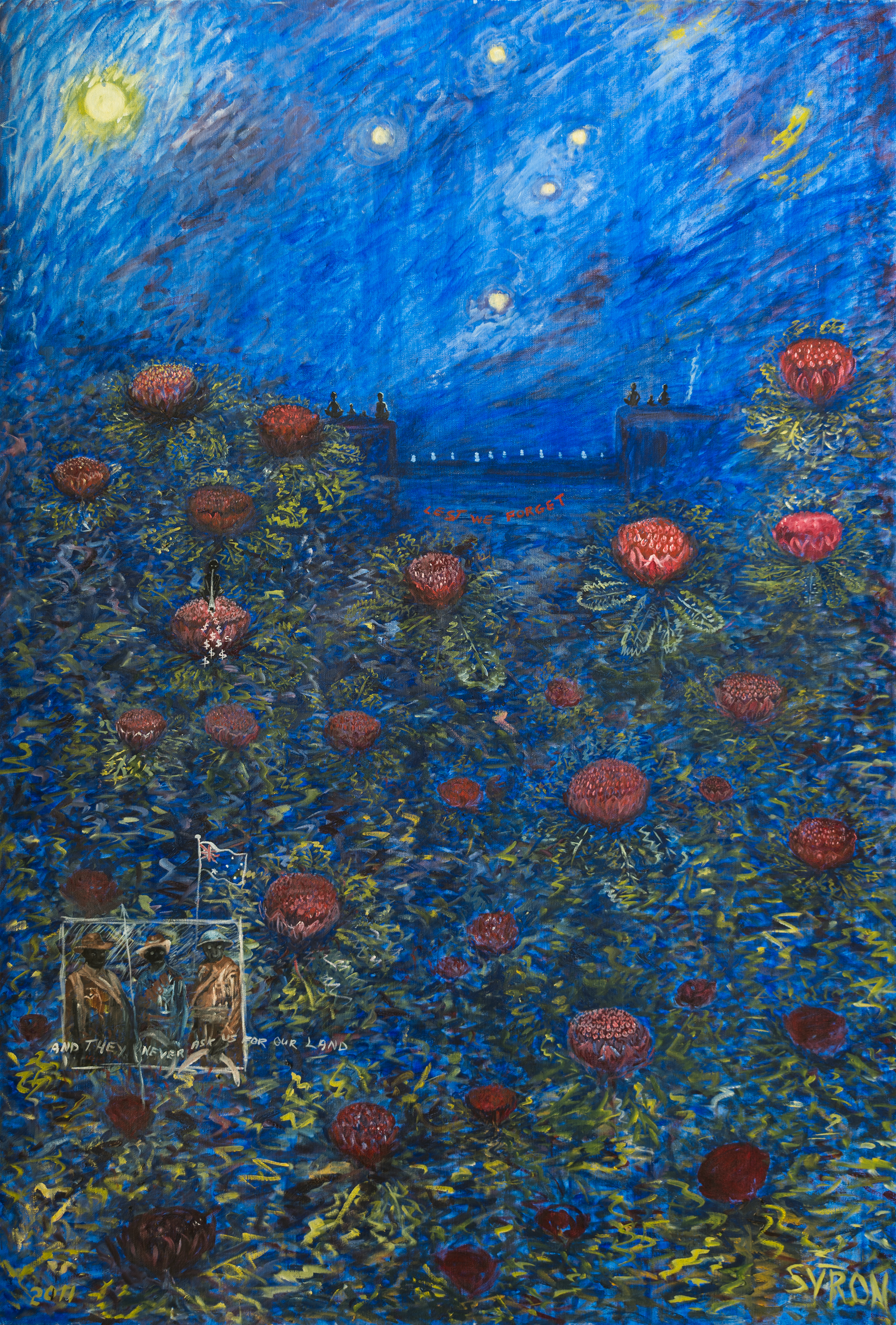
ARTWORK STORY
I grew up in a forest of tall trees where beautiful wildflowers were everywhere. My grandmother remembered when there were many waratahs in our forest. She also remembered how poachers came often and took them all to sell in Sydney. Soon there were no waratahs left in our forest.
I understood these stories because when I was growing up there were still beautiful wildflowers everywhere. That is why I painted the series Where the Wildflowers Once Grew — to remember and to explain what happened to the wildflowers and to the waratahs. The wildflowers disappeared suddenly when huge machines came in and thinned the forest, leaving only the very largest trees. Later even some of those large trees were cut down for timber. The machines scraped away a foot of the rich rainforest soil that had been full of minerals.
The Waratah Forest is my imagining of what our forest once looked like. In this series of paintings I created a fantasy forest of giant waratahs where Aboriginal people live like kings among Aboriginal fairies.
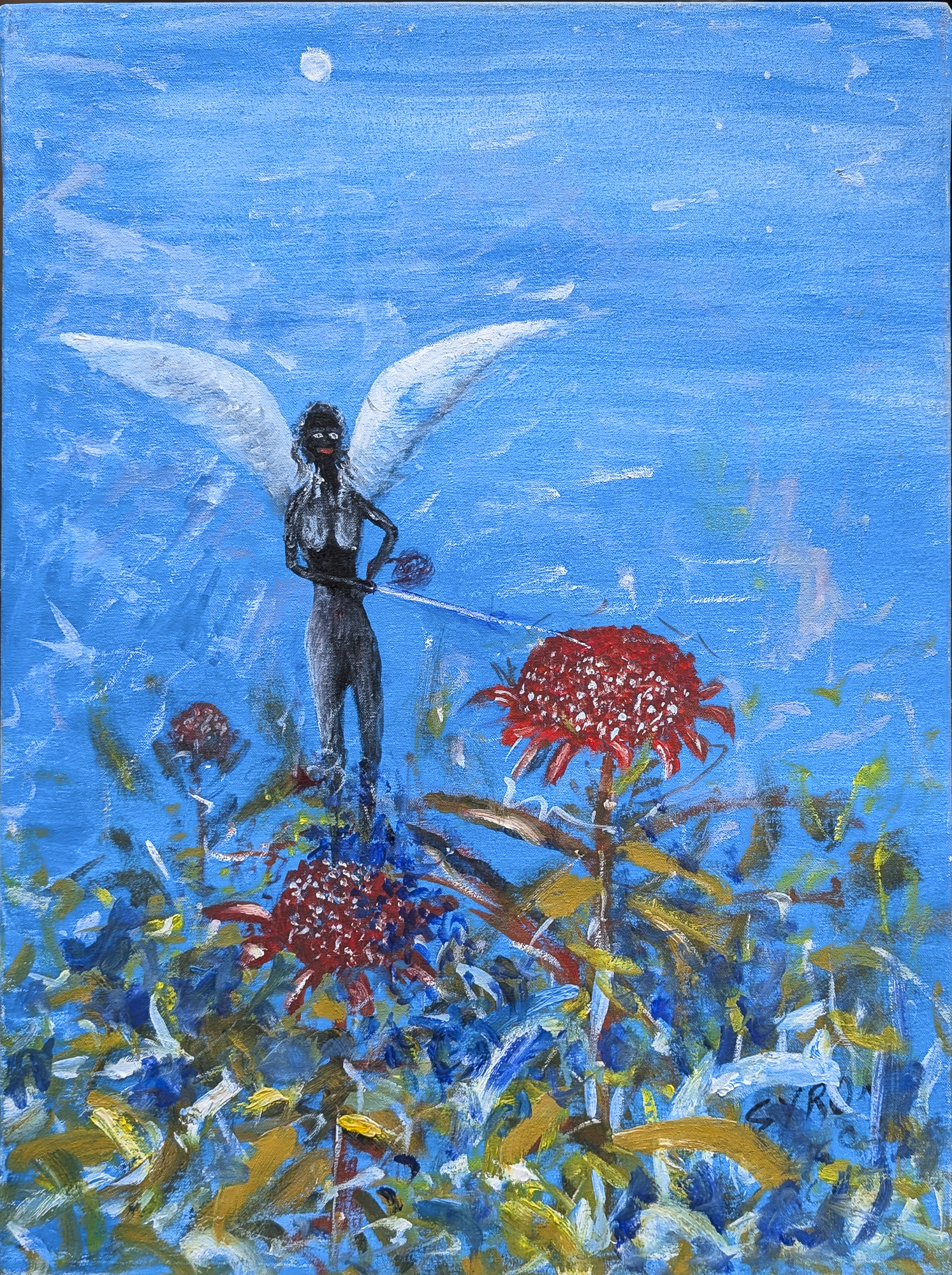
ARTWORK STORY
I grew up in a forest that had tall trees and beautiful wildflowers were everywhere. My Grandmother remembers when there were many beautiful waratahs in our forest. She remembers how the poachers came often and took them all to sell in Sydney. We didn't have any waratahs in our forest. I understood the stories because when I was growing up there were beautiful wildflowers everywhere and that is why I painted the series "Where The Wildflowers Once Grew" to remember and to explain what happened to the wildflowers and to the waratahs.
The wildflowers disappeared suddenly when huge machines came in and thinned all the trees leaving only the very large ones, some large trees were later cut down for timber. The machines took a foot of the rich rainforest soil which was so full of minerals. The waratah forest paintings are my imagining what our forest used to look like. So I created a fantasy of giant waratahs where Aboriginal people live like Kings with Aboriginal Fairies. This painting is of my fantasy where a female Aboriginal angel brings the waratahs back to life.
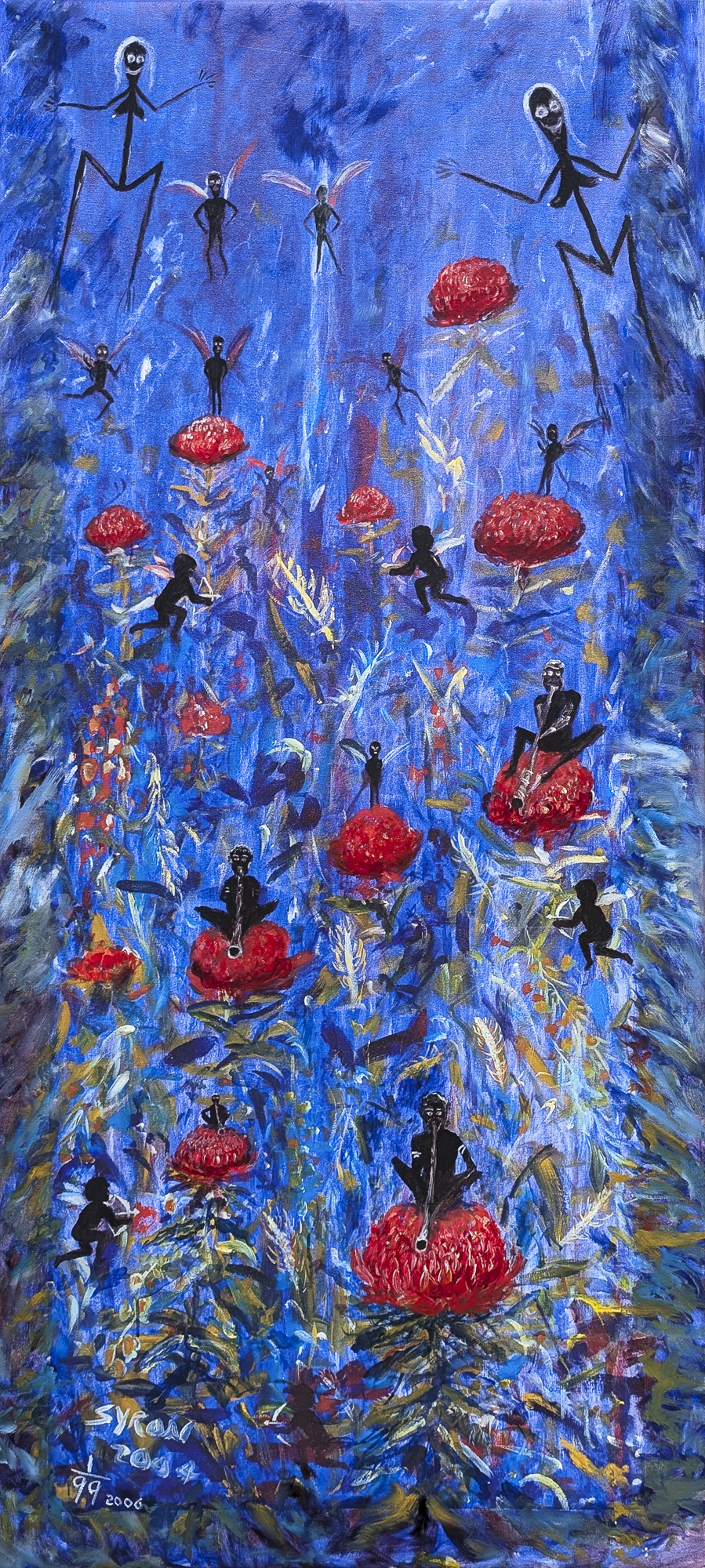
ARTWORK STORY
I grew up in a forest that had tall trees and beautiful wildflowers were everywhere. My Grandmother remembers when there were many beautiful waratahs in our forest. She remembers how the poachers came often and took them all to sell in Sydney. We didn't have any waratahs in our forest. I understood the stories because when I was growing up there were beautiful wildflowers everywhere and that is why I painted the series "Where The Wildflowers Once Grew" to remember and to explain what happened to the wildflowers and to the waratahs.
The wildflowers disappeared suddenly when huge machines came in and thinned all the trees leaving only the very large ones, some large trees were later cut down for timber. The machines took a foot of the rich rainforest soil which was so full of minerals.
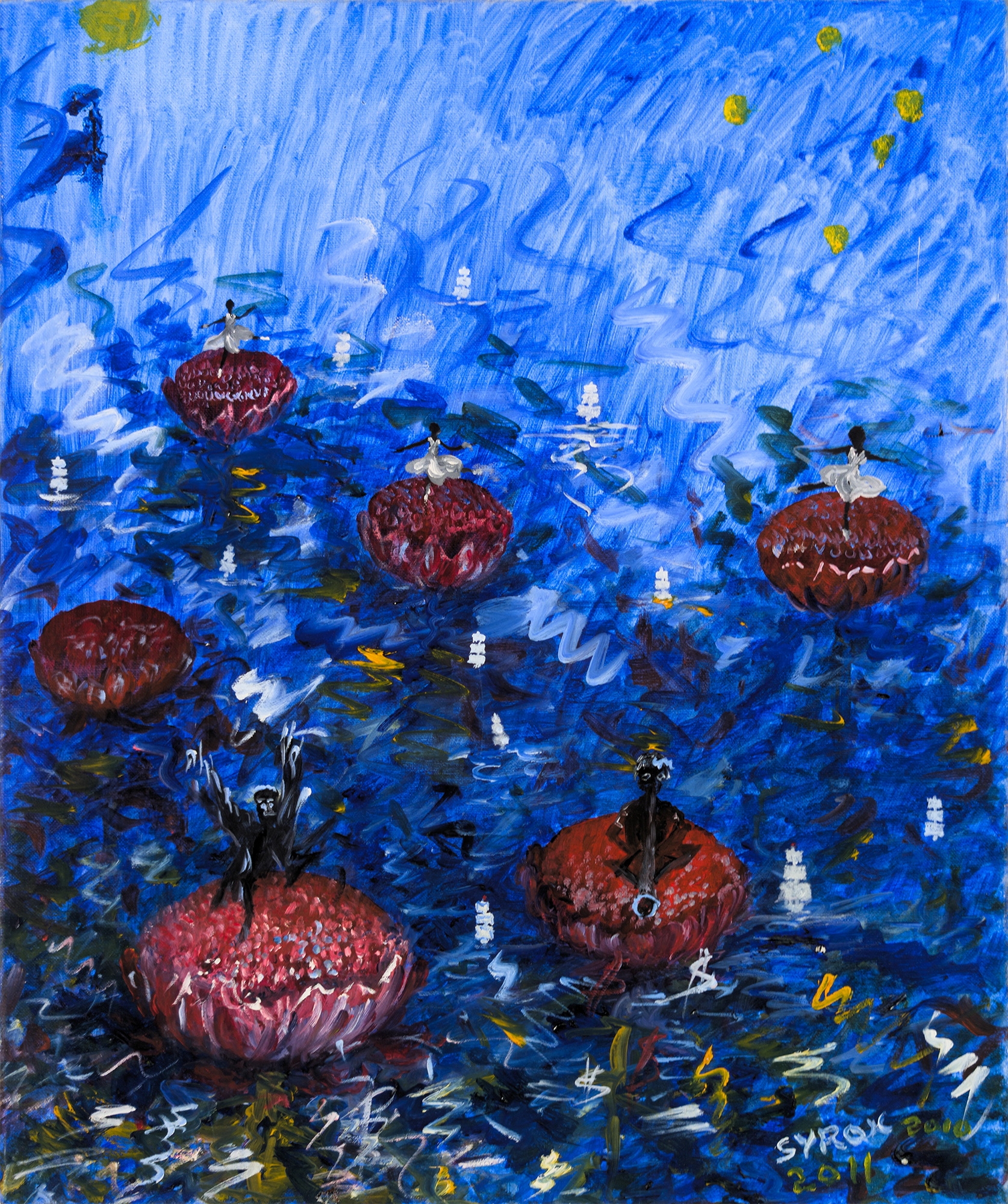
ARTWORK STORY
I grew up in a forest that had tall trees and beautiful wildflowers were everywhere. My Grandmother remembers when there were many beautiful waratahs in our forest. She remembers how the poachers came often and took them all to sell in Sydney. We didn't have any waratahs in our forest. I understood the stories because when I was growing up there were beautiful wildflowers everywhere and that is why I painted the series "Where The Wildflowers Once Grew" to remember and to explain what happened to the wildflowers and to the waratahs.
The wildflowers disappeared suddenly when huge machines came in and thinned all the trees leaving only the very large ones, some large trees were later cut down for timber. The machines took a foot of the rich rainforest soil which was so full of minerals. The waratah forest is my imagining what our forest used to look like. So I created a fantasy of giant waratahs where Aboriginal people live like Kings with Aboriginal Fairies.
In the top right corner, I painted the Southern Cross. Aboriginal ballerinas dance on the waratahs, trying to bring the Waratah forest back to life. The ‘money man’ plays the didgeridoo, with dollar signs flowing from its end to represent modern man’s greed.
ARTWORK STORY
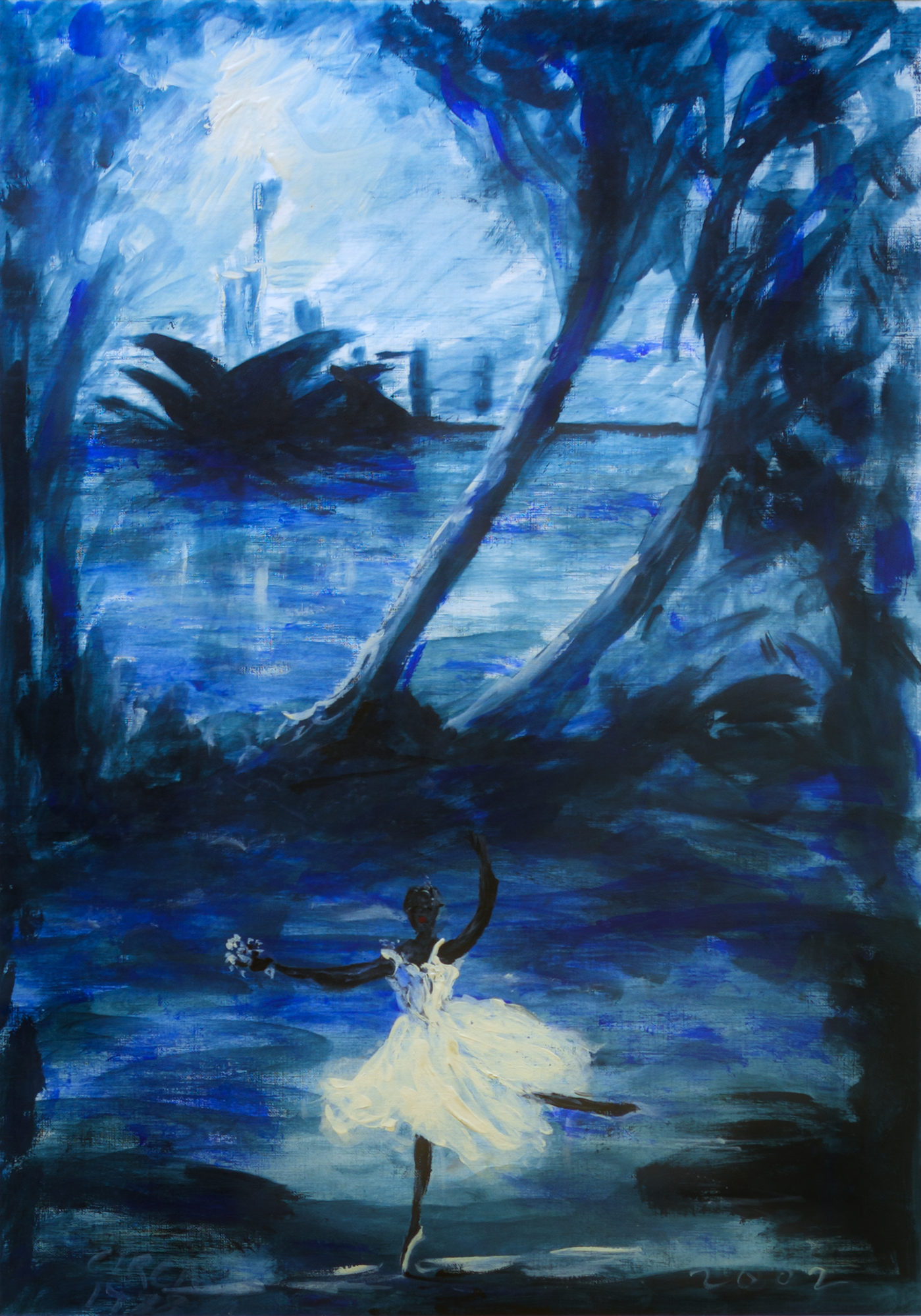
The Black Ballerina is one of the earliest of the series. It is a special painting to me because the first one I ever did… well, I burned it. I burned it as a protest.
A short film was later made about it by the journalist and activist, Mungo McCallum, and his wife Jenny. They filmed it in front of my museum and art gallery, Black Fella’s Dreaming, in Bangalow in 2005. The protest is followed by an interview with Mungo McCallum and can now be found on YouTube.
When you say the words “The Aboriginal Ballerina”, you realise they don’t quite sound right. How many Aboriginal ballerinas do you know?
I say self-determination will truly be taking place when we do see Aboriginal ballerinas, and lots of them.
Some say this painting is satirical. It is true that I often turn things around, but this painting is not satire. It is simply asking: in Sydney, how many scholarships are given to study dance?
Our dance groups are highly professional, yet why are they not given more support emotionally and financially? Our professional organisations are always begging for more money. Why?
If governments really want to close the gap, they should invest in the organisations that are already doing the work. Many grassroots organisations struggle to survive because of a lack of funding. The failure of our society to produce wonderful Aboriginal ballerinas is society’s problem. It reflects a lack of care for the very Indigenous culture this society took over.
I placed the Sydney Opera House in the background to mark the landmark of Sydney. How many young Aboriginal girls have ever dreamed of dancing at the Sydney Opera House? Are dreams important to young Aboriginal girls?
I hope this series of paintings inspires young Aboriginal girls to study dance!
ARTWORK STORY
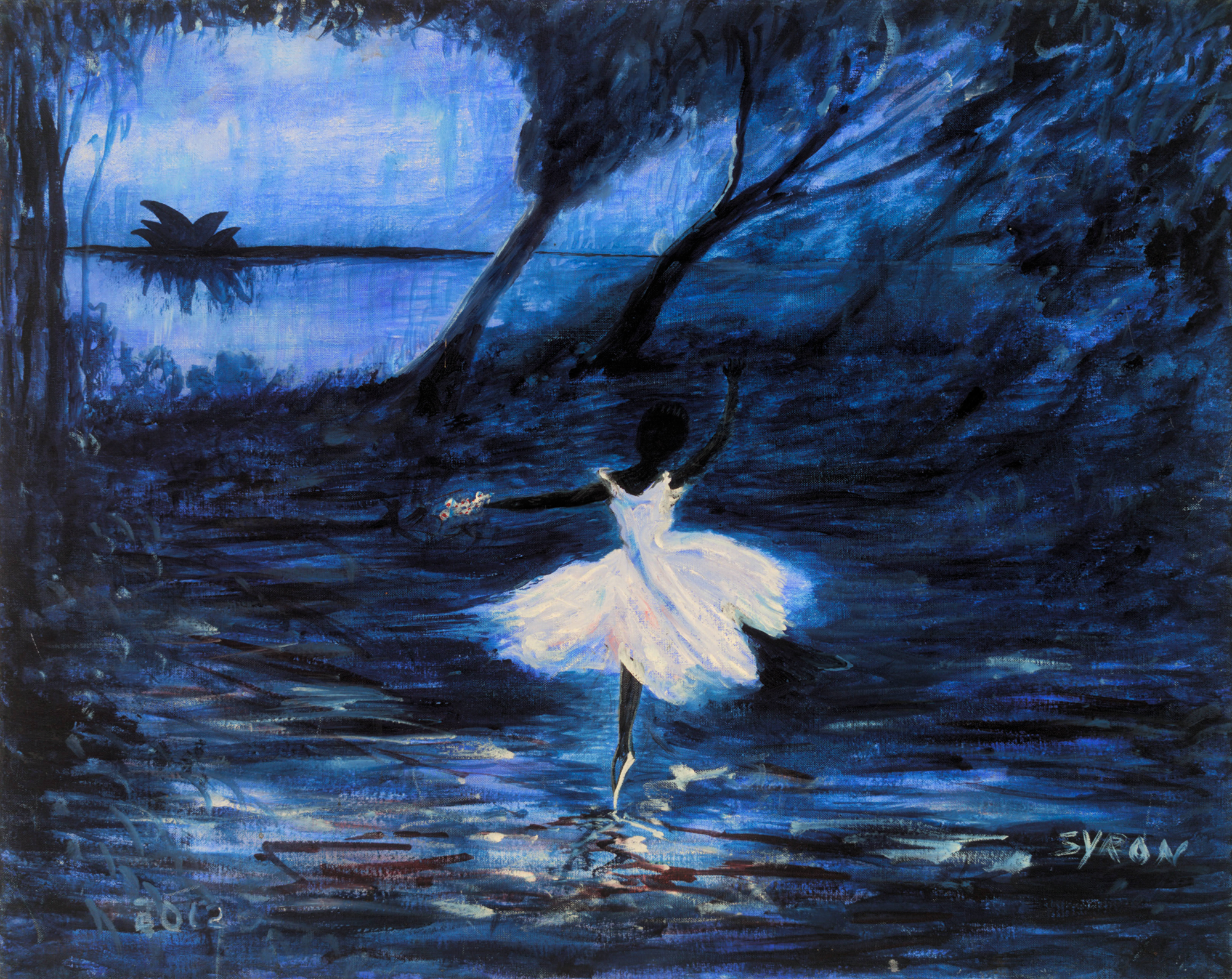
The Black Ballerina is one of a series. It is a special painting to me because the first one I ever did… well, I burned it. I burned it as a protest.
A short film was later made about it by the journalist and activist, Mungo McCallum, and his wife Jenny. They filmed it in front of my museum and art gallery, Black Fella’s Dreaming, in Bangalow in 2005. The protest is followed by an interview with Mungo McCallum and can now be found on YouTube.
When you say the words “The Aboriginal Ballerina”, you realise they don’t quite sound right. How many Aboriginal ballerinas do you know?
I say self-determination will truly be taking place when we do see Aboriginal ballerinas, and lots of them.
Some say this painting is satirical. It is true that I often turn things around, but this painting is not satire. It is simply asking: in Sydney, how many scholarships are given to study dance?
Our dance groups are highly professional, yet why are they not given more support emotionally and financially? Our professional organisations are always begging for more money. Why?
If governments really want to close the gap, they should invest in the organisations that are already doing the work. Many grassroots organisations struggle to survive because of a lack of funding. The failure of our society to produce wonderful Aboriginal ballerinas is society’s problem. It reflects a lack of care for the very Indigenous culture this society took over.
I placed the Sydney Opera House in the background to mark the landmark of Sydney. How many young Aboriginal girls have ever dreamed of dancing at the Sydney Opera House? Are dreams important to young Aboriginal girls?
I hope this series of paintings inspires young Aboriginal girls to study dance!
ARTWORK STORY
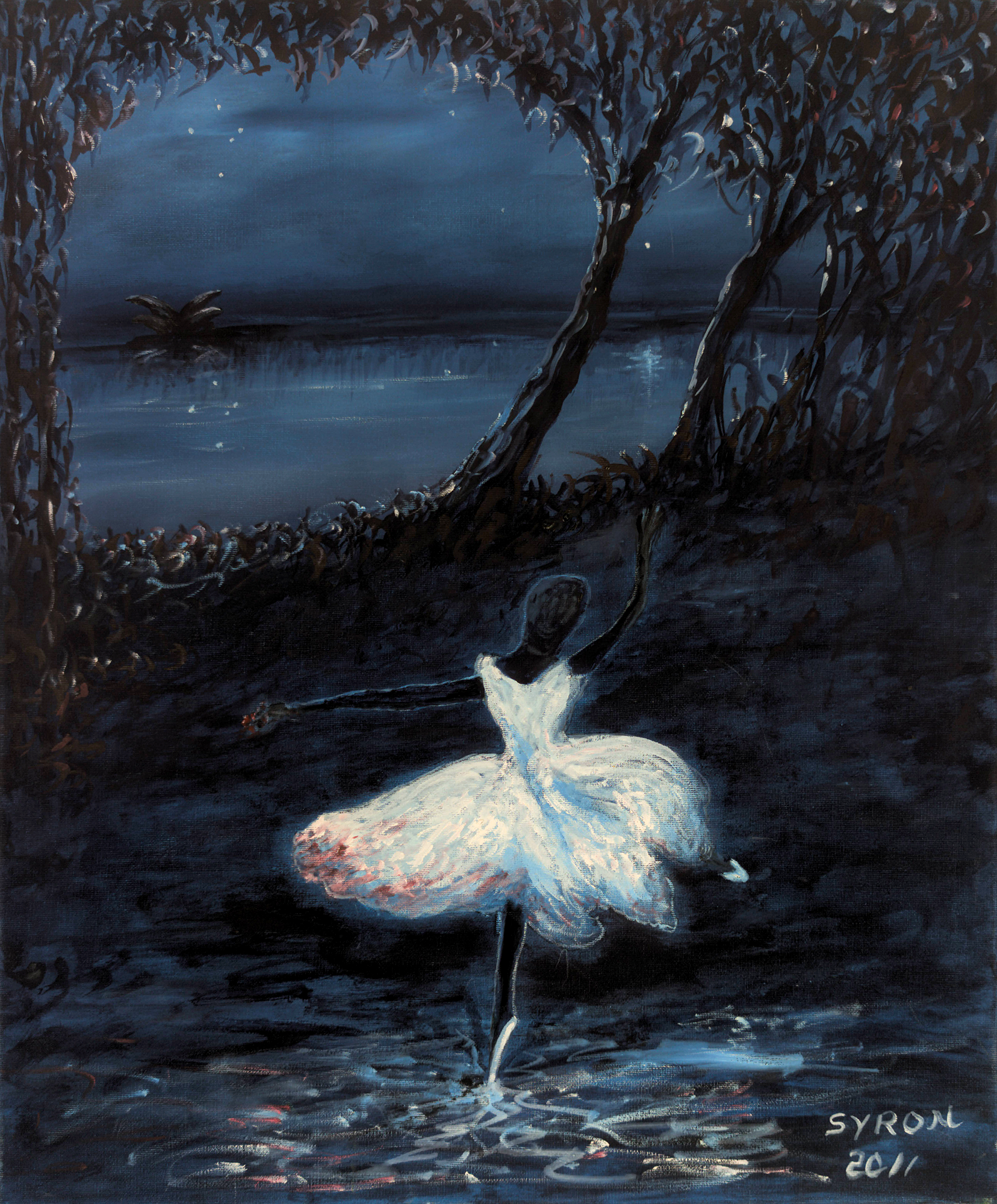
The Black Ballerina is one of a series. It is a special painting to me because the first one I ever did… well, I burned it. I burned it as a protest.
A short film was later made about it by the journalist and activist, Mungo McCallum, and his wife Jenny. They filmed it in front of my museum and art gallery, Black Fella’s Dreaming, in Bangalow in 2005. The protest is followed by an interview with Mungo McCallum and can now be found on YouTube.
When you say the words “The Aboriginal Ballerina”, you realise they don’t quite sound right. How many Aboriginal ballerinas do you know?
I say self-determination will truly be taking place when we do see Aboriginal ballerinas, and lots of them.
Some say this painting is satirical. It is true that I often turn things around, but this painting is not satire. It is simply asking: in Sydney, how many scholarships are given to study dance?
Our dance groups are highly professional, yet why are they not given more support emotionally and financially? Our professional organisations are always begging for more money. Why?
If governments really want to close the gap, they should invest in the organisations that are already doing the work. Many grassroots organisations struggle to survive because of a lack of funding. The failure of our society to produce wonderful Aboriginal ballerinas is society’s problem. It reflects a lack of care for the very Indigenous culture this society took over.
I placed the Sydney Opera House in the background to mark the landmark of Sydney. How many young Aboriginal girls have ever dreamed of dancing at the Sydney Opera House? Are dreams important to young Aboriginal girls?
I hope this series of paintings inspires young Aboriginal girls to study dance!
ARTWORK STORY
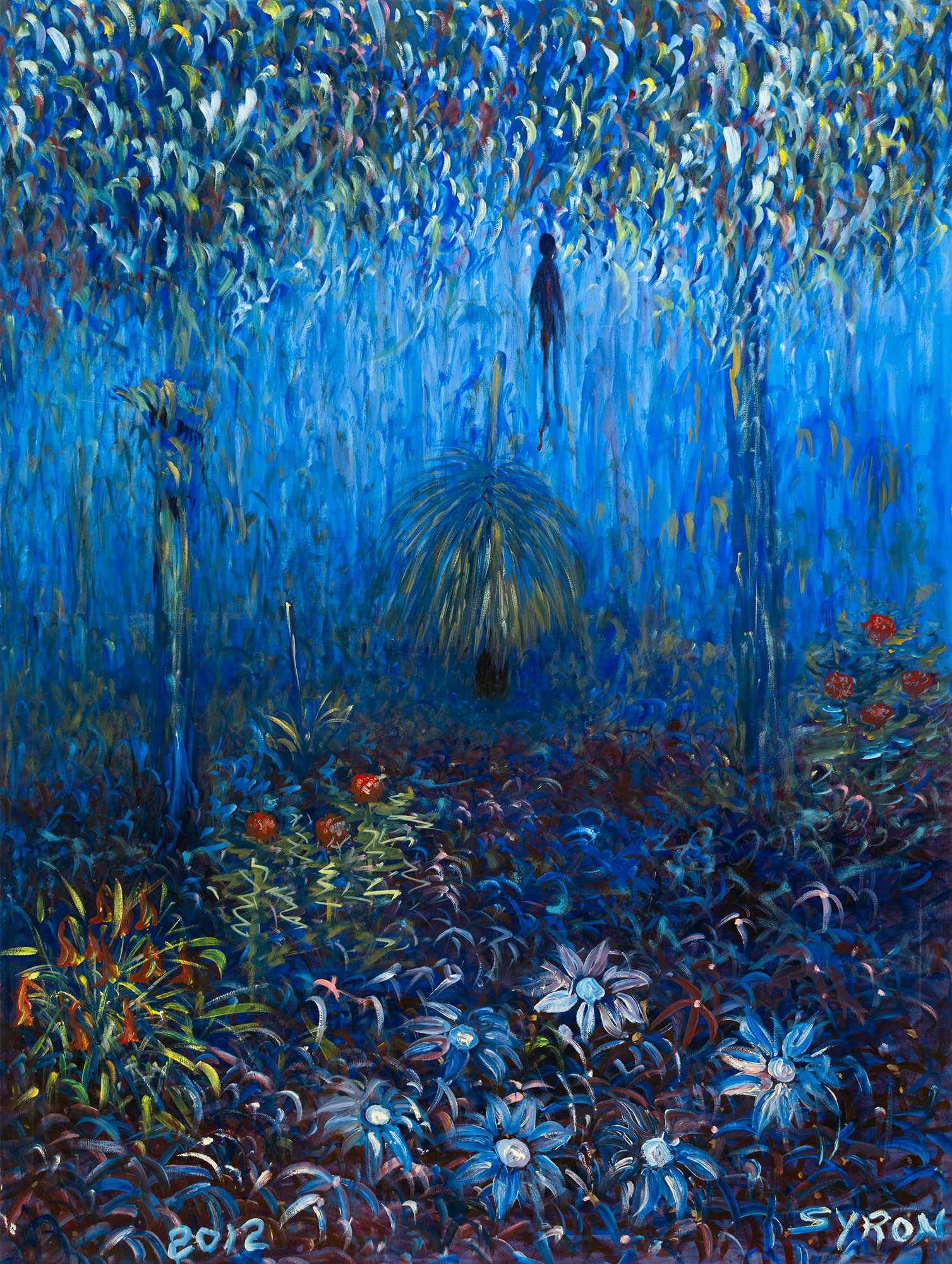
(From the Invasion Day series and Wildflowers series.)
Syron juxtaposes the beautiful landscape with the atrocity of a hanged aboriginal man amongst the gum trees.
Redcoats and Squatters often hung Aboriginals to scare and drive whole groups of Aboriginal people away from their land. This was part of colonisation, the clearing of the trees, wildlife and Aboriginals.
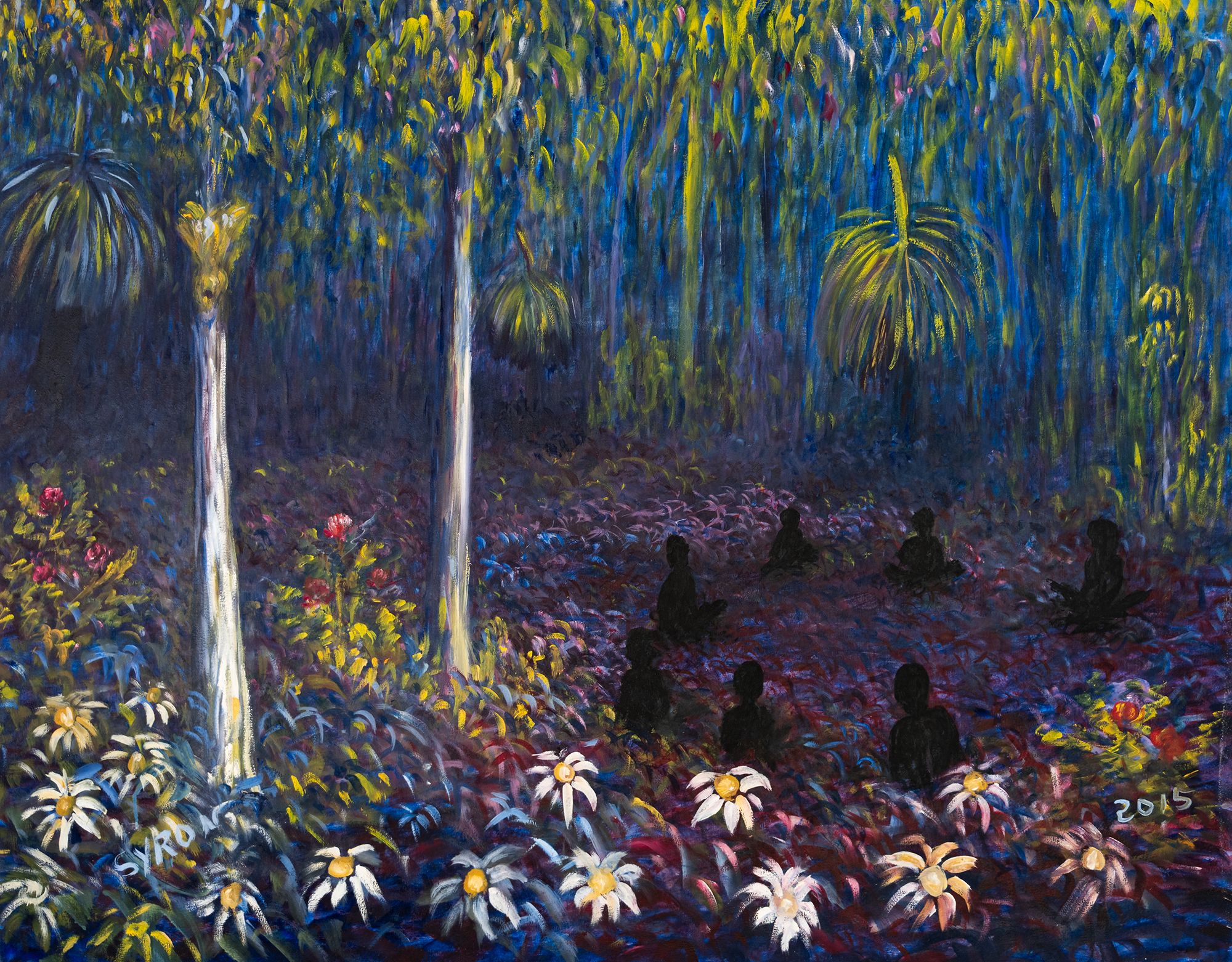
ARTWORK STORY
Women come together to rest after digging, foraging and gathering food. They share their bounty and talk together before making their way home.
The peaceful scene is set within a beautiful rainforest filled with wildflowers.
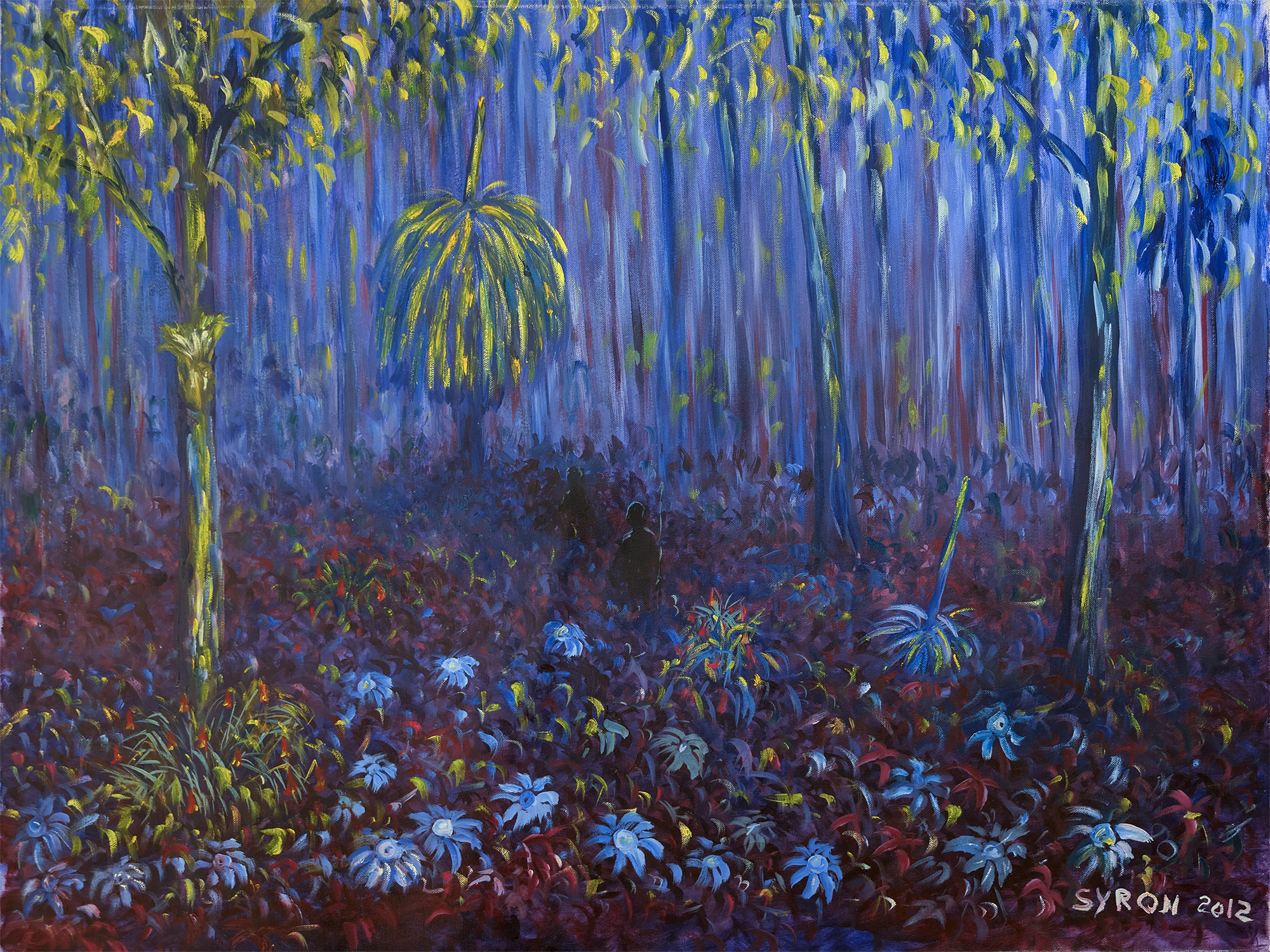
ARTWORK STORY
This painting is out of my memories as a child growing up in a rainforest on thousands of acres owned by my family.
The wildflowers don’t grow there anymore as it was logged and divided up into smaller farms, after it was mined and lost by thievery.
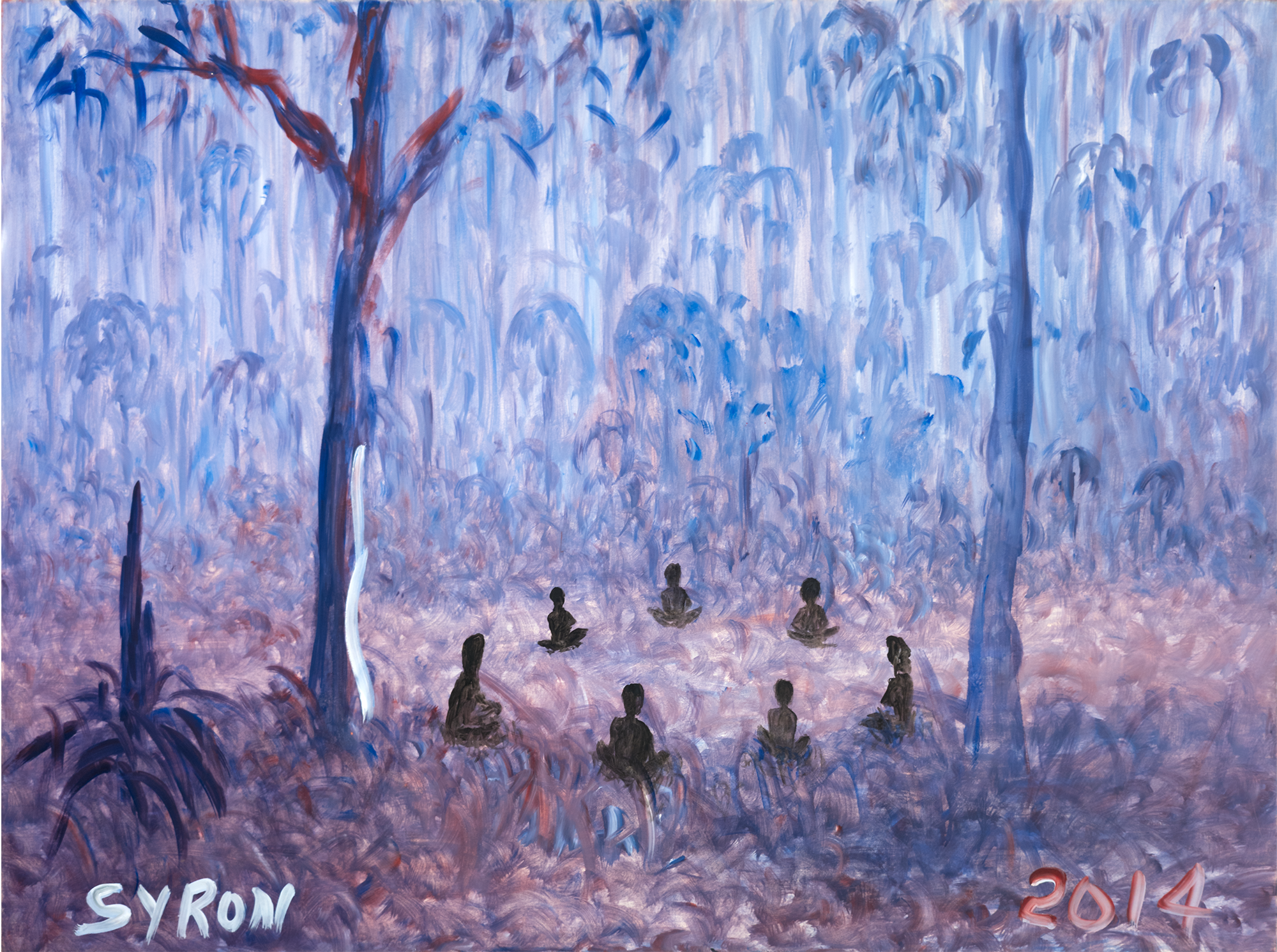
ARTWORK STORY
Women come together to rest after digging, foraging and gathering food. They share their bounty and talk together before making their way home.
The peaceful scene is set within a beautiful rainforest filled with wildflowers.
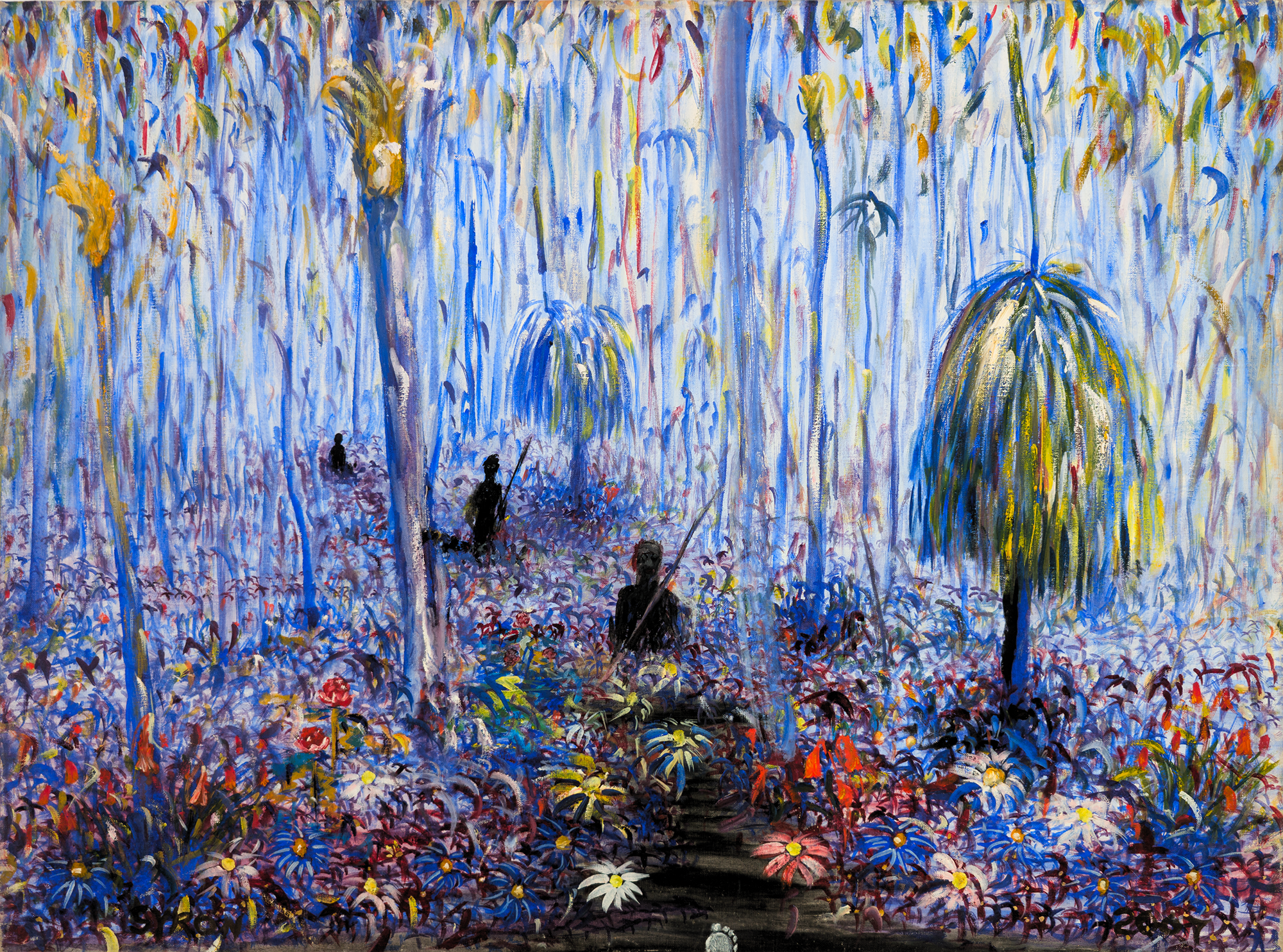
ARTWORK STORY
This painting is out of my memories as a child growing up in a rainforest on thousands of acres owned by my family.
The wildflowers don’t grow there anymore as it was logged and divided up into smaller farms, after it was mined and lost by thievery.
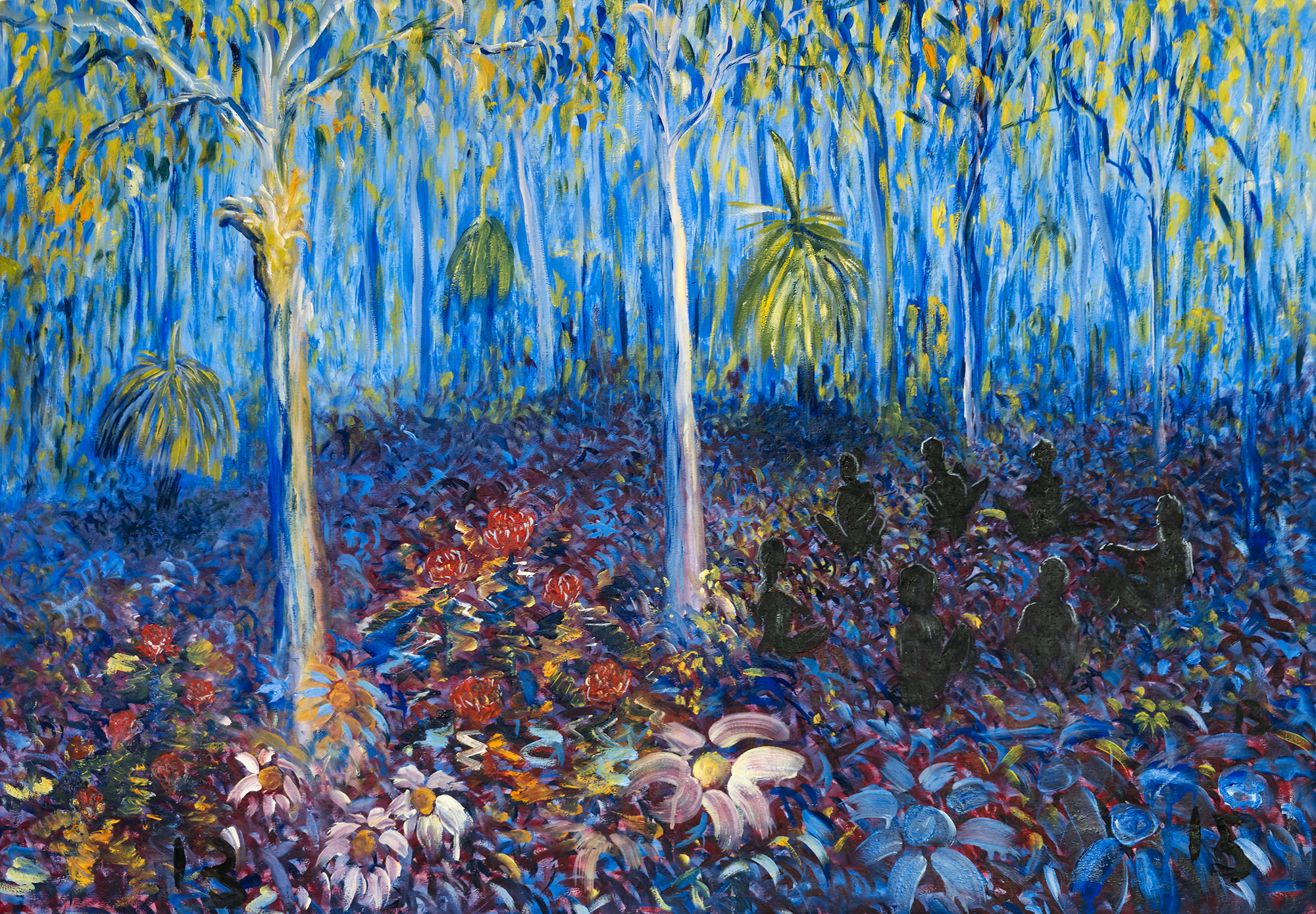
ARTWORK STORY
Women come together to rest after digging, foraging and gathering food. They share their bounty and talk together before making their way home.
The peaceful scene is set within a beautiful rainforest filled with wildflowers.
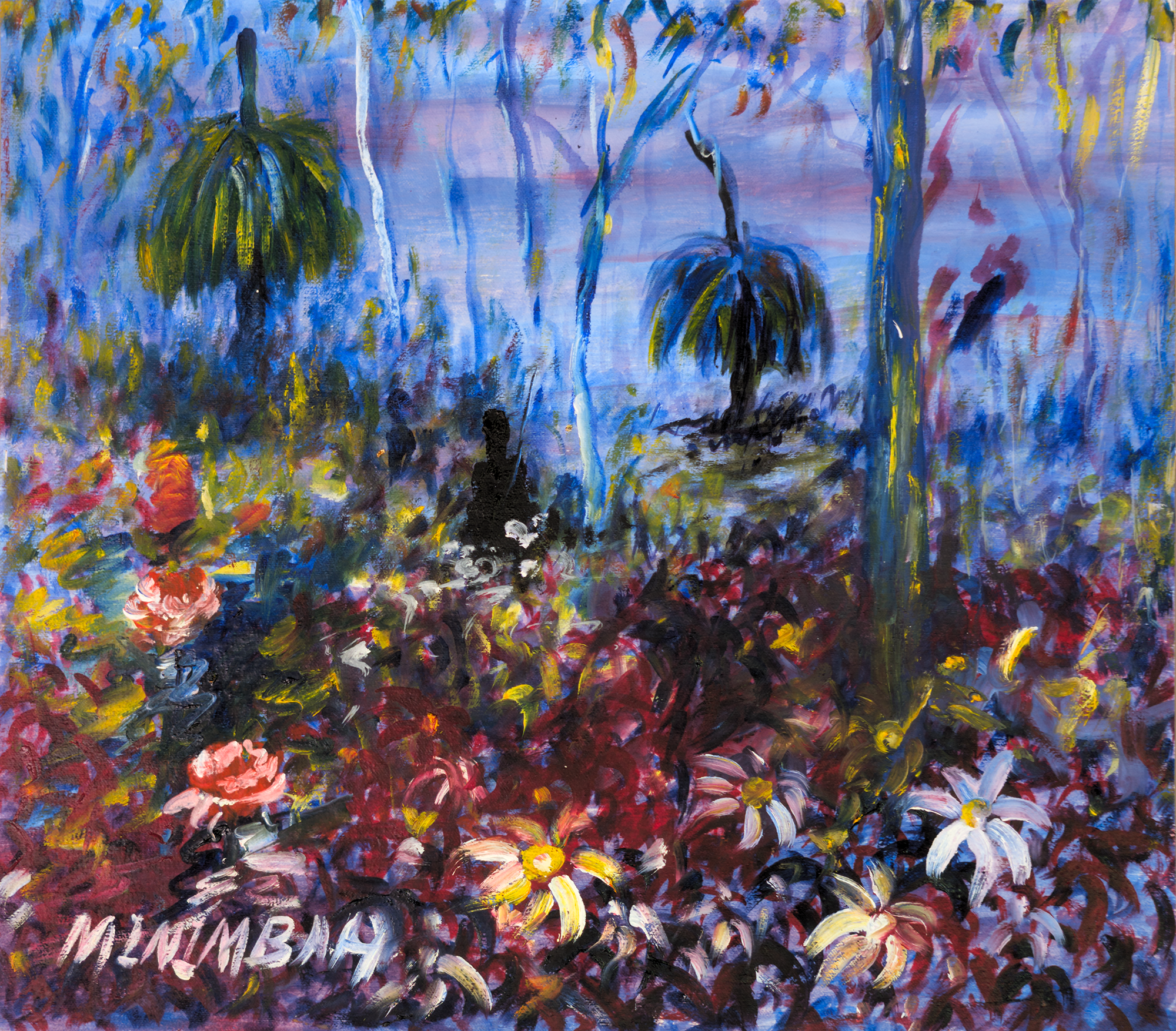
ARTWORK STORY
Minimbah is the name of our property of three thousand acres. This painting is out of my memories as a child growing up in a rainforest on thousands of acres owned by my family.
The wildflowers don't grow there anymore as it was logged, divided up into smaller farms, after it was mined and lost by thievery.
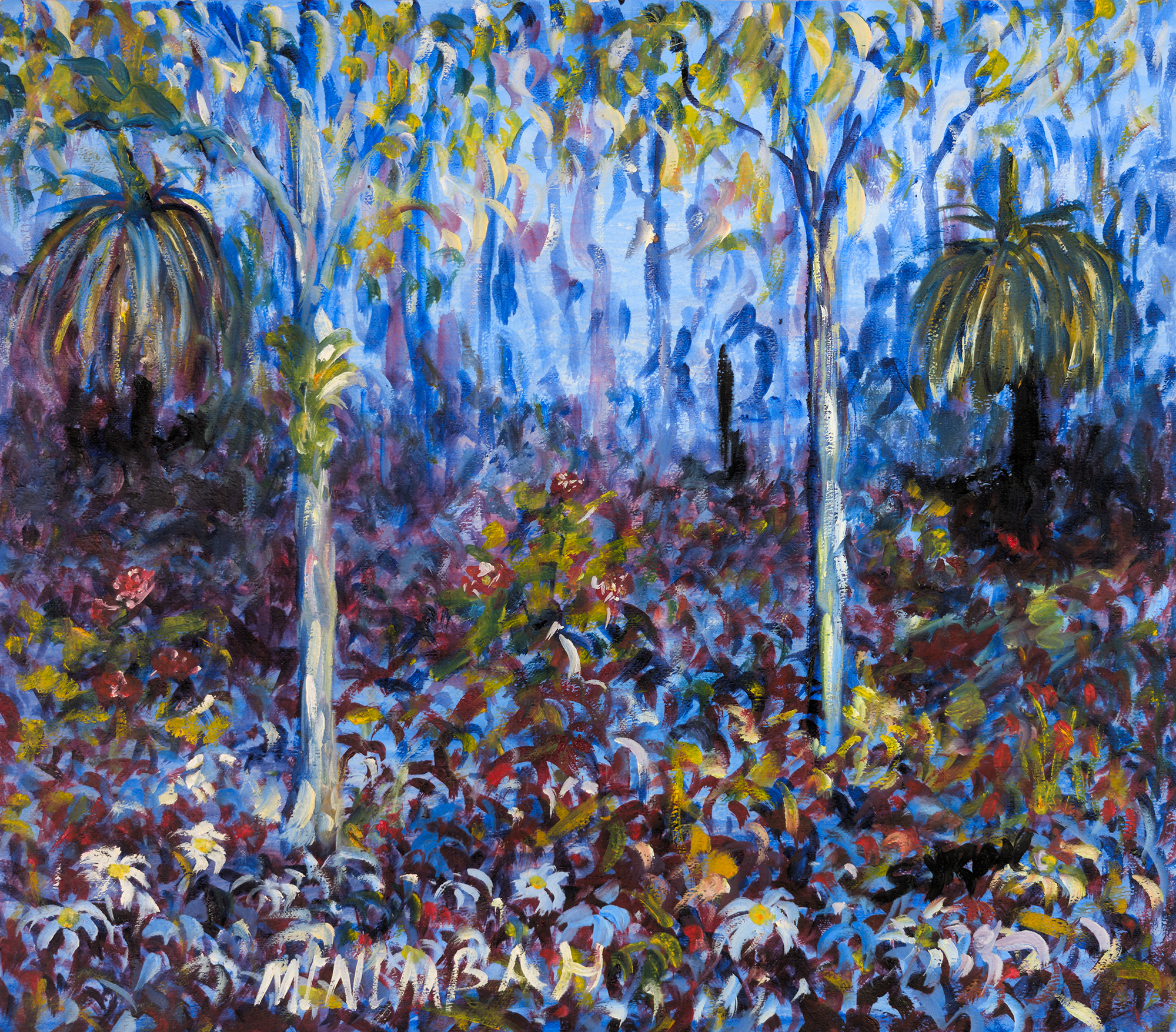
ARTWORK STORY
Minimbah is the name of our property of three thousand acres. This painting is out of my memories as a child growing up in a rainforest on thousands of acres owned by my family.
The wildflowers don't grow there anymore as it was logged, divided up into smaller farms, after it was mined and lost by thievery.
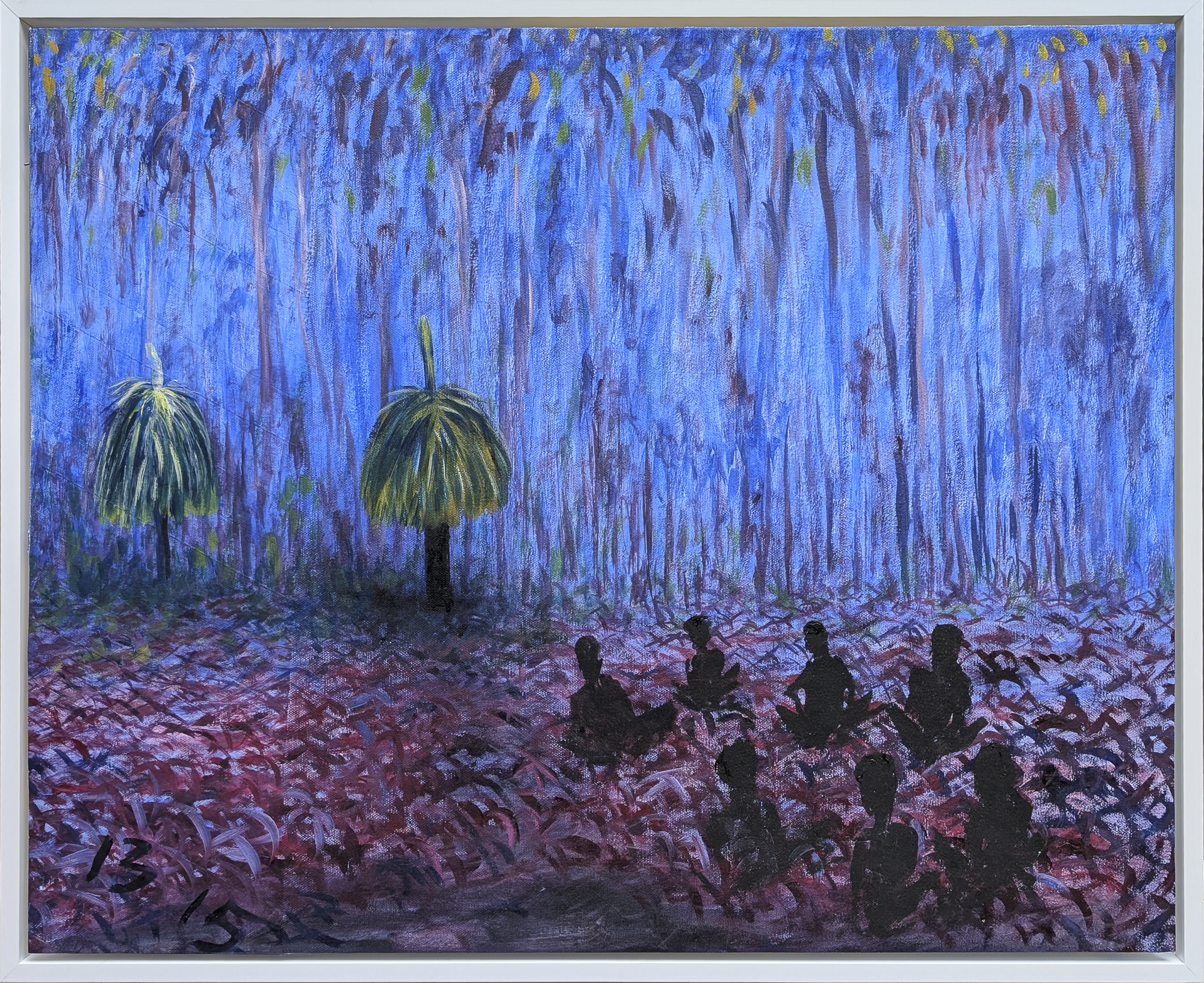
ARTWORK STORY
Women come together to rest after digging, foraging and gathering vegetables, fruit, small mammals etc. They share their bounty and chat before making their way home. The peaceful scene is set in a beautiful rainforest of wildflowers.
ARTWORK STORY
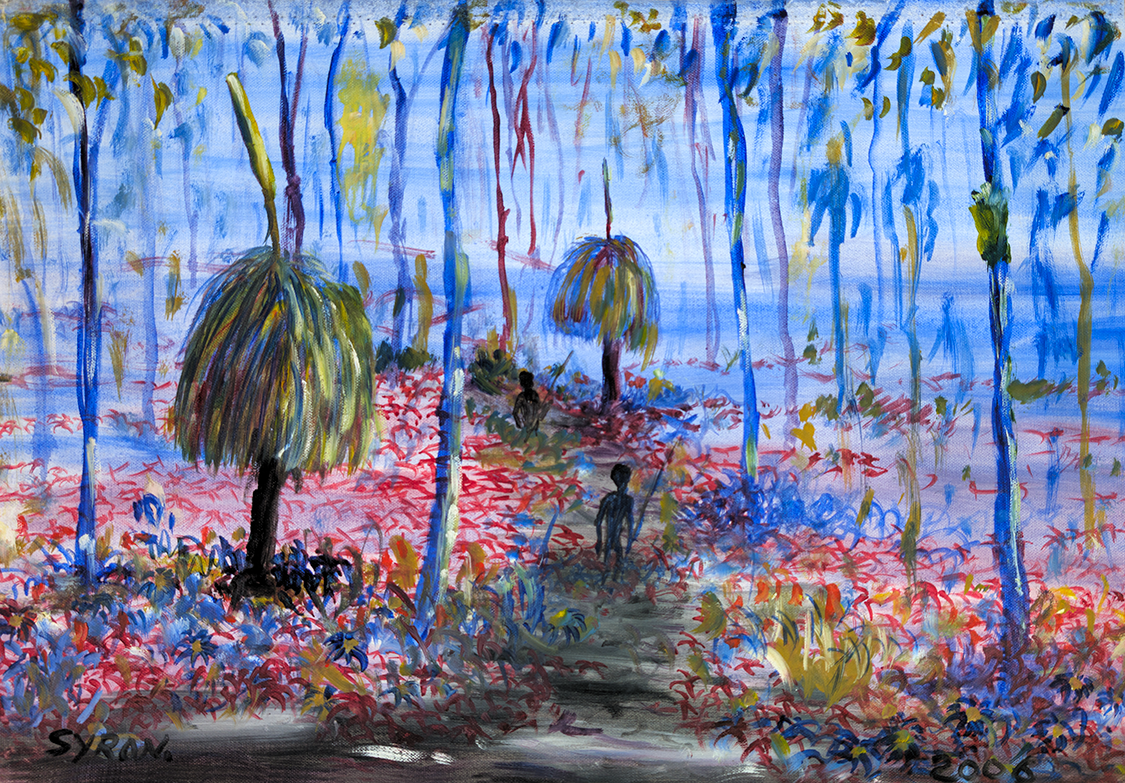
This painting is out of my memories as a child growing up in a rainforest on thousands of acres owned by my family and the wildflowers don't grow there anymore as it was logged, divided up into smaller farms, after it was mined and lost by thievery. This is a self portrait of my brother and I walking through the forest. When I was young, before they destroyed all of the flowers, I would ride horses and in seconds have an armful of breathtakingly beautiful wildflowers, I wouldn’t even have to get off my horse to pick them. This Land was sacred to me that is why I chose to paint about it.
ARTWORK STORY
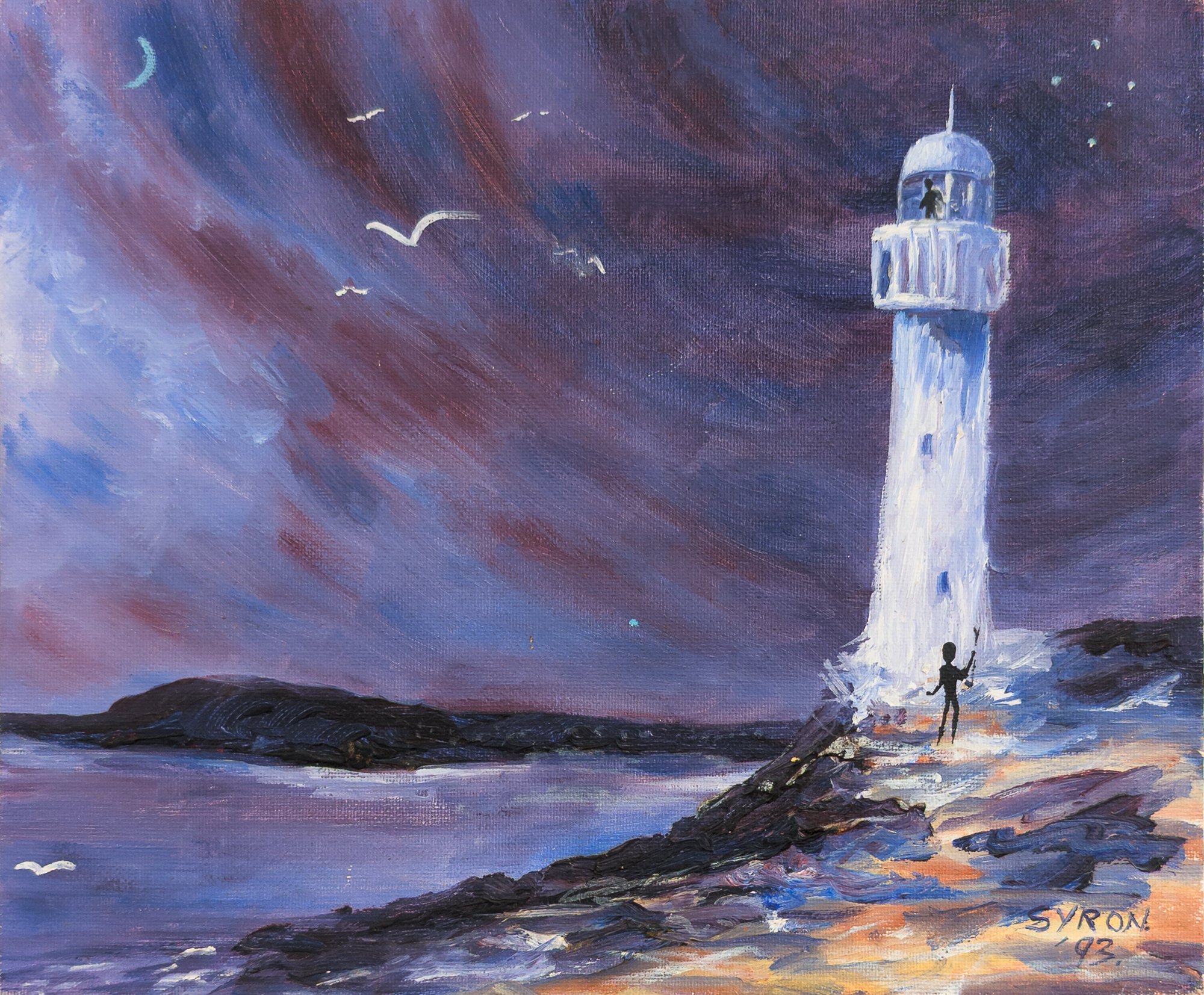
Syron painted this work more than three decades ago.
It was really just Gordon’s satirical play on words in the title.
To the Black Lighthouse - the lighthouse is always white and blacks didn’t have lighthouses.
ARTWORK STORY
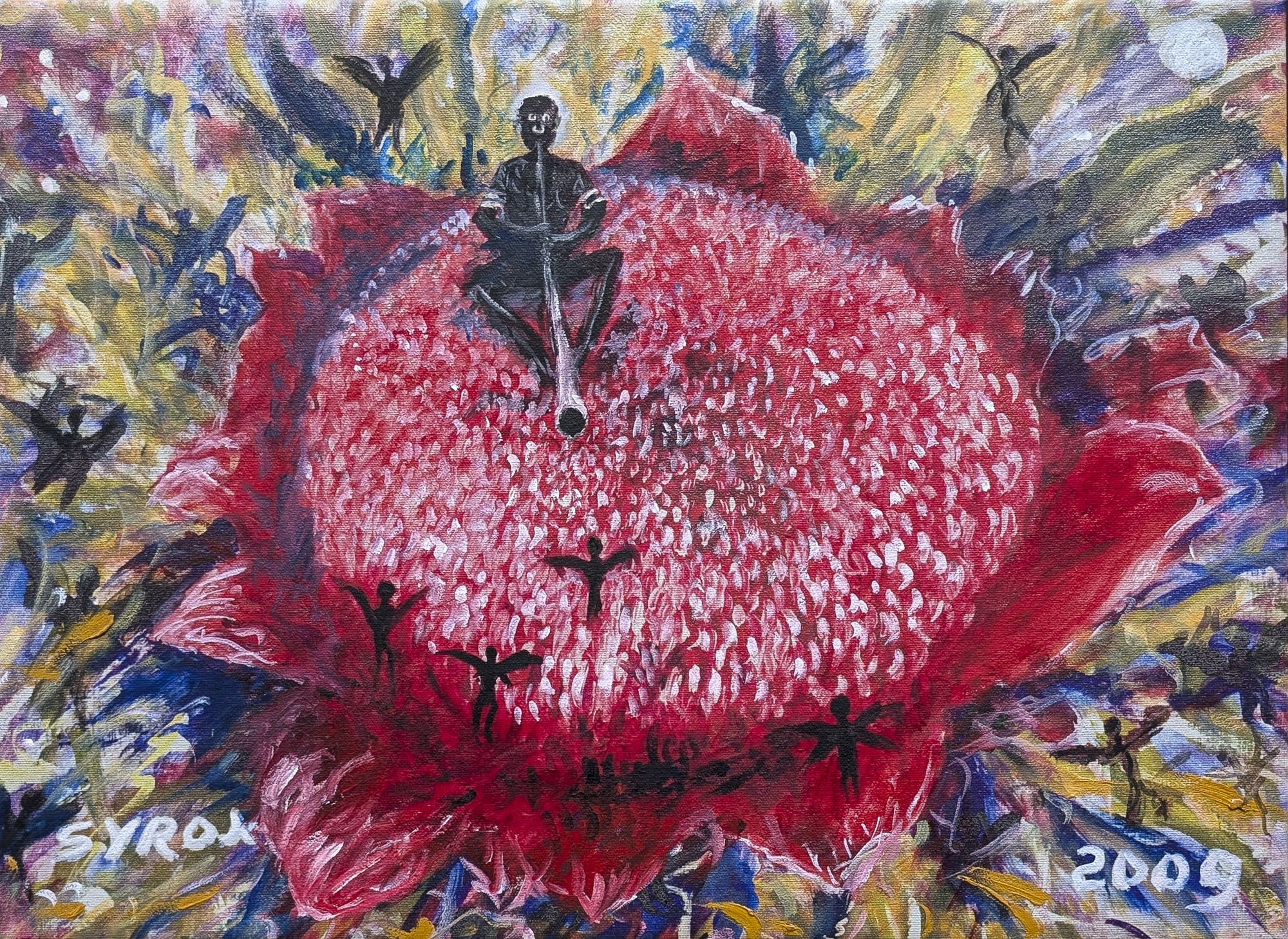
The tourists that visit Australian admire the Aboriginal culture and the rare Waratahs. Both are survivors in a harsh world that does not cultivate and nurture the remaining culture. Often I will paint $$$$ coming out of the bottom of the fairy’s didgeridoo and they represent the white man's greed to reproduce the Didge and not respect the customs where it comes from.
The Aboriginal fairies are from a series called "Do You Believe In Fairies" and it is from my fantasy and it gives our people hope and especially I paint black fairies for Aboriginal children.